









Proverbs 10
JOY IN DARK TIMES
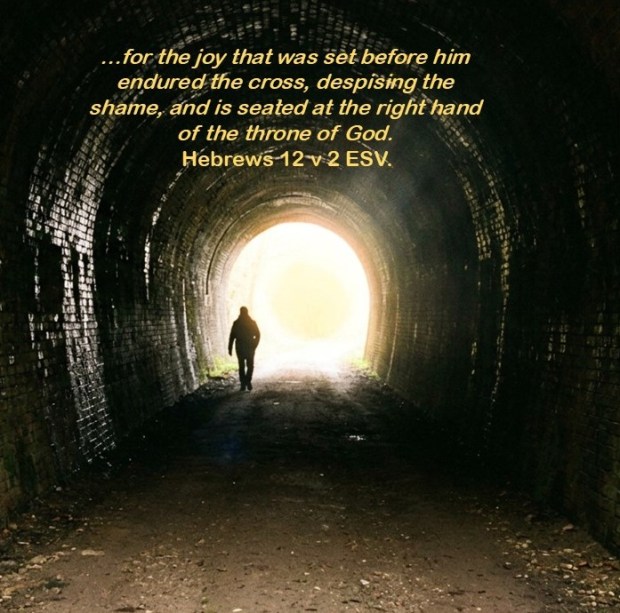
While the ministry of Jesus might have had some highlights, the end of it was pretty miserable. Jesus was rejected, his disciples fled, he was beaten, tried, arrested, hated, and no one came to his rescue. Where was the joy in all that? After his death it was his enemies who were rejoicing.
I wonder if Jesus had this proverb in mind as he went through those last few days: “The hope of the righteous brings joy, but the expectation of the wicked will perish.” (Proverbs 10 v 28 ESV). It seems the writer to the Hebrews believed he did. He said that Jesus, “for the joy that was set before him endured the cross, despising the shame, and is seated at the right hand of the throne of God.” (Hebrews 12 v 2 ESV).
Jesus had hope even in that terrible time. His hope kept him joyful. And even though his enemies were rejoicing, their expectation perished as soon as Jesus was resurrected. Their joy would have dried up completely.
Let us set our hope in God so that we can have joy even when times are bad, in the same way Jesus found joy in the hope set before him.
Numbers 10
PROTECTION PRAYER
The most dangerous tones in life are when we travel. At home we can be relatively secure within our four walls, fences and security systems, but out on the road, we are all on our own. Car accidents are a huge risk to us all, no matter how good a driver we think we are. Public transport leaves us vulnerable to anything that might happen in public, and in walking we are sitting ducks for any one with evil intent. Highway bandits, and robbers have always liked to pick on travellers in remote spots.
That’s why I think the prayer Moses offered as Israel journeyed is so amazing. “And whenever the ark set out, Moses said, ‘Arise, O LORD, and let your enemies be scattered, and let those who hate you flee before you.’ And when it rested, he said, ‘Return, O LORD, to the ten thousand thousands of Israel.’” (Numbers 10 v 35 – 36 ESV).
Let us not trust in our own strength, but pray for God’s protection as we move and as we rest. “Unless the LORD watches over the city, the watchman stays awake in vain.” (Psalm 127 v 1).
Luke 16
IF YOU HAVE IT SHARE IT

The lesson of the rich man and Lazarus has puzzled me over the years. Apart from one man being rich and the other poor, there seems to be nothing worthy of judgment in it. But here is a thought. Let’s start with the description of the rich man: “There was a rich man who was dressed in purple and fine linen and lived in luxury every day.” (Luke 16 v 19). This man had been given everything he needed by God. In fact, he had been given so much that he had too much. He even had so much food that it fell from his table.
The description of Lazarus goes like this: “At his gate was laid a beggar named Lazarus, covered with soresand longing to eat what fell from the rich man’s table. Even the dogs came and licked his sores.” (v 20 – 21). Lazarus had nothing. He had so little, he was starving and reduced to begging.
Here is the lesson: the rich man who had been so blessed by God with much more than he needed, should have shared his blessing with the people around him. We are not told, but I suspect that if Lazarus had been given two pieces of bread, he would have shared one with someone else.
If we have been given plenty, the let’s share what we have been given. It’s not just for us. God has blessed us so that we can bless others.
Leviticus 27
OUR VALUE

When anyone made a vow that included valuing people, God supplied a chart of valuation to show how much people were worth depending on their gender and age. But what is interesting about this, is that no one person had a higher or lower value than any other in their category.
“The valuation of a male from twenty years old up to sixty years old shall be fifty shekels of silver, according to the shekel of the sanctuary.” (Leviticus 27 v 3 ESV). In this case the value of both Moses and the blind cripple who had been carried out of Egypt was the same. They were both worth 50 shekels.
We might feel like we have a great leadership position or that our wealth or skills make us greater than those around us, but we are not. On the other hand, we might feel like we are weak and unable to contribute like the super-achievers around us do, but we are worth no less to God.
To God, all of us are sinners, but we are all are worth saving from sin and death. There will be rewards for our service, but our value in the sight of God remains the same. The difference comes in how we respond to him as opposed to who we are or what we can do.
Psalm 132
HARDSHIPS
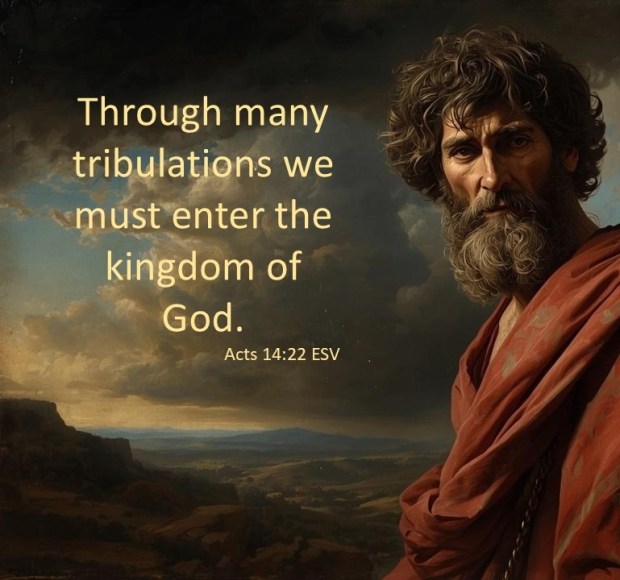
I love the way David says, “Remember, O LORD, in David’s favour, all the hardships he endured.” (Psalm 132 v 1 ESV). I hope I can pray the same thing too, or for that matter, any of us who have gone through trials and hardships.
John describes a great multitude from all the nations gathered together in the kingdom of God. He was told, “These are the ones coming out of the great tribulation.” (Revelation 7 v 14). And after he had been stoned, Paul told the believers in Lystra that “through many tribulations we must enter the kingdom of God.” (Acts 14 v 22).
We all go through hardships, problems, trials and tribulations. They come into our lives to bring us closer to God, to help us rely on him, and to discipline us in order to get us to work more closely with him. So let’s pray the same prayer David prayed: “Remember, O LORD, in [our] favour, all the hardships [we] endured.”
Leviticus 19
BEARING A GRUDGE
The most bitter people I know are the ones who are bearing a grudge. Someone has wronged them at some time in the past and they cannot forgive or let go. Their greatest wish is that something bad will happen to the subject of their grudge allowing them gloating rights. But even then, that would not be enough.
The problem with carrying a grudge is that usually the person who caused the grudge is hardly aware of the effect they are having on the person carrying the grudge. In the meantime, the holder of the grudge becomes bitter, often sick, and joyless. Carrying a grudge only hurts ourselves.
Carrying grudges is bad for us. Not only are they bad for us, but they separate us from God. Furthermore, we can’t even blame anyone else for the results the grudge causes when it is us carrying the grudge ourselves.
God gave us some life-saving advice when he said, “You shall not take vengeance or bear a grudge against the sons of your own people, but you shall love your neighbour as yourself: I am the LORD.” (Leviticus 19 v 18 ESV).
Psalm 115
ALL GLORY TO GOD
“Not to us, O Lord, not to us, but to your name give glory, for the sake of your steadfast love and your faithfulness!” (Psalm 115 v 1 ESV).
These words are easy to read, to understand and to agree with on an intellectual level, but if we were really pushed, would we be happy to give up our glory so God could have it?
Speaking for myself, I thrive on compliments and praise for the work I do – it’s probably one of the ways I receive love. But what if everyone praised God and ignored me? Would I still be as motivated to do my best? What about you?
Let’s work on our attitude of humility while growing and appreciation of the greatness of God. When we have done that, we will be able to develop the same attitude as the Psalmist: “Not to us, O Lord, not to us, but to your name give glory.”
Psalm 107
CAN REBELLION BE FORGIVEN?
Too many people think they can’t be forgiven because they have rebelled against God too many times. The psalmist deals with this attitude when he says, “Some became fools through their rebellious ways and suffered affliction because of their iniquities. They loathed all food and drew near the gates of death.” (Psalm 107 v 17 – 18 NIV). These people had rebelled and turned right away from God; they spiritually starved themselves by not reading God’s word or praying.
But listen to what happened next: “Then they cried to the LORD in their trouble, and he saved them from their distress. He sent out his word and healed them; he rescued them from the grave.” (v 19 – 20).
No matter how bad our rebellion or how big our sin, God is still listening for our cry for help. He will race in to rescue us, to feed us with his healing word and to save us from death. What an awesome God we have!
Let us “give thanks to the Lord for his unfailing love and his wonderful deeds for mankind. Let [us] sacrifice thank-offerings and tell of his works with songs of joy.” (v 21 – 22).
Leviticus 3
PEACE AND FELLOWSHIP
The peace offering, otherwise known as the fellowship offering, was the offering a person made when they were going to kill a cow (or bull), sheep or goat to eat. We need to remember that in the wilderness, and even once the Israelites were settled in the promised land, they had no refrigeration and no way of keeping meat for any length of time. Having bought the meat of half a cow once, I can tell you that there is a lot of meat to eat!
So in killing an animal, in order not to waste it, the meat needed to be shared, probably with a lot of people. No wonder it was known as the fellowship offering or the peace offering. Sharing the meat of a beast around the dining room table (or the campfire) would have been a great time of fellowship and would have promoted peace together.
Let’s never lose the spirit of the fellowship offering. While we may not need to eat a whole beast at once, we should still share our meals together with others in the spirit of fellowship and peace.
Exodus 37
CHERUBIC ATTITUDE
Bezalel made the ark, the mercy seat, and “of one piece with the mercy seat he made the cherubim on its two ends. The cherubim spread out their wings above, overshadowing the mercy seat with their wings, with their faces one to another; toward the mercy seat were the faces of the cherubim.” (Exodus 37 v 8 – 9 ESV).
The position of the cherubim over the mercy seat tells us a lot about the attitude we should have toward the grace and mercy shown to us through our Lord Jesus Christ. The cherubim were overshadowing the mercy seat with their wings spread out above. This looks to as if they were guarding the mercy seat.
The faces of the cherubim looked inward toward the mercy seat. Our faith in the forgiveness shown to us through Jesus Christ. We need to be looking toward him every day. “Our eyes look to the LORD our God, till he has mercy upon us.” (Psalm 123 v 2).
So like the cherubim, let us always have our eyes on the mercy of God and protect it with all that we are.
Exodus 30
THE HONOUR OF THE ANOINTING
I remember the occasional prize certificate for achievement or contributions when I was at school. It felt like such an honour to get an award for Second Place in Engineering, although looking back, about 300 other people were getting similar awards.
When Moses was instructed to make the anointing oil, it was to be used to anoint both the tabernacle and the priests. They were told, “It shall not be poured on the body of an ordinary person, and you shall make no other like it in composition. It is holy, and it shall be holy to you.” (Exodus 30 v 32 ESV).
So much for my school prizegiving. This honour of being anointed with the holy oil was for only five people out of about three million. What an honour that must have been!
David mentioned the precious oil and the time Aaron was anointed in one of the psalms. He compared it to unity, saying, “how good and pleasant it is when brothers dwell in unity!” (Psalm 133 v 1). This paints a picture of the precious unity we have in Christ, and what an incredible honour it is to be part of that unity in God’s family.
To be part of God’s family is like being that one-in-a-million anointed with the beautiful aroma of holiness. Wow!
Exodus 23
EXPAND THE BOUNDARIES
This is the description of the land God promised to give Israel. “And I will set your border from the Red Sea to the Sea of the Philistines, and from the wilderness to the Euphrates, for I will give the inhabitants of the land into your hand, and you shall drive them out before you.” (Exodus 23 v 31 ESV). This area would include parts of Egypt, Syria, Iraq, Saudi Arabia, Jordan, the Palestinians, Turkey and Lebanon. It’s quite a big area.
During the reigns of David and Solomon, the land size of Israel expanded to the biggest it ever became. But by no means did Israel have the combined faith to inherit all that God promised.
I wonder what plans he has for us as we journey toward his kingdom? Are there areas of our lives which could be opened up to become greatly fruitful for God if we placed a little bit more faith and trust in doing what God tells us to do? Would he expand our circle of influence if we trusted and obeyed him a little bit more?
Let’s not be limited by what we can see, but instead step out in faith and see how much God will enlarge our boundaries. It won’t always be easy, but it will be worth it.
Psalm 73
BETRAY THE NEXT GENERATION
When Asaph started to compare himself with the people around him, he ended up in a pretty low place. While he was doing his best to live a godly life, the people around him were doing their own evil things without regard for God at all.
This is what he thought to himself: “All in vain have I kept my heart clean and washed my hands in innocence.” (Psalm 73 v 13 ESV). But then Asaph realised what would happen if he spoke his thoughts aloud: “If I had said, ‘I will speak thus’, I would have betrayed the generation of your children.” (v 15).
If Asaph had voiced his comparisons and dissatisfaction out loud in the hearing of his family and children, he would have shaken their faith in God. He would have betrayed them by leading them away from God.
We all have doubts and fears occasionally, but let’s stand firm in our faith of the goodness of God and never betray our children by giving them reason to turn away from God.
Psalm 34
DEDICATED TO YOU
This is how the LORD is described as relating to us: His eyes are toward the righteous and his ears are open to their cry. He hears when we cry; he delivers us; he is near when we are broken hearted; he saves us when we are crushed in spirit, he delivers us from afflictions and keeps us safe in our life. (Psalm 34 v 15 – 22 my paraphrase).
In other words, God is continually watching over us, listening for us and helping us. He is always there and will spring into action at our slightest call. What an awesome God we have!
If this is how God treats us, then let’s do the same for him. Let us be completely attentive to God, listen to his word, talk to him and obey him. Let’s be as dedicated to him as he is to us.
Psalm 31
ENCOURAGEMENT FOR YOU
Here is a word of encouragement, penned by David and written especially for you: “Be strong, and let your heart take courage, all you who wait for the LORD!” (Psalm 31 v 24 ESV).
David had been through a lot of trials. He had struggled, but he had also prayed and found God to be a strength and refuge for him in times of trouble. The same went for our Lord Jesus Christ who quoted some of this psalm while he was on the cross.
Neither David nor Jesus had easy lives despite being men totally dedicated to God. But they both knew they could succeed in the strength of the LORD, and they also knew that God would come through for them in the end.
We can have the same faith. That’s why David encourages us in the same way: “Be strong, and let your heart take courage, all you who wait for the LORD!”
Psalm 21
WELCOME TO ETERNITY
Imagine yourself being welcomed into God’s kingdom by Jesus Christ. All your prayers have been answered, and God has worked hand in hand with you to perfect your character, victory by victory. And imagine if the beginning of Psalm 21 was written especially for you. It was actually written by David, but I have changed the pronouns so we can read the psalm as if it was our own.
“I rejoice in your strength, LORD. How great is my joy in the victories you give! You have granted me my heart’s desire and have not withheld the request of my lips. You came to greet me with rich blessings and placed a crown of pure gold on my head. I asked you for life, and you gave it to me – length of days, for ever and ever. Through the victories you gave, my glory is great; you have bestowed on me splendour and majesty. Surely you have granted me unending blessings and made me glad with the joy of your presence. For I trust in the LORD; through the unfailing love of the Most High I will not be shaken. … Be exalted in your strength, LORD; I will sing and praise your might.” (Psalm 21 v 1 – 7, 13, based on the NIV with pronouns changed).
Have another read through the psalm and make it your own to let this beautiful picture of glory become part of you. Pray for it to be real for you. Make it the desire of your heart.
Genesis 12
WITH THEM BUT NOT LIKE THEM
God had told Abram to go and live in the land of Canaan. In other places we learn that the people living in Canaan at the time were very wicked, which is why God planned to destroy them and give the land to Abram and his descendants.
As Abram arrived in Canaan, this is what we read: “When they came to the land of Canaan, Abram passed through the land to the place at Shechem, to the oak of Moreh. At that time the Canaanites were in the land.” (Genesis 12 v 5 – 6 ESV).
Abram was a man of faith and the Canaanites were people who didn’t honour God at all. As Abram lived among the Canaanites, he didn’t let their ways rub off on him. Later on, God said of Abraham, “For I have chosen him, so that he will direct his children and his household after him to keep the way of the LORD by doing what is right and just.” (Genesis 18 v 19 NIV).
The lesson of Abram is this: Although we might live among wicked or immoral people, we don’t have to be like them. Let us live lives that are pleasing to God no matter who we rub shoulders with.
Matthew 5
BLESSED ARE THE MERCIFUL
It can seem a lot more fun and much more profitable to carry a grudge when someone seems to deliberately mess up. It might be niggly comments from your wife, the attitude shown by your husband, the way your employer takes you for granted, the way you or someone you know has been treated at church, or that you were not selected for the sports team.
I thought it would be better to hold a grudge too—until I discovered God’s grace and forgiveness toward me. In being able to pass on the same love and forgiveness to people who annoy me, I have discovered how much freedom and joy being merciful has given me. And it was there in black and white in my Bible all the time: “Blessed are the merciful, for they shall receive mercy.” (Matthew 5 v 7 ESV).
Mercy doesn’t stop at overlooking resentment, grudges, sin or agitation. Mercy is about not getting the punishment we deserve. It is about dragging people away from death, saving them and giving them the hope of life. What a feeling of absolute joy it is to have a part in changing lives for good!
Blessed can also be translated ‘Happy’. “Happy are the merciful.” How true that is!
Revelation 17 v 3 – 6
THE LOOK OF SIN
What does sin look like? A sinful woman is described in Revelation. She is the picture of sinfulness. She is described as a great prostitute. John says,
“I saw a woman sitting on a scarlet beast that was covered with blasphemous names and had seven heads and ten horns. The woman was dressed in purple and scarlet, and was glittering with gold, precious stones and pearls. She held a golden cup in her hand, filled with abominable things and the filth of her adulteries. The name written on her forehead was a mystery: BABYLON THE GREAT, THE MOTHER OF PROSTITUTES AND OF THE ABOMINATIONS OF THE EARTH. I saw that the woman was drunk with the blood of God’s holy people, the blood of those who bore testimony to Jesus.” (Revelation 17 v 3 – 6).
Unless we have a preconceived idea about her, this woman looks very attractive. She is sexually appealing, extremely rich and flaunts her riches. She has lived an exciting and daring life, making her appeal to those who have a sense of adventure.
Sin is attractive. That’s what sin looks like. She is exciting. But her mind is not on God and she will be destroyed. Let’s not give in to how attractive she might seem, but instead let us follow the Lamb wherever he goes.
Revelation 7 v 3, 9, 14
NO ACCIDENT
In the visions John was given of the sixth seal, he heard the numbers of the people who were redeemed by God and given salvation.
The first group of people were 144,000 from all the tribes of Israel. These people were singled out for a particular reason. They were called, “the servants of our God.” (Revelation 7 v 3).
The next group of people were “a great multitude that no one could count, from every nation, tribe, people and language.” (v 9). These people, many more of them than in the first group, were singled out because they had “come out of the great tribulation; they have washed their robes and made them white in the blood of the Lamb.” (v 14).
None of the people in either of these groups were there by accident. To be a servant of God we have to choose to serve. Service needs to be our reason to live. It doesn’t just happen, it’s a choice.
To come through great tribulation is something that requires determination, perseverance and proactive choices. Washing our robes (robes of righteousness) in the blood of the Lamb is no accident either. It means asking for forgiveness and changing the way we live.
The lesson is this: if we want to be part of either of these groups, we need to make our decision now, and then live as if we mean it.
Hebrews 11
ENCOURAGED
Part of my personality is to be an encourager. That means my most effective gift to other people is my gift of encouragement. Whether in writing, speaking, discussions, or even emails and texts, I try to put in an encouraging word, aiming to help people grow, to keep on, to give them motivation or thanks. Some of that includes showing my appreciation for what they have done or are doing.
As much as I like to give encouragement, I also like to receive it. Encouragement keeps me going. It is a motivator in my life. If I don’t get encouragement from other people, I can quickly dry up and wither like a thirsty plant.
While appreciation and encouragement from other people is important, the appreciation we get from God is even more important. Speaking about faith and how it works, the writer to the Hebrews said, “For by it the people of old received their commendation.” (Hebrews 11 v 2 ESV). The point made in Hebrews 11 is that if we show the same faith, we can have the same commendation and reward.
To me, commendation equals encouragement, praise and appreciation. So if we want praise, appreciation and encouragement from God, let’s step out and live in faith.
Amos 9
THE JOY THAT WAITS
A lot of the book of Amos is about judgement and gloom, a day of disaster when God, if left to himself, would have destroyed the whole nation of Israel. But through the interceding of his prophet Amos, God concedes to leave a remnant, despite the fact they have grievously hurt him.
But wait. At the end of his doom-and-gloom prophecies, Amos concludes his message with hope. There are small glimpses of hope throughout the prophecy of Amos, but now it all comes together in a picture of salvation, restoration, plenty and joy.
Instead of drought, famine, locusts and fire, God promises so much food that the harvesters will not have time to harvest it all before it is time to plough again. Their fortunes will be restored and Israel will never again be uprooted from their land.
It is a shame to have to wait for the end of the book for this prophecy of joy, but it could have come earlier. If Israel had heeded the call to repent, the promised joy would have been theirs straight away.
Let’s not leave it to the last minute to repent and turn to God. The joy that waits could be ours right now.
Nehemiah 7
IMPORTANT PEOPLE
Nehemiah’s record is the second time the genealogy of the returned exiles is listed. A genealogy is something I am often tempted to skip over or skim read at best, but there must be something in it God wants us to see.
Maybe God wants us to see that people are important to him. There isn’t room to supply the names of every single person, but each of them was counted individually and recognised by God as doing a good work. So much so that God felt it was important for us to review the list twice – first in Ezra 2 and then again in Nehemiah 7.
Genealogies are important because people are important. Today we would probably take a group photo instead. We might feel like we are just one face in the photo or one name or number on the list, but God sees a man or woman he loves and wants to remember.
1 Thessalonians 2
HOW TO BE A GREAT DAD
When we look around at the parents of the children in our schools, there are not many men who are great dads. There are a lot of single parents, there is violence and abuse, there are dads who are absent, dads who don’t care, dads who are too busy, and dads who wish they hadn’t had children. So if any of us are looking for a great dad as an example to follow, there are not so many around as there used to be.
It’s hard to know how to be a great dad when there are not many good examples to follow, but here is something Paul wrote which could give us a bit of encouragement and direction:
Paul described his relationship with the believers in Thessalonica as a father / child relationship. This is what he said: “For you know that we dealt with each of you as a father deals with his own children, encouraging, comforting and urging you to live lives worthy of God, who calls you into his kingdom and glory.” (1 Thessalonians 2 v 11 – 12).
So there it is. If we want to be a great dad, then do these things: encourage (do it lots), comfort, and most importantly urge our children to live lives worthy of God.
The young lives God has put in our care are children of God called by him into his kingdom. So let’s be great dads and do all we can to make sure they are there.
Hosea 5
WHAT SORT OF SPIRIT?
Sometimes I get a bit depressed with the consistency and regularity of my sin. There is something addictive about it that makes me want to go back there time and time again. But there is another side of me that hates my sin. I think the side that hates sin is actually stronger than the part of me that wants it.
When I look back on my sin, I detest my actions. I want to love God with all of my being, but sometimes I fail.
Hosea said this about Israel: “Their deeds do not permit them to return to their God. For the spirit of whoredom is within them, and they know not the LORD.” (Hosea 5 v 4 ESV).
The question to ask ourselves is this: What sort of spirit do we have? Do we have a spirit that desires to seek God, that wants to please him, but is sometimes overcome by selfish desires? Or do we have a spirit that is not interested in God, that doesn’t feel bad about sin at all, the spirit of whoredom that is used to describe Israel?
Both spirits live in us, but one will grow stronger than the other. We must feed the one we want to grow and starve the other. If we want to grow a godly spirit, we need to make the choice to purposely feed it.
Let’s not get depressed by our sin, but starve the spirit of sinfulness and grow the spirit of godliness.
2 Chronicles 32
PREPARE THE HORSE
The wise man writing Proverbs said, “The horse is made ready for the day of battle, but the victory belongs to the LORD.” (Proverbs 21 v 31 ESV). It was this principle from Proverbs that Hezekiah enacted in a very practical way.
When Sennacherib threatened to besiege Jerusalem, Hezekiah got to work. He stopped up the springs of water that were outside the city so that the Assyrians would not have access to water, he built up the wall, made towers, built an extra wall, manufactured as much armoury as he could, and called the people together to encourage and motivate them. Hezekiah had prepared the horse for battle.
But as Hezekiah encouraged the people, this is what he said: “Be strong and courageous. Do not be afraid or dismayed before the king of Assyria and all the horde that is with him, for there are more with us than with him. With him is an arm of flesh, but with us is the LORD our God, to help us and to fight our battles.” (2 Chronicles 32 v 7 – 8 ESV). The city was prepared, but the LORD was their winning strength. Prepare the horse, but don’t rely on it. Rely on the LORD.
We need to do the same. In the battles we face we should do what we can, but most of all, we must rely on God to win the war.
Acts 9
A WEEK-OLD CHRISTIAN
Some of us have known the gospel message all our lives – and often we find ourselves put to shame by those who have only just come to know Jesus. Saul was a good example of early enthusiasm. His amazing conversion on the road to Damascus changed him completely.
This is what happened just a few days after he was baptised: “At once he began to preach in the synagogues that Jesus is the Son of God.” (Acts 9 v 20). Then when he was persecuted there, he went to Jerusalem “speaking boldly in the name of the Lord.” (v 28). That caused him persecution in Jerusalem too.
Saul, as a believer, was only a few weeks old. As a week-old Christian, he was braver and more active in his service for Christ than I am. Compared to Paul, I feel more like a weak old Christian than I do with the passion of a week-old Christian shown in the life of Saul.
So here is something to aspire to today: Let us be re-invigorated with the passion of someone who has only just found Jesus. Let’s put aside our weak old Christian status and be strong and courageous like a week-old Christian.
Acts 5
TO SPEAK OUT, OR NOT?
“‘We gave you strict orders not to teach in this name,’ he [the high priest] said. ‘Yet you have filled Jerusalem with your teaching and are determined to make us guilty of this man’s blood.’
Peter and the other apostles replied: ‘We must obey God rather than human beings!’” (Acts 5 v 28 – 29).
Even now I can think of several countries where it is illegal to preach Christianity or to convert certain groups of people, particularly in Muslim countries. But little by little the same policies are growing in our schools, workplaces, community events, and even in our countries.
More often than being a direct command against teaching in the name of Jesus, preaching the gospel is perceived as not politically correct. I suppose if there was a law that said we cannot preach, we would have to stand on one side or the other, but when it is only an expected behaviour, we can all too easily submit to it without much thought.
We need to consider when and where we speak up for Christ and where we might not. We cannot deny him, but can our silence be giving the wrong message? Is it better to keep the peace than to preach? Is it better to preach passively, or to speak out and let everyone hear?
I can’t say what the right or wrong answers are for you, but our obedience to God at the right time in the right place is much more important than leaning toward the opinions of the people around us.
Acts 2
ALWAYS
There were a number of things that kept Jesus going as he followed his life through to the cross. One of them was the joy set before him (Hebrews 12 v 2). Another was his submission to the will of God (Mark 14 v 36). And in Acts chapter 2 we have yet another: “I saw the Lord always before me, for he is at my right hand that I may not be shaken; therefore my heart was glad, and my tongue rejoiced; my flesh also will dwell in hope.” (Acts 2 v 25 – 26 ESV).
Jesus had God in the front of his consciousness all the time. God was not in a Sunday morning box or a Bible reading box to be put away until needed later. He was there all the time. Always.
God was at the right hand of Jesus. There was nothing Jesus did without relying on the strength of his Father. He trusted in God completely in every little area of his life. And because Jesus always had God right in front of him and lived in God’s strength, the result was joy and hope, a perfect life and complete obedience.
Let’s follow his example. Let’s put the Lord ever before us, live in his strength with joy and hope as we obey the Lord our God.
2 Chronicles 16
TWENTY YEARS LATER
King Asa had twenty years of peace. He probably could have had more if he had humbled himself and turned to the LORD as he had done in his earlier years. It seems that the twenty years peace had given Asa time to forget the miraculous ways God had worked in his life earlier.
The same thing can easily happen to us. From a strong start when we first got baptised, the wear and tear of life can tone down our memories and dedication until we can hardly remember where we once were. That’s why it is so important to refresh our memory and renew our commitment on a regular basis.
Jesus knew that we would need to refresh and renew regularly or we would forget him too. That’s the reason he instructed his disciples to follow his example at the last supper, taking bread and wine and telling us all to “Do this in remembrance of me.” (Luke 22 v 19 ESV).
Let’s not be like Asa in our last years and forget God. Instead let’s remember him regularly and renew our devotion so that we will stand firm to the end.
2 Chronicles 9
MORE THAN YOU EVER IMAGINED
So much speculation goes on as to what we will do in the kingdom of God during the reign of Jesus. Some of the descriptions I hear sound boring – at least to my personality type, but I am aware of others who think the same. I have also heard people say that they don’t want to live for ever because it will be boring.
When the queen of Sheba visited Solomon, she had some good inside information as to what his kingdom would be like – but she wasn’t prepared for the reality. Solomon’s kingdom was much better than she expected. In the end she said, “And behold, half the greatness of your wisdom was not told me; you surpass the report that I heard. Happy are your men! Happy are these your servants, who continually stand before you and hear your wisdom!” (2 Chronicles 9 v 6 – 7 ESV).
Solomon’s kingdom was better than she ever imagined. Everyone in his kingdom was happier than she dreamed. Why wouldn’t we want to be part of that?
Jesus is greater than Solomon. His kingdom will be greater still. His servants will be happier than Solomon’s servants. Wow! Why wouldn’t you want to be part of that?
Ezekiel 38
HOW TO MAKE GOD ANGRY
Do you want to know how to make God really angry? I mean really, really angry – way beyond annoyed or frustrated. This is the way to do it: curse, attack and become an enemy of his people Israel. There are a lot of people making God really angry at the moment.
How do I know this is what makes God angry? Listen to this verse: “This is what will happen in that day: when Gog attacks the land of Israel, my hot anger will be aroused, declares the Sovereign LORD.” (Ezekiel 38 v 18). Then the prophecy goes on to describe the ultimate punishments that will be brought on Gog and everyone with him for their attacks on Israel.
God’s attitude toward Israel is first shown in Genesis 12, where God says to Abram, the father of Israel, “I will bless those who bless you, and whoever curses you I will curse.” (Genesis 12 v 3). So God’s attitude runs two ways: those who are against Israel stir up his hot anger, but those who bless and support them obtain his blessing.
Of course, none of us want to face the hot anger of the God of the universe. I can’t think of anything worse. So let’s take on the same attitude that God has toward his people Israel. Let’s pray for them, bless them and look forward to the day of blessing when their Messiah comes to save both Israel and us.
Ezekiel 34
SEEKING
The sheep of God’s pasture had been scattered by evil shepherds. Sheep were lost. No one knew where they were.
Imagine it from an actual shepherd and sheep perspective. The good shepherd looks everywhere to find his lost sheep. He looks all through the hills, in caves and holes, under bushes, around walls, in ditches or anywhere a sheep might be found. That’s God seeking for his lost sheep. That’s God looking for us.
God says, “Behold, I, I myself will search for my sheep and will seek them out.” (Ezekiel 34 v 11 ESV).
Jesus told us to seek too. We need to search and seek following the example that God gives us when he seeks us out to give us a hope and a future and to bring us back to him. Jesus said it in these words: “But seek first the kingdom of God and his righteousness, and all these things will be added to you.” (Matthew 6 v 33). And God said, “You will seek me and find me, when you seek me with all your heart.” (Jeremiah 29 v 13).
If God is seeking us and we are seeking him and we are both seeking each other with our whole hearts, we will find each other. And what a blessing that will be!
Galatians 6
BOAST IN JESUS
The Jews boasted in circumcision. It was, after all, circumcision that brought them into covenant relationship with God, just as God commanded Abraham. They also boasted about the numbers of people they had circumcised or had caused to be circumcised. But circumcision is only a small piece of skin cut off a small member of the male anatomy. Unless it is accompanied by a change of heart, it means nothing.
In the context of circumcision, Paul said, “May I never boast except in the cross of our Lord Jesus Christ, through which the world has been crucified to me, and I to the world.” (Galatians 6 v 14).
Paul had been circumcised, but that was not his boast. It meant nothing. Jesus meant the world to Paul. Circumcision had left its mark on his body, but more important to him, he said, “for I bear on my body the marks of Jesus.” (v 17). The scars Paul received from following Christ – from being stoned, beaten, imprisoned and more – told a much more important story of love and devotion than the small and probably involuntary mark of circumcision.
Let’s not boast in what we have done or achieved, but boast in Christ. May our relationship with Jesus mean more to us than anything else.
Luke 24
THE MESSAGE
They could barely believe it. They had seen Jesus on the cross, he had died, he had been placed in a tomb, and now he was standing there alive in front of them!
Jesus told them that this shouldn’t have been a surprise, and they should have seen it coming as they read the scriptures. He told them, “This is what is written: The Messiah will suffer and rise from the dead on the third day, and repentance for the forgiveness of sins will be preached in his name to all nations, beginning at Jerusalem.” (Luke 24 v 46 – 47).
From our perspective we can see that Jesus actually did suffer and rise from the dead, so the scriptures he referred to for these events have been fulfilled. The next part of his statement is still to be fulfilled: “repentance for the forgiveness of sins will be preached in his name to all nations.” (v 47). It began with the apostles to the people of their generation, and it needs to continue with us so that the people around us know that by repenting they can be forgiven.
Let’s get out and preach this gospel of repentance and forgiveness. What a hope we have to offer!
Luke 18
PERSISTENT BOOK ENDS
Luke 18 is book-ended with two very similar stories. It begins with the parable of the persistent widow who kept crying out for justice against her adversary. It was because of her persistence that her plea was eventually answered. Jesus said we need to have the same persistence in prayer.
At the end of Luke 18 we read about the blind beggar who heard that Jesus was passing by. As soon as he knew it was Jesus, he began calling out to Jesus for mercy. The blind man must have been making quite a nuisance of himself because the people in the crowd started telling him to be quiet. Instead he began shouting louder, “Son of David, have mercy on me!” (Luke 18 v 39). Eventually his persistence was rewarded and Jesus healed his sight.
The lesson we should learn from these bookends in Luke 18 is to be persistent in faithful prayer. Keep praying. Our faith might be tried longer than we think, but let’s not give up. Never give up. At some stage our faith will be rewarded.
Luke 9
THE JOY SET BEFORE HIM
Jesus and his disciples set out for Jerusalem. It was the time and place for him to suffer and die. I would imagine that every cell in his body would be pulling away from the prospect of what was to come. He knew exactly what was in store because he knew the prophecies given about him better than anyone else.
But it was not with the suffering servant mindset that Jesus went to Jerusalem. He looked beyond the suffering. Luke says, “As the time approached for him to be taken up to heaven, Jesus resolutely set out for Jerusalem.” (Luke 9 v 51).
Jesus looked to the promise of the resurrection and longed for the time he could be together with his Father.
The writer to the Hebrews puts it this way: “And let us run with perseverance the race marked out for us, fixing our eyes on Jesus, the pioneer and perfecter of faith. For the joy that was set before him he endured the cross, scorning its shame, and sat down at the right hand of the throne of God.” (Hebrews 12 v 1 – 2).
Let’s be like Jesus and look beyond our present trials to the joy set before us. Let’s allow that joy to motivate us to be faithful in everything – even when its hard.
Luke 7
WATCH AND SEE
One of the most life-changing questions we can be asked is, ‘How have you seen God working in your life this week?’ If we had to answer this question every seven days, we would start looking out for the ways we can see God’s active hand at work in our lives. And it’s amazing what we see when we are looking! If we don’t think of looking to see God working in our lives, we will miss so much and won’t appreciate the blessings he pours out on us every day.
At the time John’s disciples came to Jesus asking if he was the one to come, Jesus did not give them a straight answer. Instead he made them watch and see. Then he told them, “Go back and report to John what you have seen and heard: the blind receive sight, the lame walk, those who have leprosy are cleansed, the deaf hear, the dead are raised, and the good news is proclaimed to the poor. Blessed is anyone who does not stumble on account of me.” (Luke 7 v 22 – 23). The answer to their question was in what they saw.
Maybe we too will see God and Jesus more clearly if we just watch as well. What is he doing in your life this week?
2 Kings 16
REAL DEVOTIONS
King Ahaz made a new altar. It was a fancy one to replace the bronze altar in the courtyard of the temple, which should have been used to offer burnt offerings, grain offerings and drink offerings. God’s bronze altar was shoved out of the way and put on the north side of the new altar – to be overshadowed by the huge, new, glamorous altar.
Ahaz gave this order about the two altars: “On the large new altar, offer the morning burnt offering and the evening grain offering, the king’s burnt offering and his grain offering, and the burnt offering of all the people of the land, and their grain offering and their drink offering. Splash against this altar the blood of all the burnt offerings and sacrifices. But I will use the bronze altar for seeking guidance.” (2 kings 16 v 15).
We recoil with horror at the actions of Ahaz, but it is the same for us when we water down our morning and evening devotions when we should be praying and reading God’s word. Instead we listen to worship music instead of praying, read devotionals instead of reading the Bible, or for that matter, watch television or ignore our devotional time completely instead!
Let’s not create new altars of devotion, but give God the devotions he really wants from us.
2 Corinthians 5
CREATED ON PURPOSE
We are not accidents, either as humankind in general, or as individuals. We were made for a purpose. Even if your parents did not plan or want you, there is a greater power behind your life to give you a reason to live and a meaning for life.
Paul said, “Now the one who has fashioned us for this very purpose is God, who has given us the Spirit as a deposit, guaranteeing what is to come.” (2 Corinthians 5 v 5).
What is “this very purpose” God made us for? It is to be given immortality by God; an eternal glory planned for us that far outweighs all the troubles we have now. (2 Corinthians 4 v 17). God has planned for us to be part of his family, to be at one with him, to inherit the riches of the most valuable inheritance we could ever imagine. And he has made us for this very purpose.
Even if it seems that nobody else loves us, God made us on purpose, loves us and has a plan for us. Let’s live for him in thankfulness and love.
2 Corinthians 1
WORKING TOWARD JOY
It’s about time this important topic had a bit more of a look in. It is what Paul said he was working toward with the believers in Corinth, and it should be what we are working toward with each other.
This is what Paul said to the Corinthians: “Not that we lord it over your faith, but we work with you for your joy, because it is by faith you stand firm.” (2 Corinthians 1 v 24). Paul was working toward growing joy in his fellow believers so that their faith would stand strong.
Joy is a crucial part of our Christian life. It is part of the fruit of the Spirit. It is something God wants to see in the lives of his children, and is an important source of our strength.
Let’s be like Paul and promote joy in each other when we get together. Let’s work toward growing joyful congregations. Let’s work with each other for joy so our faith can stand strong.
Jeremiah 51
INVEST WISELY
Jeremiah prophesied about the destruction of Babylon. His prophecy related to the time when Babylon would be punished for the terror they had measured out on Jerusalem. But at the time Babylon was punished, these prophecies were not completely fulfilled. We know that because some of this prophecy is quoted in Revelation: “Come out of her, my people! Run for your lives! Run from the fierce anger of the Lord.” (Jeremiah 51 v 45, Revelation 18 v 4).
Whether the Babylon in Revelation refers to a literal place or not, it certainly represents the worldly systems we live among. Our responsibility is not to get too attached to it. Listen: God will make Babylon “a burnt-out mountain. No rock will be taken from you for a cornerstone, nor any stone for a foundation, for you will be desolate for ever.” (Jeremiah 51 v 25 – 26).
None of our investments in the mountain of Babylon will pay off. They will be burnt out. But by investing in God’s kingdom, we are investing in his stone that will become a great mountain and fill the whole earth, and we are investing in Jesus, our cornerstone who will never be moved.
Let’s invest wisely. We know the end results. Let’s invest for the long term because the only investment that will actually pay off is by putting our trust in God and his everlasting kingdom.
1 Corinthians 10
HEART ATTITUDE
It is one thing to do as we are told, to grin and to bear it even though we don’t want to have to do it, but it is quite another to be willing and eager to do the things we are supposed to be doing, without regretting what we might have wanted to do. As a good friend of mine puts it, “We need to replace the ‘Must I?’ with ‘May I?’’’ And yes, it is possible to change the desires of our hearts.
Paul gave the Corinthians instructions about how to do it. He said, “Now these things occurred as examples to keep us from setting our hearts on evil things as they [Israel in the wilderness] did.” (1 Corinthians 10 v 6).
Let’s fill our minds with the examples we read in the word of God so that our hearts can be changed to be responsive and willing to serve the Lord our God.
Jeremiah 40
THINK THE BEST
As a general rule, we are more likely to hear a rumour about something bad someone has done than something good. And, as a general rule, we are more likely to believe the bad thing we hear than the good.
Gedaliah was different. When he was told that Ishmael wanted to kill him, Gedaliah refused to believe it or to do anything about it. When Johanan told Gedaliah about Ishmael’s plans and suggested they kill Ishmael before Ishmael killed Gedaliah and continued to destroy the remnant of Judah, Gedaliah’s response was this: “Don’t do such a thing! What you are saying about Ishmael is not true.” (Jeremiah 40 v 16).
Gedaliah believed the best about his fellow Jews – even though it would cost him his life.
Instead of thinking the worst about people, let’s think the best. We might not always be right, but it is better to be found judging with grace than to unjustly condemn.
Jeremiah 37
PRAY FOR US
One of the best requests King Zedekiah made of Jeremiah was when he asked, “Please pray to the Lord our God for us.” (Jeremiah 37 v 3).
Zedekiah’s request is one I don’t hear very often from the people around me. How often do people ask us to pray for them? Or how often do we ask other people to pray for us? Even Jesus in the garden of Gethsemane asked his disciples to pray, while he specifically prayed for Peter, for the rest of his disciples and for us.
In his request that Jeremiah pray, there was one thing missing from Zedekiah’s life. He was unwilling to build his own relationship with God. He possibly wasn’t even praying.
Let’s be people of prayer. Let’s pray for other people. Let’s ask other people to pray for us. And at the same time, let’s make sure we are building a relationship with the God who will answer those prayers. Let us seek him, love him, and obey him with all our heart.
Mark 7
GATHER AND WATCH
“The Pharisees and some of the teachers of the law who had come from Jerusalem gathered round Jesusand saw…” (Mark 7 v 1 – 2).
When people are jealous or there is a scandal in the air, the people at the centre of attention are watched very carefully. Often their backgrounds are researched so that as much dirt as possible can be dug up about them to make the picture as dark as possible.
The Pharisees were doing the same to Jesus. They had gathered around him to watch and to see what dirt they could pick up about this upstart preacher from Galilee.
It is interesting that we don’t gather around good people to find out how good they are, and dig into their past to discover the other good things they have done, but maybe we should. Let’s start with Jesus. If the Pharisees could watch him from a negative point of view, then let us gather around Jesus to learn of all the greatness of the coming King of Israel.
Mark 2
OUT TO PREACH
It is interesting to see the places where Jesus taught and preached. He started by calling disciples “beside the Sea of Galilee” (Mark 1 v 16), then he “went into the synagogue and began to teach” on the Sabbath (1 v 21). Simon and Andrew’s home was the next stop (1 v 29), and then “he travelled throughout Galilee, preaching in their synagogues” (1 v 39). By the end of Mark chapter one, he “stayed outside in lonely places” and the people came to him.
Jesus preached in a house (Mark 2 v 1), beside the lake (2 v 13), at Levi’s house (v 15), in grainfields (2 v 23), in a synagogue (3 v 11), beside the lake again (3 v 7), on a mountainside (3 v 13), in another house (3 v 20), and by the lake yet again (4 v 1).
Jesus went where the people were unless he was swamped with people wanting to hear him. He didn’t hide himself up in a hall and wonder why the response was so small. He preached on a beach, in the synagogues where the people came to learn, in homes and on mountainsides.
Let’s not wonder why people don’t come to listen to us, but like Jesus, let’s get out to where the people are.
Jeremiah 26
GOT THE MESSAGE?
Jeremiah was told to prophesy against the temple of the LORD, saying that if the people did not listen to him and obey the law, then the temple would become “like Shiloh and this city a curse among all the nations of the earth.” (Jeremiah 26 v 6).
The priests, the prophets and the people heard Jeremiah’s prophecy and wanted to kill him. But when Jeremiah was brought before the city gate before the officials and elders, a big debate erupted. The debate was about whether Jeremiah was speaking the words of God or not, and whether he should be killed or not.
The sad thing is that there was no debate as to what they should personally do about Jeremiah’s prophecy. If it was true (and they decided it was), they should have debated the way to change. But a change of life was ignored.
We too can debate the truth of the Bible, but it is no use at all if we are not prepared to change and live the way God wants us to live. When we hear the word of God, let’s ask what changes it needs to make in our lives.
Romans 7
SIN SPRINGS
I let the cat outside this morning and it spotted a bird on the lawn. Instantly the cat’s muscles tensed, the end of its tail began to swish from side to side, and it crouched ready to spring. The unsuspecting bird was in mortal danger from the coiled-spring of cat waiting for its moment.
Imagine if we were the bird hopping around on the lawn, completely unaware of the cat ready to pounce. Before we knew it, the cat could spring and we would be fighting for our lives.
Paul’s words to the Romans about sin and the law remind me of a cat and an unsuspecting bird. He said, “Once I was alive apart from the law; but when the commandment came, sin sprang to life and I died … For sin, seizing the opportunity afforded by the commandment, deceived me, and through the commandment put me to death.” (Romans 7 v 9, 11).
Sin springs. Sin deceives. We don’t see it coming unless we are absolutely alert. So let us always be watchful and prayerful so that sin doesn’t spring itself on us.
Matthew 27
THE ROCKS CRY OUT
It was one of the most momentous events in the history of the world. Nothing like it had ever occurred or would ever occur again. It was the day when the sinless Son of God was crucified and killed.
Another momentous event happened just a few days earlier when Jesus rode into Jerusalem as the coming king, and all the people called out, “Blessed is the king who comes in the name of the Lord!” (Luke 19 v 38). It was then that the Pharisees criticised the crowd, telling Jesus to rebuke his disciples. But Jesus said, “If they keep quiet, the stones will cry out” (v 40).
None of us would have expected the stones to cry out. We see them as inanimate objects. But in this case the stones kept quiet because the praise was coming from the followers of Jesus.
It was a different story at the death of Jesus. As he died, “The earth shook, the rocks split” (Matthew 27 v 51). So distressing was the scene that even the rocks broke open with the pain if it.
If the death of Christ so affected the rocks, what does it do for us? Let us allow the accounts of the death and resurrection of our Lord to affect us in a way that gives glory to both Jesus and God.
Jeremiah 15
THE KEYS TO SERVICE
The greatest purpose we could ever have in life is to be able to serve the LORD. It might not be the easiest thing to do, and the results may not always be what we would like, but serving the LORD will be the most fulfilling and rewarding achievement we could ever reach.
Jeremiah wanted to serve the LORD, so God gave him the conditions of his employment. He said, “If you repent, I will restore you that you may serve me; if you utter worthy, not worthless, words, you will be my spokesman. Let this people turn to you, but you must not turn to them.” (Jeremiah 15 v 19).
No doubt the conditions of service are the same for us:
- Repent. Only we ourselves know what we need to repent of, and if we don’t then we can ask, listen, and then repent, in order to cleanse our lives from anything that might keep us from God.
- Speak what is right. We need to use our words well.
- Don’t follow other people. We need to be the leaders and have those we serve turn to us as we follow God.
Let us be true servants of our God.
Matthew 23
LINGER WITH WHAT PROVOKES
Prophets, wise men and teachers don’t always say what we want them to say. In fact, if they are honest (which they should be), it is possible we won’t like what they say at all, because their words will poke at us, show up our sore spots, make us uncomfortable and sometimes even angry.
A wise person once told me, “Linger with what provokes.” If something provokes us, angers us, hurts us or irritates us, then it is worth our stopping to honestly figure out why. If the hurt turns out to be because our conscience has been pricked; if the hurt is because we have an unresolved issue; if it points out a lack in ourselves or our character, then we need to deal with it. But if they are wrong, after examining ourselves, we can dismiss what provoked us.
When the Jews were provoked by the prophets, wise man and teachers Jesus sent, they persecuted and killed the people Jesus sent instead of examining themselves. (Matthew 23 v 33 – 34). That was not a good thing to do. Let’s not be like that.
Let us linger with what provokes and change our lives to become more like Christ.
Matthew 21
GO, WORK TODAY
Jesus told the parable of the two sons. Their father told them both to go and work today in his vineyard. The response of the first was to say, “I will not,” but later he changed his mind and went. (Matthew 21 v 29). The other son was more willing. He said, “I will, sir,” but he did not go. (v 30).
Then Jesus asked, “Which of the two did what his father wanted?” (v 31). The answer was obvious. Not the son who agreed to do the work, but the son who actually got stuck in and did it.
In the parable Jesus was talking about the response of people like tax collectors and prostitutes who responded to the message of Jesus, compared to the religious Jews who rejected Jesus and his words. But the parable can also apply to us.
Like the two sons, we have been called to work in God’s vineyard. Have we made plans to work for God today? Are we doing so? What have we done today to promote the kingdom of God? Are we bearing fruit for him?
The father’s request was not just that his sons work in his vineyard, but that they work in the vineyard today. Let’s get on with it and honour our heavenly Father by working in his vineyard today and any day that is called today.
May we be willing and faithful servants today.
Matthew 18
TORTURE, ANYONE?
Here is a thought that I didn’t think as I woke up this morning: I didn’t think it would be a great day to be tortured, pulled limb from limb, roasted over a slow fire, dragged behind wild horses or to have my fingernails pulled out one by one. Actually, as I woke, I was hoping for a much better day than that!
In the parable of the unmerciful servant, unforgiveness led to a fellow servant being thrown into prison, and then to the unmerciful servant himself being handed “over to the jailers to be tortured, until he should pay back all he owed.” (Matthew 18 v 34). Who knows what the torture was like – but we do know that it would not have been pleasant.
It is then that Jesus gives us a warning: “This is how my heavenly Father will treat each of you unless you forgive your brother or sister from your heart.” (v 35).
We don’t plan on being tortured, but do we forgive? Let’s remove the possibility of being tortured by God by forgiving each other from the heart.
May the love and forgiveness shown to us, flow from us toward others this week.
Matthew 14
SIT DOWN, BE STILL
One of the greatest miracles the people had ever seen was about to happen. They had seen plenty of small miracles, such as the sick being healed, but they were about to experience a bigger miracle still. It was a miracle, that, according to John, would leave the people talking about it for days and weeks afterward.
Five thousand (and possibly more like twenty thousand) people were gathered and hungry. No doubt they were all milling around, some very busy doing their things, others pushing to the front to hear Jesus, and some wondering if they could find any more food in their lunch bags. It was a busy environment.
Before Jesus did the miracle of feeding the five thousand, he did this: “And he told the people to sit down on the grass.” (Matthew 14 v 19). They sat. They were still. They waited.
Before Israel crossed the Red Sea, Moses told them to, “Do not be afraid. Stand firm and you will see the deliverance the Lord will bring you today.” (Exodus 14 v 13).
We need to be still to see the salvation of God. We need to be still to hear his voice and to appreciate his works in our lives. So let’s stop our rushing around, sit down and be still to see the salvation of God in our lives.
Matthew 5
SHIFTING LINES IN SAND
We often see courting couples, who, if they think about it, decide to draw a line in the sand as to what their limits of physical intimacy will be before marriage. Some brave couples choose not to kiss before their wedding day, others draw the line at touching certain body parts, and for many, sexual intercourse before marriage is the big stop light. Except for the very strong, human nature, being what it is, means that many couples will go one or two steps further than their initial line in the sand.
The problem is the line in the sand. The automatic response to a line in the sand is “how close can we get to the line without crossing it?” Then all of a sudden, oops, the line has been crossed and a new one has to be drawn. Rather than drawing a line in the sand to measure the limit of our activity, a better question to ask is, “how pure can we stay?”
In the Sermon on the Mount, Jesus used this principle when he spoke about murder, adultery, oaths, prayer, fasting, adultery, loving enemies, and many other topics. The line had been drawn in the sand in the law of Moses: “You shall not murder.” But Jesus changed the line to the question of, how far away from murder can I stay?” He said that even hating was as good as killing someone.
There are all sorts of areas in life for which we draw lines in the sand. But instead of walking on the edge of the line, let’s listen to Jesus and say as far from it as we can.
Jeremiah 1
GOD AT WORK
We can confidently say that God was working in Jeremiah’s life. Whether Jeremiah realised this when God called him as a young man or not, he certainly knew after God had called him.
Listen to the ways God said he had worked and was working in Jeremiah’s life:
- “I formed you” (Jeremiah 1 v 5).“I knew you” (v 5).
- “I set you apart” (v 5).
- “I appointed you as a prophet to the nations” (v 5).
- “I send you” (v 7).
- “I command you” (v 7).
- “I am with you” (v 8).
- “[I] will rescue you” (v 8).
- “I have put my words in your mouth” (v 9).
- “I appoint you over nations and kingdoms” (v 10).
- “I command you” (v 17).
- “I have made you a fortified city, an iron pillar and a bronze wall” (v 18).
Twelve times in just thirteen verses, God explains his work in Jeremiah’s life. He may not have seen God working in his life before, but now Jeremiah would have been able to see God at work clearly.
God works in our lives in the same way. In fact, all the statements God made to Jeremiah can apply to us as well. So if God has formed us, knows us, has set us apart, and has given us a commission, let’s obey him and do his will without fear, knowing that he is with us.
Revelation 22 v 10
UNSEALED
We are so blessed to have the message of the Revelation given to John. The angel said to him, “Do not seal up the words of the prophecy of this scroll, because the time is near.” (Revelation 22 v 10). What that means for us is that we are free to be able to read the vision that was left for us, and with attention to it we can come to understand it. The words are not sealed up so that we cannot read or understand them. They are there for us to learn and grow by.
The other reason the words of this prophecy have not been sealed up is “because the time is near.” It is important for us to read and understand the message of Revelation in order to face the last days with the strength we need to overcome. If we had no idea as to what would happen before Jesus returns, we would be totally unprepared and our faith might not survive the hardships we may have to face. But having been forewarned, we can prepare and overcome.
Let’s not put the book of Revelation aside, because now, more than ever, as the time draws nearer, we need to be familiar with its message and strengthened by its encouragement. Even if we think it is too hard to understand, with prayer and by persistence we can all learn something about the way we should live, what God wants from us, and place the glorious hope of eternity higher in our minds.
Let’s rejoice that the revelation has not been sealed up so that we cannot hear its message. And let us read it and be strengthened so that we will be ready for our Lord’s return.
Revelation 21 v 8
DON’T BE BAD
We all want to be part of God’s kingdom. Very often we look at the good qualities mentioned in the various parts of the Bible and try to live up to them. The fruit of the Spirit and Pauls description of love are some we often think about. But it is less often that we take note of the lists of evil deeds and compare ourselves to them. Perhaps we should.
One such list tells us, “But the cowardly, the unbelieving, the vile, the murderers, the sexually immoral, those who practise magic arts, the idolaters and all liars – they will be consigned to the fiery lake of burning sulphur. This is the second death.” (Revelation 21 v 8). I wonder if any of these could be said of us?
- Cowardly. Are we afraid or fearful to preach God’s word?
- Unbelieving. Do we have a sincere faith in God, or do we disbelieve him or wonder whether his promises are real?
- Vile. Are our actions or our language sometimes disgusting?
- Murderers. We may not murder, but do we get angry with our brothers? (Matthew 5 v 21 – 22)
- Sexually immoral. Again, adultery or sex outside of marriage may be out of the question, but how do we go with pornography or lust?
- Magic arts. These are people who deal in drugs or take them for recreational purposes. How do we treat alcohol and other drugs?
- Idolators. Do we have anything we put above God?
- And all liars. Telling lies is so easy to do. Could we be called a liar?
It’s not too late to change our lives and repent. Let’s ask God to clean out any wicked ways in us so that we can really be one of his chosen people.
Revelation 20 v 2, 10
SIN – WILL YOU MISS IT?
How much do you like sin? The theoretical answer is easy. We hate it and we want it to be gone from the world and from our lives. But what about the answer in practice? What would happen if sin was taken out of your life and out of the world completely? Would you miss it? I hear the resounding, “No, we won’t miss sin!” That’s great, but let’s be honest. That extra drop of alcohol, the things you find on the internet, the second look at a pretty girl, keeping up with the gossip, whatever you do when you procrastinate, time in novels or movies, feasting on delicious food, fast cars, wild imaginations … many of these things are not bad in themselves, but they can quickly turn into sin. If we are honest, we enjoy them. If we didn’t enjoy them, sin wouldn’t be a temptation.
At the end of time as we know it, John saw an angel who “seized the dragon, that ancient serpent, who is the devil and Satan, and bound him for a thousand years.” (Revelation 20 v 2 ESV). And then, after the thousand years it will be “thrown into the lake of fire and sulphur.” (v 10).
Let’s align our hearts and minds with God and Jesus so that when the time comes, we will not miss sin so much, but will rejoice in the glory of God.
Revelation 19 v 9
TRULY HAPPY
It’s not often in the Bible that we are reminded that some of the specific things that God says are true. We know that it is all true, so when his truth is especially pointed out to us, we should pay more careful attention to what is said.
Here is one example that John was told to write down for us to read: “Then the angel said to me, ‘Write this: Blessed are those who are invited to the wedding supper of the Lamb!’ And he added, ‘These are the true words of God.’” (Revelation 19 v 9).
Of all the teachings we could read that could have been punctuated with “These are the true words of God,” it is a blessing on us that is recorded. The wedding of the Lamb is not just a happy time. It will be the best! And it is those who are invited who are blessed! That’s you and me.
Listen again: “The Spirit and the bride say, ‘Come!’ And let the one who hears say, ‘Come!’ Let the one who is thirsty come; and let the one who wishes take the free gift of the water of life.” (Revelation 22 v 17). That’s the invitation. You are invited. And the true word of God declares that since you are invited, you will be blessed. No wonder everyone calls out, “Hallelujah!”
Revelation 18 v 7
LIVING IN LUXURY
At the fall of Babylon, her sins are described along with the judgement from God that is coming upon her. I would expect that we, as followers of Christ, are not at all like the harlot Babylon, but sometimes we can find ourselves slipping into some of her traits. One in particular caught my attention as I read Revelation 18. It says, “As she glorified herself and lived in luxury, so give her a like measure of torment and mourning.” (Revelation 18 v 7 ESV). The verse continues describing the prideful attitude in her heart, an attitude God hates.
Glorifying ourselves and living in luxury are two symptoms of pride that we can easily get used to. It’s nice to be proud of who God made us to be, but we need to remember to give the glory to him and not take it to ourselves. Taking pride in how good we look, in our skills or social position, or even in a discussion where “my story is better than yours,” are all warning signs of pride.
And what about living in luxury? The better house, better car, comfortable recliners, holidays in exotic places … how much does living in luxury define us?
Let’s be sure we don’t fall into the same prideful sins as Babylon.
Revelation 17 v 14
VICTORY
In the last days one of the signs of the times we will see is when ten kings “will make war on the Lamb.” (Revelation 17 v 14 ESV). Having combined their power with the beast, the ten kings will seem like an unstoppable force. Together the ten kings and the beast will have a monopoly on world power, and especially in the Middle East. But listen to what happens next: “and the Lamb will conquer them, for he is Lord of lords and King of kings, and those with him are called and chosen and faithful.” (v 14).
While we sit here and read this in the comfort of our lounges, what does this mean for us?
There are three qualifications to being with Jesus and joining in with the victory on that day.
- We need to be called. We have no control over that, apart from choosing to respond to the calling.
- We need to be chosen. Our only control over whether we are chosen or not is to humble ourselves, to become obedient, to work on being changed to be like Christ, and to build a relationship with God and Jesus, all so that we become a good choice.
- And then we need to be faithful. Don’t switch teams no matter who looks like they are winning. Stay faithful to Jesus no matter what.
Then, when the day comes, we will be there with Jesus rejoicing in the ultimate victory.
Revelation 16 v 15
MESSAGE TO US
Since the end of Revelation 3, when the visions of the future began in earnest for John, we have listened to the things John saw and heard. But in Revelation 16 we get an interjection from Jesus himself: “Look, I come like a thief! Blessed is the one who stays awake and remains clothed, so as not to go naked and be shamefully exposed.” (Revelation 16 v 15). Following that brief interjection from our Lord, the narration goes on as if nothing had happened.
It occurs to me that the words Jesus spoke have a direct relevance to the people living at the time this prophecy has its fulfilment. If we think about the time setting of this prophecy, we will see that the words of Jesus were almost certainly written specifically to us. It is in the time of the sixth angel pouring out his bowl of wrath. The events this particular bowl of wrath lead up to all the kings of the world gathering together for the battle of Armageddon, for the great day of the God Almighty. We have to realise that this event has not yet taken place, but is sure to come, maybe sooner than we expect.
If that is so, then let us especially take note of the words of Jesus to us. He is coming like a thief. If we are not watching, we will not be ready. Let’s stay awake and stay dressed in the righteousness we have in Christ.
Revelation 15 v 2 – 3
SLAVES
This is the victory parade for those who had conquered the beast and its image and the number of its name. “And I saw what appeared to be a sea of glass mingled with fire—and also those who had conquered the beast and its image and the number of its name, standing beside the sea of glass with harps of God in their hands. And they sing the song of Moses, the servant of God, and the song of the Lamb, saying…” (Revelation 15 v 2 – 3 ESV).
In the footnotes of my Bible there is a note that says that the word ‘servant’ in ‘Moses the servant of God,’ should be ‘bondservant.’ In other words, Moses, the slave of God.
This is quite ironic. Moses came out of Egypt where the Israelites were slaves to the Egyptians. And though Moses was never a slave, he willingly allowed himself to become a slave of God, leading the Israelites away from their slavery in Egypt into the freedom of serving God. And this is where the lesson lies. The beast, the image and the number of its name sound like they promise freedom, but in fact, they promise slavery.
Like Moses, and like Jesus, we need to choose who we will serve. We can’t have the best of both. If we want to be part of the winning victory parade, we need to choose to stop being slaves to the system and to be slaves of God instead.
Revelation 14 v 7, 8, 9 – 11
WORSHIP GOD
Three angels appeared to John and each had a different message.
The first said, “Fear God and give him glory, because the hour of his judgment has come. Worship him who made the heavens, the earth, the sea and the springs of water.” (Revelation 14 v 7).
The second angel had this message: “’Fallen! Fallen is Babylon the Great,’” which made all the nations drink the maddening wine of her adulteries.” (v 8).
And the message of the third angel concerned worshipping the beast. Those who worship the beast will be tormented and punished in God’s fury against them. (v 9 – 11).
Let’s think again about the message of the first angel whose instruction was to worship God. By obeying this commandment, putting God first in our lives and giving nothing and no-one a higher place than him, we will be free from the torment fulfilled in the messages of the other two angels. If God is the one we live for, then it will not matter to us if Babylon (or anything else dear to us) falls, is broken, or taken from us. Neither will we need to worry about the terrible torments coming on those who worship the beast, because our worship has already been reserved for God.
So let’s pay special attention to the message from the first angel. Let’s worship God, fear him and give him glory. In doing so we will not only save ourselves from heartache and punishment, but will also receive a great reward.
Revelation 13 v 5, 7, 8, 10, 17
DON’T GIVE UP
The lesson I get from reading Revelation 13 is that we must not think that God has abandoned us if things get really bad. That’s why we have been told in advance what will happen. So how bad might it get? Let’s start with this:
The beast (a ruler or a system) is marked by blasphemy and everyone admires its blasphemous attitude. It is allowed to make war on the saints (Revelations 13 v 5) and to conquer them (v 7). We will be the odd ones out because everyone else will worship the beast (v 8). Captivity and death will result because of our differences (v 10). And believers who refuse to worship the beast or take part in its system will be prevented from buying or selling (v 17).
Let’s put these things into single words: persecution, torture, killings, losing battle, hated, despised, pressure, poverty, starvation, death. And on top of that, it seems that no one will care.
When it happens, don’t give up. It will be tempting to join the crowd, but the real reward is in staying strong and faithful until the end.
Revelation 12 v 11
OVERCAME BY THE BLOOD OF THE LAMB
When we decide to follow Christ, we also decide that we will also stand strong in the face of any persecution that will inevitably come for the sake of Christ. People will hate us because we are Christians and will make our life difficult, sometime even persecuting to the death. In our own strength there is no way we could stand up to that sort of treatment, but in the strength of Christ, we can overcome.
“They triumphed over him [the dragon] by the blood of the Lamb and by the word of their testimony; they did not love their lives so much as to shrink from death.” (Revelation 12 v 11).
By the blood of Christ we have been given a strength and victory we could only dream of. He was the sinless Son of God who died for us so that we could be washed clean and be forgiven. His blood, if we accept his sacrifice, frees us from sin and death. Through his blood we can overcome anything!
So let us stand firm against all that might come our way knowing that nothing can separate us from the love of Christ. Paul said that in all our hardships “we are more than conquerors through him who loved us.” (Romans 8 v 37 ESV).
Trouble, persecution, famine, nakedness, danger, the sword, death, life, angels, demons, the present, the future, powers, height, depth or anything else are all powerless to take the love of Christ from us and to prevent us overcoming by the blood of the Lamb.
Let us stand firm until he comes.
Revelation 11
THE DEADLINE
How do you cope with deadlines? Perhaps it is the big exam and you should have been studying for the last three months to prepare, but have tried to cram everything into the last week. Maybe it is the talk you are to present at Bible Class. Do you ever wish you had been more prepared when the time came? What about a big event – a party or a wedding you have been organising? Were there last-minute things you wish you had planned better to complete?
In each of these examples, we know the time and date we need to be prepared for. Sometimes we even get an extension on our preparation time. I know what it is like for me, and I can often say that I wish I had been able to do more preparation for any of those scenarios. I would regret not being as prepared as I could be.
When the seventh trumpet blasts to signal the beginning of the kingdom of God, judgement and the end of the kingdoms of men, how prepared will we be? Will we wish we had more time or had known the day or the hour, or will we be ready to drop everything and give it up for our Lord?
There will be no last-minute cramming for the return of Jesus. We need to be prepared today and every day.
Revelation 10 v 6, 7, 11
UNTIL THERE IS NO MORE DELAY
“There will be no more delay!” cried the angel. (Revelation 10 v 6). Then he continued, “But in the days when the seventh angel is about to sound his trumpet, the mystery of God will be accomplished, just as he announced to his servants the prophets.” (v 7).
At this point there may be no more delay before the seventh angel sounds his trumpet, but in the text, there is still a lot to be described before the trumpet gets blown in the next chapter.
One of those descriptions is about John eating a little scroll. When he had eaten it and found it to be sweet in his mouth but turning his stomach sour, he was told, “You must prophesy again about many peoples, nations, languages and kings.” (v 11).
I wonder if this has any correlation to what Jesus said: “And this gospel of the kingdom will be preached in the whole world as a testimony to all nations, and then the end will come.” (Matthew 24 v 14).
Yes, we are on the brink of the kingdom of God becoming a reality on the earth, but there is one thing left to do. Preach the gospel. Let everyone know. That way, when they see Jesus returning, they will know what it is all about. And when the preaching has been done, then the end will come. Let us continue to preach until there is no more delay.
Revelation 9 v 13 – 16
MASSIVE DEATH TOLL
We thought Covid was bad when it killed something over three million people. The flu pandemic in 1918 killed up to 50 million people, about one percent of the world’s population. World War Two killed up to 85 million people, about three percent of the world’s population. But those statistics seem nothing compared to what is prophesied in the trumpet call of the sixth angel.
“Then the sixth angel blew his trumpet, and I heard a voice from the four horns of the golden altar before God, saying to the sixth angel who had the trumpet, ‘Release the four angels who are bound at the great river Euphrates.’ So the four angels, who had been prepared for the hour, the day, the month, and the year, were released to kill a third of mankind.” (Revelation 9 v 13 – 15 ESV).
This is a huge massacre. One in every three people you know will be killed. It will be a huge battle because “The number of mounted troops was twice ten thousand times ten thousand.” (v 16). That make 200 million mounted troops.
Whether this happens as literally as it says or in some other way, let’s not let this disaster shake our faith. Instead let us know that this sign means we are very close to the return of Christ.
Revelation 8 v 3 – 5
WHAT HAPPENS TO PRAYER?
For years and years people have been praying for the return of Jesus and for all the wickedness in the world to be put to an end by the grace of God. Prayer after prayer has gone up to heaven, and yet we are still here, praying the same prayers, afflicted by the same sin and evil that are all around us, and nothing seems to have changed. Are our prayers being heard? Are we wasting our time?
The status of our prayers are described in graphic detail in Revelation. “Another angel, who had a golden censer, came and stood at the altar. He was given much incense to offer, with the prayers of all God’s people, on the golden altar in front of the throne. The smoke of the incense, together with the prayers of God’s people, went up before God from the angel’s hand.” (Revelation 8 v 3 – 4).
From this we can be reassured that our prayers are heard by God and that he loves listening to them. But despite the fact that he listens, is he doing anything about it? The next verse tells us the answer. “Then the angel took the censer, filled it with fire from the altar, and hurled it on the earth; and there came peals of thunder, rumblings, flashes of lightning and an earthquake.” (v 5).
At some time in our near future, our combined prayers will be taken and answered all at once. Let’s keep praying and fill heaven with the incense of prayer, and the wickedness of the earth with God’s righteous judgement.
Revelation 7 v 10
LOVE AND SALVATION
A multitude, a great multitude that no-one could count, from every nation, tribe, people and language, all wearing white robes, stood before the Lamb and cried out in a loud voice: “Salvation belongs to our God, who sits on the throne, and to the Lamb.” (Revelation 7 v 10).
The picture John saw was a picture of all the people of God throughout time, resurrected and made perfect, in the kingdom of God. One of the people he saw was you.
Right now, we are preparing for that time. I hope we are working hard toward it – working to perfect our characters, working to encourage others to come along with us, and working to honour God as we should. But we need to ask ourselves the real motivation for all our hard work. Is it so we can find a place among the great multitude while wearing white and giving glory to God and to the Lamb? Or is our motivation to work for them based on our love and thankfulness for the salvation that has been offered.
The cry, “Salvation belongs to our God, who sits on the throne, and to the Lamb,” should make us realise that nothing we can do will save us. Salvation comes from God and Jesus. Our works must be done in thankfulness and love.
The great immortal multitude all came to the same conclusion: “Salvation belongs to our God … and to the Lamb.”
Revelation 6 v 9 – 11
PERSECUTION
During a discussion on persecution the other day, I was disturbed to find out that one Christian is killed for their beliefs every three minutes throughout the world. A quick calculation tells us that there are 20 every hour, 480 every day and 175,200 Christians killed for their beliefs every year. We learn from Revelation that this persecution and martyrdom of the followers of Christ will continue. (Revelation 6 v 9 – 11).
Right from the beginning the servants of God have been persecuted and killed by those who don’t want God in their lives. Able was first, and in this chapter John the Baptist was beheaded. John the Baptist had condemned the marriage of Herod and Herodias because Herodias had already been married to Herod’s brother, Philip. It was for this outspokenness of God’s truths that John the Baptist was eventually killed. John was prepared to do what was right no matter what the consequences were. So too were most of Jesus’ apostles, who were also eventually killed for their commitment to Christ.
Maybe we are not facing persecution. If not, let’s rejoice and make the most of it. But let us also answer the question and answer it honestly, are we avoiding persecution because we are not prepared to face the cost of doing what is right? Do truth and right get put aside when they could lead us into trouble? Let’s stand by our Lord no matter what comes, knowing that we will receive a greater resurrection.
Revelation 5 v 12, 13
OUR OFFERING
I puzzled for a moment about the difference between the song of the angels and the song of “every creature in heaven and on earth and under the earth and on the sea, and all that is in them.” (Revelation 5 v 13). The angels sang this: “Worthy is the Lamb, who was slain, to receive power and wealth and wisdom and strength and honour and glory and praise!” (v 12). The song of the others (including us) goes, “To him who sits on the throne and to the Lamb be praise and honour and glory and power, for ever and ever!” (v 13).
There are a lot of similarities between these two songs. They both offer the Lamb power, glory, honour and praise, but the angels also offered wealth, wisdom and strength. We are not in the position to offer Jesus these things. Everything we have comes from God, and as mortal people we cannot hold on to it for longer than a lifetime, so we cannot offer wealth. We cannot offer wisdom. It is obvious that the Lamb is already far wiser than we are. And we cannot offer power because we are only here and have the strength that we have by the grace of God. But we can offer him power over our own lives, glory in the way we speak and live, honour in our attitude and relationship with him and praise in our prayers, music and way of life.
So let us present our offering of power, glory, honour and praise to the Lamb of God.
Revelation 4
SETTING THE SCENE
This chapter sets the scene for all that is to come in the book of Revelation. We are given a glimpse into heaven itself to see the Lord our God on his throne surrounded by his attendants. It is a scene of absolute and awesome purity, glory and majesty. God is the one to whom all praise, honour and glory is due. He is the powerful creator of all and it is by his power that creation continues and exists. Because of this praise is constantly offered before him. God is holy and his throne room unspotted by the stain of sin. Everything we are shown is perfect and there is nothing to mar its glory.
It is from here, viewed from the perspective of the perfect, Almighty and Holy Creator that the rest of Revelation is viewed. We see the redemption of man from God’s point of view, we see his wrath against sinners and sin, we see his judgements on the earth, the punishment for wickedness, his mercy to the righteous and his love for his people. Above all we see that God is selecting and preparing people for himself. The prophecy begins with God’s throne in heaven, separate from sinners on earth, and ends with the throne of God and of the Lamb in the New Jerusalem with the multitude of sinless children of God, living at one with him in perfection.
Revelation 3 v 19
THE IMPOPRTANCE OF BEING EARNEST – Laodicea
When Oscar Wilde wrote his famous play entitled, The Importance of Being Earnest, he built it around a word play. Ernest was the main character in the play, but it was also a study in grabbing life with both hands – being earnest in both name and character.
Jesus also encourages us to be earnest (not in name, but in character). Jesus did it first. This is what he says: “Those whom I love I rebuke and discipline. So be earnest and repent.” (Revelation 3 v 19).
The characteristic of earnestness is something we usually relate to positive things like earnest encouragement, earnest in our preaching, earnestly striving towards the goal, but in particular, Jesus wants us to be earnest and repent. This is where the true meaning of repentance comes in. It’s not about feeling sorry for ourselves. Repentance is a change of direction. As we turn from sin and change the direction of our lives toward God, let’s do it earnestly. We need to put our all into it. In some ways the change we need to make is like heading a boat into the wind because so much of our old way of life wants to push back and make us turn around again. But by being earnest we can push through and repentance will mean a change for good.
Revelation 2 v 10
DO NOT FEAR -Smyrna
The believers in Smyrna were faced with the nasty prospect of persecution. They were already poor and had been slandered by the Jews, but the pace was about to increase and persecution was about to break out. It is important to note that Jesus never told them how to avoid persecution, but instead gave them some instructions about how to face it. When persecution comes for us, it will not be a matter of avoiding it, but having the strength to overcome.
The words Jesus wrote to them were these: “Do not be afraid of what you are about to suffer.” (Revelation 2 v 10). This group of believers had been given advance warning of what was coming. Now they were told not to be afraid of it. Fear can destroy all the good that we have put into living our lives with the Lord. It is fear that will make us back down and give up on the incredible hope we have been given. But when we realise that we are not alone and that when it is over there will be an everlasting crown of righteousness waiting for us, our fears can be overcome.
Fear is also a negative influence on the believers who associate with us. Fear can be infectious, and by infecting each other with fear, we could destroy other as well.
Instead of fearing the immediate future, let’s look ahead to when it is over, and instead of fearing, remain faithful and full of hope.
Revelation 1 v 5 – 6
LOVE LETTER
When we think about the content of Revelation we automatically think of judgement, punishment, suffering, terrible times and the end of the world. Yes, Revelation contains all that and more. But one of the keys to our understanding of this book comes in the first chapter. What we read is a description of Jesus – not a description of vengeance and wrath, but of love.
“To him who loves us and has freed us from our sins by his blood, and has made us to be a kingdom and priests to serve his God and Father – to him be glory and power for ever and ever! Amen.” (Revelation 1 v 5 – 6).
Many of the prophecies in Revelation do describe terrible times, but they are there as a warning to those who will listen so that the people Jesus loves will not be caught off guard. While these prophecies seem harsh, it shows the love of Jesus in giving us the opportunity to inherit the good instead of the bad.
Revelation is the last love letter God and Jesus wrote for you and me, to give us strength in the last days. The wrath and anger in it are for those who do not love Jesus.
So let us read this letter looking at it with the point of view that Jesus loves us so much that he has warned us of what is to come and has promised us a great inheritance.
1 John 5
TAKE A GUESS
Have people ever guessed what sort of job you do? I worked as a mechanical engineer getting my hands dirty in an engineering workshop. During those years I was privileged to have neighbours guess at what I do for a living. Three guesses stood out for me.
The first thought I was a postman because I would ride my antique postman-style bicycle to work each day. The other two guesses were neighbours who assumed I was a pastor or worked at a church because they saw us heading to church several times a week. What a compliment! However, I am hoping it was Jesus they could see in me, and not just another religious nut!
John said, “If we receive the testimony of men, the testimony of God is greater, for this is the testimony of God that he has borne concerning his Son. Whoever believes in the Son of God has the testimony in himself.” (1 John 5 v 9 – 10 ESV). In other words, if we show ourselves to be followers of men, we are pretty average. But if we carry the testimony of Jesus Christ in us, and if Jesus shines out from our everyday lives, that is a great thing.
Let’s make sure that Jesus shows in our lives, so that no matter what people think we do, they will know that we are Christians.
1 Peter 4
SO YOU CAN PRAY
Peter’s words are even more relevant to us than they were to the Christians of his day, and no doubt they will become more relevant all the time. “The end of all things is near. Therefore be clear minded and self-controlled so that you can pray.” (1 Peter 4 v 7).
Prayer is one of the most important tools we have to get us through the last days until Jesus returns. If persecution comes, people may take away our fellowship, they may burn our Bibles and remove any other access we have to the word of God, they may lock us up, but they can never stop us praying. Even though prayer might be banned, prayer from our hearts and minds can never be quenched.
But in order to pray we need to be clear minded and self-controlled. We also need to be in the habit of prayer. We are not going to be able to pray effectively if we are intoxicated by alcohol or drugs, craving them, or worried about the rest of life’s problems. We need to be self-controlled in order to pray, because prayer takes discipline. Our minds wander easily enough without being caught in outbursts of anger, jealousy or lust.
So let us practice keeping our minds clear and self-controlled so that with prayer, we will get through the last days and into the kingdom of God.
NB. In just the last month, Christians in the UK were arrested for praying silently on the street. It’s happening.
Isaiah 31
CANNOT COMPETE
The other day I learnt that, on order to continue developing computers, researchers are studying the human brain. While computers are very good at mathematics, the human brain is amazing that it both learns and processes information from the things it experiences. Computers (even AI) are an amazing development, but in the end, they are only a crude copy of what God has already created.
It is the same with almost everything else that has been created by people: God made it first in one form or another. Our human creations cannot compete with God’s creation. Our wisdom cannot compete with God’s wisdom.
In the past, Israel thought that the army of Egypt was almost invincible, but what they forgot was that it was God who gave Egypt the strength to be the best. A far greater power for Israel would have been to rely on the LORD who gave them strength.
At that time, God said to Israel, “But the Egyptians are mere mortals and not God; their horses are flesh and not spirit.” (Isaiah 31 v 3). Nothing the Egyptians or their horses could do could compete with the power of God – their strength was just a pathetic imitation of the strength of God.
No matter how much we achieve or how great and strong we become, we will never be able to compete with the wisdom and power of God or with what he has already achieved. No only that, but everything we experience now is only a shadow of the spirit of life that is to come.
No matter how great we become, what we create, or how strong we think someone else is, we need to remember that God strength and creation are always better. Let’s always stand in awe of God and give him the honour he is due.
Hebrews 9
NOT TELLING
One of the most annoying parts of the Bible for me, is the following verse. The writer to the Hebrews has briefly described the furniture in the tabernacle and appears to be leading up to an exciting exposition of it all, when he says, “But we cannot discuss these things in detail now.” (Hebrews 9 v 5). I, for one, would not have complained if his letter to the Hebrews had been a few chapters longer. Then we could have had the benefit of his wisdom as he discussed the tabernacle with us. But he didn’t.
Today I looked at these words in a different light. It was a shame that he could not discuss those things in detail with us then, but his words leave us with questions, mysteries to solve, and answers to find.
We have the completed Bible at our fingertips, so maybe one of the reasons the Hebrew man would not discuss the parts of the tabernacle was so that we would search them out ourselves. We have the same resources, and even more than the author of Hebrews had, from which to glean our information. We have Bibles, concordances, maps, the internet, study Bibles, cross references and commentaries, to name a few of our resources. God wanted us to study the tabernacle for ourselves.
Let’s not get frustrated that we are not spoon-fed all the details, but open our Bibles and learn for ourselves what the writer to the Hebrews wouldn’t tell us.
Hebrews 1
PURIFICATION FROM SINS
If Jesus had been in the tomb long enough to have had a tombstone carved out for him, I wonder what it would have said? What would you have written?
My thoughts probably would have centred around him being the Son of God, describing his love, the greatest teacher, the miracle man, or that he had done good to all mankind.
The writer to the Hebrews puts a wonderful spin on this. He was not writing a pithy statement for a tombstone, but he did summarise the work of Jesus perfectly. He said it this way: “After he had provided purification for sins, he sat down at the right hand of the Majesty in heaven.” (Hebrews 1 v 3).
Jesus provided purification for sins. That was his work while he walked this earth. The whole purpose of Jesus is so we can be forgiven, so that our dirty and disgusting sinful nature can be purified and we can be brought back into the presence of God. He opened the way for us to be like him – pure, holy, and perfect.
Jesus achieved his purpose – not just for those whose sins are easy to forgive – but even for you and me. Because he provided purification for sins, we can receive forgiveness.
Joshua 13
NO INHERITANCE?
As much as it would have been nice to have received an inheritance of land and riches, fields and vineyards in the land of Canaan, the Levites got a better deal.
“To the tribe of Levi alone Moses gave no inheritance. The offerings by fire to the LORD God of Israel are their inheritance, as he said to him.” (Johsua 13 v 14 ESV). And, “But to the tribe of Levi Moses gave no inheritance; the LORD God of Israel is their inheritance, just as he said to them.” (v 33).
Looking at it from our worldly and current perspective, Levi missed out. They could have had mansions, fast cars, boats and big business, but they didn’t get any of that. Instead God provided what they needed – food, clothing and places to live. And best of all, they were the ones to have a special relationship with God, no doubt to be rewarded greatly in the kingdom of God when Jesus Christ returns.
Let’s not put too much emphasis on our here-and-now inheritance, but instead focus on the fact that we have the privilege of growing our relationship with God and spending eternity with him.
Joshua 8
SELECTIVE READING
We had a couple over for dinner one night who were very interested in the Bible. They were asking us lots of questions about it, which we did our best to answer. We got on to the topic of resurrection, and one of them asked, “What sort of body do people get raised with?” How often do you get a question like that, one that is directly answered in the Bible?
We turned to 1 Corinthians 15, and I read, “But someone will ask, ‘How are the dead raised? With what kind of body will they come?’” Then I paused, skipped a few words, and carried on with, “… What you sow does not come to life unless it dies…” (1 Corinthians 15 v 35, 36).
I was cut off at that point by the person asking the question. “You should be reading it all,” she said.
I hadn’t wanted to offend them, so I had left out the words Paul used between the question and the answer: “How foolish!” I had not read the word of God honestly.
When Joshua read the words of the law to all Israel, he did a much better job of it than I did with my selective reading. “Afterwards, Joshua read all the words of the law – the blessings and the curses – just as it is written in the Book of the Law. There was not a word of all that Moses had commanded that Joshua did not read to the whole assembly of Israel, including the women and children, and the foreigners who lived among them.” (Joshua 8 v 34 – 35).
Let’s remember that the Bible is God’s word, not ours. Let’s not edit it for him. He knows best. Let us be honest.
1 Thessalonians 5
THE SPIRIT’S FIRE
“Don’t put out the Spirit’s fire.” (1 Thessalonians 5 v 19 ISV).
In everything, in our personal lives, our churches, workplaces and families, there are improvements to be made. No one sees the need for change better than young people. They are the ones with the enthusiasm, time, energy and motivation to be able to make or facilitate some of those changes.
Those of us who have been around a little longer can also see the need for change, but the drive to do it, the experiences we have had, the times we have tried (and failed) to make changes before, the busyness of our lives, and the energy we often lack, hold us back from even attempting to do what should be done.
The problem is when someone young or enthusiastic comes along with their new ideas, or even ideas that have previously been tried (and failed), we only see the problems. As a consequence we pour cold water on the fire so that it doesn’t get too hot for us.
Being around people who have the Spirit’s fire can make us feel threatened. But if it is a spirit that God has put there, woe to us if we try to put it out. Instead of feeling threatened, let’s allow that person to reignite our fire so that the Spirit’s fire can burn in us both.
Isaiah 4
GOD’S GLORIOUS PRESENCE
In chapter 3 of Isaiah, people defied the glorious presence of the LORD (Isaiah 3 v 8). But after a series of judgements on these people, humility is restored and God’s will is done on the earth. We read, “In that day the branch of the LORD shall be beautiful and glorious, and the fruit of the land shall be the pride and honour of the survivors of Israel.” (Isaiah 4 v 2 ESV).
People might think they have the last word when they redefine the beautiful gift of sexuality God has given us; or paint God out of the picture by denying the Creator and hanging their belief on the flimsy theory of a big bang and evolution; or decide that unborn lives are not really lives at all, but they won’t actually have the last word at all. In the end there will only be one winner – and it will not be the sad and confused people who deny God and his principles. As tempting as it is to join in, let’s stay true to God, because in the end it is his presence that will be glorious – not our pride or understanding.
Song of Songs 4
A HIGH CALLING
I love the way the lover describes his bride. She might sound a little bit weird if we take the descriptions to literally – hair like goats, eyes like doves, neck like a tower, lips like a ribbon, and so on, but almost every one of the descriptions given have some sort of relationship to either the tabernacle and its service, or the newly built temple as it was in Solomon’s day.
Doves, sheep and goats were all used in the sacrifices. Goat’s hair was used as one of the coverings of the tabernacle. Pomegranates were used as decorations in various places around the temple. Scarlet ribbon or cords were woven into the decorative curtains. The gold shields that Solomon made are placed in the context of the work he did while making the temple. All these are used in the lover’s description of his bride. The lover in the song saw in his bride the holiness of a temple fit for God.
Solomon may have been the original lover, but this is also a picture of the Lord Jesus Christ and us. Paul compares us to the temple, when he says, “Don’t you know that you yourselves are God’s temple and that God’s Spirit lives among you?” (1 Corinthians 3 v 16). And Peter says, “You also, like living stones, are being built into a spiritual house to be a holy priesthood, offering spiritual sacrifices acceptable to God through Jesus Christ.” (1 Peter 2 v 5).
If we are God’s temple and seen as someone holy and beautiful by Jesus Christ, let’s live up to that high ideal.
Ecclesiastes 10
KEEPING UP
I remember the days when I was too busy to mow my lawn. A few weeks later, it was no longer a 45-minute job, but would take three hours because the grass was so long. I had a similar experience with some rot in a window frame. It was a low priority, but while I left it, the rot got worse and worse until it was a major job to fix up.
The preacher said, “Through sloth the roof sinks in, and through indolence the house leaks.” (Ecclesiastes 10 v 18 ESV). If we don’t want to keep up with the maintenance on our houses, then at some stage we are going to have bigger problems and they are going to be a major job to fix.
It’s the same in our spiritual lives. When we let small sins creep into our lives, they quickly take root and can take a lifetime to weed out. If we miss our Bible readings for a day or two (or more), it’s very hard to catch up. When we lose a habit of prayer, we will never make up for all that lost time we could have been walking with God.
Let’s not let our lives – and especially our spiritual lives – fall apart through sloth. Let’s do what needs to be done when it should be done. Let’s keep right with God.
Ecclesiastes 7
ANGER
“Do not be quickly provoked in your spirit, for anger resides in the lap of fools.” (Ecclesiastes 7 v 9).
The times we most regret are usually the ones where we have spoken rashly, often in anger, and always without giving the matter due thought. Those times leave us wishing we could take back the hurtful words and actions we have just produced.
There were times when Jesus became angry and acted or spoke because of his anger. But Jesus took time to think about what he was going to do or say before he did it. When he cleansed the temple, he did it in his anger but he also spent the night preparing himself to do it in the right way. (Mark 11 v 11, 15 – 17).
Another time when he was tested by the Jews as to whether he would heal on the Sabbath day, “He looked around at them in anger” but chose to do good and heal the man. (Mark 3 v 5). Notice that Jesus did not act in anger. His time of anger was spent looking around, giving himself time to decide what he should do.
As the wise man said, “Do not be quickly provoked in your spirit.” We need to follow the example of Jesus and take the time that is needed to choose the right course of action or words, so that we will not live to regret them later on. Let’s not be a fool who gives anger a place to live within him, where he nurtures it, keeps it and protects it. Instead, let’s be like Jesus who could be angry and at the same time still choose to do what was right and avoid sin.
John 20
GRAVE CLOTHES
There was something about the linen cloths that convinced John that Jesus had been resurrected from the dead. This is what we are told that Peter and John saw when they ran into the tomb: “And stooping to look in, he [John] saw the linen cloths lying there, but he did not go in. Then Simon Peter came, following him, and went into the tomb. He saw the linen cloths lying there, and the face cloth, which had been on Jesus’ head, not lying with the linen cloths but folded up in a place by itself. Then the other disciple, who had reached the tomb first, also went in, and he saw and believed.” (John 20 v 5 – 8 ESV).
I had always imagined the linen strips lying in an untidy heap like an unravelled roll of toilet paper, tangled and piled up. But I wonder whether the grave clothes looked a little different. Maybe the thing that convinced John that Jesus had been risen from the dead was that the grave clothes were still wrapped up where his body had been lying, but without a body inside the wrapping. Deflated but still wrapped. No one could have done that either from inside or outside the grave clothes unless there had been a miracle of resurrection. If that was the case, no wonder he saw and believed!
What is it that convinces you that Jesus was raised from the dead?
Deuteronomy 4
TEACH
As Moses instructed Israel to obey all the commands the LORD had given them, he said this: “Only be careful, and watch yourselves closely so that you do not forget the things your eyes have seen or let them fade from your heart as long as you live. Teach them to your children and to their children after them.” (Deuteronomy 4 v 9).
The same thing is true of us. We, like Israel, must be very careful that we do not forget the things we have learnt, or the experiences we have been through, as God has worked in our lives. It is crucial that we remember the instructions God has for us to live by.
Probably the best way we can do this is to use the method described in Deuteronomy 4. God says we must teach God’s instructions and our experiences to our children and to their children after them.
I know from personal experience that teaching other people is the very best way for me to learn myself. No wonder the psalmist considered the man who has a fruitful wife and lots of children to be blessed! (Psalm 128 v 3 – 4). That man had to teach the laws of God over and over to each of his children, getting God’s law so ingrained in his heart that it would always be there. And then once his children had been taught, he had to start again with his grandchildren!
Let’s do the same. For our own sake as well as for our children’s, let’s teach God’s words and never forget his commandments or what he has done for us.
John 11
ABSOLUTE FAITH
Jesus had seen some great examples of faith during his ministry around Israel. The best ones came from Gentiles, but there were a select few Jews who came to have the same sort of faith as well. Martha and Mary were two of them.
When Lazarus became sick, “the sisters sent to him, saying, ‘Lord, he whom you love is ill.’” (John 11 v 3 ESV). Maybe like the centurion, they were hoping for a miracle done by remote control. But Jesus seemed to ignore them. Despite the inaction of Jesus when he didn’t turn up to heal Lazarus, the faith of the sisters was not shaken.
When Jesus arrived five or six days later, after Lazarus had been dead for four days, both Martha and Mary declared their faith in Jesus’ power to heal, saying, “Lord, if you had been here, my brother would not have died.” (v 21, 32). They were still confident that he could heal, and that he would have healed Lazarus if he had been there. Martha even declared her absolute faith in the resurrection, saying, “I know that he will rise again in the resurrection on the last day.” (v 24).
It is the faith of Martha and Mary, even though they were disappointed, that God is looking for in each of us. Like them, we can have absolute confidence in the power of God and the power of our Lord Jesus Christ no matter what happens. Let us grow and show that confidence in our lives.
John 5
HOW TO KNOW WHAT TO DO
How did Jesus know what to do and what to say as he went though life? How did he know how to act in any given situation?
This is what Jesus said, “Truly, truly, I say to you, the Son can do nothing of his own accord, but only what he sees the Father doing. For whatever the Father does, that the Son does likewise. For the Father loves the Son and shows him all that he himself is doing.” (John 5 v 19 – 20 ESV).
And later he said, “I can do nothing on my own. As I hear, I judge, and my judgement is just, because I seek not my own will but the will of him who sent me.” (v 30).
One of the reasons Jesus lived such a perfect life was because he followed the perfect example of God, learnt all about him from the Scriptures, listened for his voice, followed and filtered the examples of others before him, and put his own desires aside to do God’s will. He relied completely and fully on God. He did what God wanted him to do, above what he himself wanted to do.
The way Jesus knew what to do and what to say is the same way we should be trying to do better too. Look to Jesus. Look to God. Imitate their characters. Ask ourselves, “What would Jesus do?” And put our own desires aside to do God’s will instead of our own.
Numbers 29
GET TOGETHER
As we read through the section of the law that describes the offerings at the Jewish feasts, one of the themes repeated many times is this: “You shall have a holy convocation.” (Numbers 28 v 18, 25, 26; 29 v 1, 7, 12 ESV). Then there is another one that says, “You shall have a solemn assembly.” Numbers 29 v 25).
To have a holy convocation means to hold a sacred public meeting. When it was time for the holy convocation at the feast times, all the men gathered together to have a meeting. It is likely that they worshipped together and heard the law read to them. It would also have been a time of wonderful fellowship where they could catch up with friends and family to enjoy each other’s company around the worship of the LORD.
The solemn assembly was a get together for the feast of booths. This was a family occasion. Again, it would have been an amazing time of fellowship and teaching.
These few verses show me that the fellowship we share together around our worship of God is just as important as the sacrifices we offer. We need to get together – not online or virtually – physically together, to worship and learn. Our fellowship is just as important as our devotion.
Numbers 19
SACRIFICE
In order for the water of purification to purify a person after they had touched a dead body, certain people had to be prepared to sacrifice themselves for those people.
The first was the priest, Eleazar, who had to supervise the burning of the red heifer. He was to be unclean until the evening. (Numbers 19 v 7). So too was the person who burnt the heifer to ashes. He had to wash and be unclean until evening. (v 8). Then the man who gathered up the ashes to put them into storage also had to wash and be unclean until the evening. (v 10). They all sacrificed their time, their fellowship and their ritual holiness to help other people become pure.
Contact with sin leads to death and makes us unclean. We might think we can cleanse ourselves, but our cleansing comes at a cost to others as well. The biggest cost for our cleansing came from Jesus, our high priest, who died for our sin. Then there are others throughout history who have lost their lives preaching the gospel so we could hear it. And many of those around us have given up their time, comfort and possessions to help bring us to Christ.
We should also sacrifice ourselves in order to save those around us. Let’s remember the cost of our cleansing, and let’s be prepared to sacrifice ourselves, our time, possessions, comforts or anything, to have a part in saving others from sin and death.
Luke 23
DEVASTATED
It would have been the most devastating thing that had happened in their lives. Jesus, the man they had followed and supported and loved for the past three years (at least), the man they knew as the Messiah and Son of God, had been unjustly tried, beaten half to death and crucified. He was dead. They thought Jesus was going to free Israel. They thought Jesus was God’s plan for his people. Now he was dead.
With such a great let down by God, what would our faith look like? Would we be angry at God? Would we rebel against God for letting this happen to the one man you knew didn’t deserve it?
On the day Jesus was crucified, the women who followed him watched. They followed his body to the tomb. “Then they returned and prepared spices and ointments. On the Sabbath they rested according to the commandment.” (Luke 23 v 56 ESV).
Despite feeling so let down, these women still obeyed God and rested on the Sabbath. They did not obey God because of what people might think, they obeyed by resting on the Sabbath because God commanded it.
Despite how let-down or abandoned we might feel by God, let’s be like the women who followed Jesus and remain faithful by obeying God anyway. In the end they were not let down, Jesus was raised from the dead, and their obedience was all worthwhile.
Psalm 146
PRAISE THE LORD
Have we praised the LORD today? Have we counted our blessings and given him thanks for what he has done? Have we made music with our voices and sung praise to him? Do we fill each day with praise?
The psalmist begins Psalm 146 by saying, “Praise the LORD. Praise the LORD, my soul. I will praise the LORD all my life; I will sing praise to my God as long as I live.” (Psalm 146 v 1 – 2). I wish we could all have this attitude toward the LORD our God.
To praise the LORD all of our lives is a great and long commitment, yet it is one of the most precious things we can do in our lives. To praise the LORD with our soul is to praise him with all that is within us, from the very centre of our being and our deepest emotions. Praise is not something we should turn on and off like a tap, neglecting the flow at times and overflowing at other times. Praise to our God should be constant all the days of our lives. On occasions we should offer God more praise as we celebrate special happenings in our lives – but we should never praise less. The psalmist said that he would praise the LORD all of his life. We must do the same.
Just as the psalmist did, we should make our praise heard. Singing is something that requires volume. Praise should flow from us like water running from a tap. It’s no good looking at the tap and believing there is water in it – the water needs to come out, or the tap is useless. In the same way, our praise needs to be heard, not just thought about.
God hasn’t changed. He still deserves our praise. Let’s renew our praise to him today – now and forever – and let the sound of his praise be heard.
Psalm 137
SONGS? WHAT SONGS?
“How can we sing the songs of the LORD while in a foreign land?” (Psalm 137 v 4).
The children of Israel had been taken captive by the Babylonians. Many of their friends and families had either been separated from them or had died in the process. But the thing that saddened the captives most was that they had been taken away from the house of their God and from the land God had given them. Separated from all they loved, the people lost their joy.
When their captors asked them to sing the songs of praise they were renowned for singing, they couldn’t. “How can we sing the songs of the Lord while in a foreign land?” they asked.
If we were in the same position and separated from our place of worship, would it be a noticeable thing if we stopped singing our songs of worship? Would people be able to ask us to sing like we used to sing? Do we sing enough to be known for the songs we sing?
It is likely that the time will come when persecution separates us from our places of worship. Until that time, let’s show that we love God and rejoice in him to be able to overflow with praise to him in song. Let’s make sure God’s music in our lives would be noticeably absent if we ever find ourselves in the same position as the captives from Zion.
Luke 6
CHOOSING PEOPLE
How do we choose people when it comes time to choose them? Perhaps it is a wife of a husband we need to choose, an employee, Sunday School teachers, elders, volunteers to serve among believers, or even friends.
Jesus had to choose apostles. There would have been a lot of disciples that were following Jesus around, of which some would have stood out as leaders, others would have stood out because they showed compassion, were personable, or had other skills. How did he narrow them down to twelve?
This is how Jesus did it: “In these days he went out to the mountain to pray, and all night he continued in prayer to God. And when day came, he called his disciples and chose from them twelve, whom he named apostles.” (Luke 6 v 12 – 13 ESV).
Jesus chose by asking for God’s guidance. It was not a quick, “Help me choose the people I want,” but a genuine seeking of God’s direction. Maybe some of them weren’t the people he would have chosen by himself!
Let’s do the same. Let’s pray for wisdom as we choose a wife, church leaders, employees or whoever. After all, God sees the heart. He knows best.
2 Corinthians 9
EAGER TO HELP
“For I know your eagerness to help, and I have been boasting about it to the Macedonians, telling them that since last year you in Achaia were ready to give; and your enthusiasm has stirred most of them to action.” (2 Corinthians 9 v 2).
How would Paul have written to us? In the time when other brothers and sisters were in desperate need of financial support, the members of the church in Corinth were the first to volunteer to help. They were eager to do all they could to help relieve the suffering of their brothers and sisters.
Maybe today we have been so saturated with cries for help and people asking for financial assistance that we are not affected in the same meaningful way. Yet if we are to follow the wonderful example of our brothers and sisters in Corinth, we too should be first in line to help out in any way we can.
All too often it happens the other way around. When a need is announced, we jump to the back of the queue to see who will offer first. After all, someone else may relieve us of our opportunity to be generous! This must not be our attitude.
Just as the Corinthians were a great example of generosity, let us also be at the front of the queue to help and support others. May our example of generosity stir others into action so that our Lord will be glorified in his children.
2 Corinthians 2
WORDS FROM THE HEART
Whether we are involved in business, sports groups or churches, emails and messages fly back and forth with information and opinions. Communication can get especially passionate when controversy is introduced and divisions are created. My observation is that communications about controversial issues often leave out fact and opinion, and instead share statements that are designed to tear the other party apart instead of adding to a reasonable debate.
No doubt the things going on in Corinth were the same sort of controversies we all encounter in our dealings with other people. But when Paul wrote his letter to them, he wrote with a completely different attitude. He said, “For I wrote to you out of great distress and anguish of heart and with many tears, not to grieve you but to let you know the depth of my love for you.” (2 Corinthians 2 v 4).
I wish the same could be said of us, whether in our letters, emails, X posts, or even in our verbal conversation. I wish our words would come from a loving heart. I wish our words would build up, and let people know the depth of our love for them.
Let’s resolve to be more like Paul, that in whatever we say or do, it is done in love for the benefit of all those around us – even for those with whom we don’t see eye to eye.
1 Corinthians 10
WE CAN OVERCOME
Sometimes it can seem as if we have no choice against temptation’s lures. But that is not the case. Paul gives us some great encouragement helping us to know that we are not alone when it comes to being tempted. We do not have to face temptation alone, and our temptations will never be too strong for us to resist.
Paul said, “No temptation has overtaken you except what is common to mankind. And God is faithful; he will not let you be tempted beyond what you can bear. But when you are tempted, he will also provide a way out so that you can endure it.” (1 Corinthians 10 v 13).
Our temptations, even our most private ones, have been experienced by thousands of people before us. If we care to ask, there are probably many others around us right now going through the same temptations as we do – and each of them afraid to admit it.
If we could bring ourselves to confess our sins to each other (James 5 v 16), we could begin to build up a support network that would be a huge help to us all as we struggle to overcome temptation and sin.
And God does not leave us to whatever temptations come our way. He knows where our breaking point is and will never allow us to be tempted beyond that. We can overcome!
With the help of each other, and with God actively involved in our lives, we can overcome and become more than conquerors through him who loved us.
Psalm 102
YOU ARE NOT ALONE
The psalmist was going through a really low time. He describes what he was going through as we read through Psalm 102, and he shows all the classic signs of depression:
- He felt alone and separated from God. (Psalm 102 v 2).
- He had no interest in everyday life – every day was a grey haze. (v 3).
- He suffered from unexplainable aches and pains. (v 3).
- His emotions felt withered up and dead. (v 4)
- He suffered from loss of appetite. (v 4).
- He was groaning. (v 5).
- He felt all alone. (v 6).
- He couldn’t sleep. (v 7).
- All his friends had left him. (v 7).
- He imagined that everyone was talking about him behind his back. (v 8).
- Even when he did make the effort to eat, his food tasted like ashes. Eating was an effort. (v 9).
- Tears are always close at hand. (v 9).
- He felt like he was being punished by God, guilty and never able to be free from his sin. (v 10).
- And life felt fleeting and worthless. (v 11).
If you feel this way, you are not alone. The psalmist went through it before you. Others are going through it right now, and more will follow.
Depression and other mental illnesses are a terrible thing. But we are not alone. Pray to God. It might not feel like he is listening, but he does.
And ask for help: family, friends, a counsellor, a doctor, or a helpline. You are not alone. Together we can get through it.
Exodus 28
PRECIOUS
The attitude we should have toward family and fellow believers is shown in the garments of the high priest.
Firstly, the high priest had to wear two onyx stones secured to the shoulder straps of his garment, and held in by settings of gold filagree. On these two stones were to be engraved the names of the sons of Israel. The onyx stones were to sit on the shoulders of the high priest.
And secondly, on the front of his garment, the high priest had twelve precious stones on display. Each of these stones also had an engraving – each stone was engraved with a single name of one of the tribes of Israel.
The comment on the onyx shoulder stones was this: “And you shall set the two stones on the shoulder pieces of the ephod, as stones of remembrance for the sons of Israel. And Aaron shall bear their names before the Lord on his two shoulders for remembrance.” (Exodus 28 v 12 ESV). And the comment on the twelve breastpiece stones was this: “So Aaron shall bear the names of the sons of Israel in the breastpiece of judgement on his heart, when he goes into the Holy Place, to bring them to regular remembrance before the Lord.” (v 29).
What attitudes should we learn from the precious stones the high priest had to wear?
Our family, and especially our brothers and sisters in Christ, are precious, like precious stones, and deserve to be treated as such. We must remember them and lift them up in prayer before the LORD. It is our job to carry our brothers and sisters on our shoulders, to bear their burdens, and to be a strength and encouragement. And we need to hold them in the most precious place we can – in our hearts.
We might not be wearing the high priest outfit, but let’s make sure we display the right attitudes.
Mark 10
HOW RICH?
Jesus said, “Children, how hard it is to enter the kingdom of God! It is easier for a camel to go through the eye of a needle than for someone who is rich to enter the kingdom of God.” (Mark 10 v 24 – 25).
The disciples picked up on the idea of what Jesus was saying when they asked each other, “Who then can be saved?” (v 26). They didn’t ask, “How can a rich man be saved?”, they asked, “Who then can be saved?” We are all rich!
How rich is rich? Where do we draw the line? Someone who is considered below the poverty line in New Zealand would live like kings somewhere else. And someone who considers themselves poor in another country would be at the top of the heap where I live.
We all put a certain amount of trust in our money and possessions. If that were not so, we would not use money or have possessions. We also put our trust in our own strength, talents and intellect, and maybe it is in those areas that we are rich. Perhaps the definition of worldly riches is when we trust in ourselves or our possessions over God.
When Jesus answered the question, “Who then can be saved?”, he said, “With man this is impossible.” (v 27). We cannot save ourselves, and our possessions certainly cannot save us. “But not with God; all things are possible with God.” (v 27).
No matter how rich we are (and we are all rich), we need to put aside our love of riches and put our trust in God. It is only by God’s grace we can be saved.
Exodus 21
CALL OF DUTY
After giving Israel the ten commandments, God continued giving laws to Moses for governing his people Israel. As he begins, we can see the priorities God had on his mind as he announced laws for Israel.
God’s first priority was for those who had less rights than anyone else – slaves and servants. Many of the laws he states in Exodus 21 are given to protect those who are not as well off as everyone else. Whether they were slaves, wives, hurt or injured, God’s laws protected them and showed that he cared for them.
Jesus showed exactly the same priorities in his life during his ministry. He healed the sick, helped the poor, fed the hungry and spent much of his time with tax collectors and sinners.
Living a good Christian life is not just about meeting together on Sunday, doing Bible study or having prayer time. It’s about looking after the poor and weak. God did it, Jesus did it, and looking after the poor should be one of our highest priorities too. There are always people that are not so well off as ourselves. It’s easy to find a homeless person, someone who is sick, whose relationships have fallen apart, or whose finances have collapsed. They are all around us.
Let’s develop God’s priorities in our lives and be like Jesus as we help and protect those who are not as well off as ourselves.
Romans 13
HOW TO AVOID SIN
James says, “each person is tempted when they are dragged away by their own evil desire and enticed. Then, after desire has conceived, it gives birth to sin; and sin, when it is full-grown, gives birth to death.” (James 1 v 14 – 15). And Jesus said, “For out of the heart come evil thoughts – murder, adultery, sexual immorality, theft, false testimony, slander.” (Matthew 15 v 19). Jesus and James are both telling us that sin begins with our thoughts. Every action begins with a thought. It takes thought to get the body into gear for whatever we want to do.
With this in mind, Paul gives us some good advice to help us stay free from sin. He says, “Clothe yourselves with the Lord Jesus Christ, and do not think about how to gratify the desires of the flesh.” (Romans 13 v 14).
Paul’s advice is profoundly simple. If we don’t want to sin, don’t think about ways in which we could sin. The more we think about it, the more tempted we become – especially if we come up with a plan that will allow us to get away with the deed we want to do. And when our minds have gone that far, desire conceives and gives birth to sin.
Let’s take Paul’s advice and stop sin at the thought process. Instead, let’s focus our minds on Jesus Christ our sinless example.
Matthew 10
PERSECUTION
In one of the many times Jesus and other New Testament writers speak about the persecution of the followers of Christ, Jesus said this: “You will be hated by everyone because of me, but the one who stands firm to the end will be saved.” (Matthew 10 v 22).
There are two things to note here. The first is that persecution comes because of our relationship with Jesus. This might seem hard to imagine at the moment, especially if we are living in a tolerant western culture, but things can change very quickly.
Jesus did not say that SOME people would hate us because of him, he said that ALL men would hate us because of him. It appears there will be a real swing in attitude toward Christians.
The second point to note is what we should do about it. Stand firm. When persecution comes, the end will not be far away. Don’t give up. It would seem so much more hopeless if we were not expecting to be persecuted. If we were surprised by it, we would feel like giving up. But we have been warned. Now that we know we will probably be persecuted, we can anticipate it, stand stronger and be prepared to stand firm.
Let’s not let persecution take us by surprise, but determine to stand firm no matter what happens until our Lord returns.
Revelation 5
THERE IS NO ONE LIKE JESUS!
We need to remember to lift Jesus up in our minds, heart and lives, to give him the honour he truly deserves.
Great sports people are honoured, great politicians, people who make amazing changes to the world, while the world’s greatest actors, singers and musicians are idolised. But with practice and advice, other people could fill those shoes and become just as great.
Jesus overcame sin, broke the curse on mankind, overcame death, and opened the way to make us one with God again. No one else in the course of history has ever been able to do that.
There will always be another basketball player, another pop star, another charismatic leader, but there will never be anyone like Jesus. Can any one of us follow him, even for a week, without messing up? I think we all struggle to avoid sin every day and fall to its temptations much more than we would like. We would like to be more like him, but it’s hard.
Jesus achieved a greater conquest than anyone else in human history when he defeated his human nature. No wonder people and all God’s creatures bow before him! What status, what glory, what honour and praise should rise to Jesus! He is the greatest!
Job 14
LONGING FOR RENEWAL
“If someone dies, will they live again? All the days of my hard service I will wait for my renewal to come. You will call and I will answer you; you will long for the creature your hands have made” (Job 14 v 14 – 15).
When we go through hard times, we find that we long all the more for the return of Jesus and the time when everything will be made right. When everything is going well our desire for the return of Jesus is not always so strong. That’s the way it often happens, but it doesn’t have to be that way.
Waiting for our renewal to come should be the one event we long for more than anything else, both when times are good and when they seem to be against us. Job felt the need for renewal greatly during the time of his suffering. Whether or not we feel the same desire for renewal right now, we can cultivate a longing that motivates us, will change our direction in life, and help us make the most of every decision we make.
In order to increase our longing for renewal, try the following:
- Start a Bible study of what the Bible says life will be like after Jesus returns. Don’t forget to take note of patterns, types and parables.
- Ask God to help you to become aware of your own sinfulness and limitations in order to see the beauty of his grace.
- Ask God to fill you with a vision of his plan for you and for all his people.
- Talk to other people about the time when Jesus returns. Find out what they think it will be like.
- Make it a habit to think about God’s great future for you at certain times during your day.
Micah 2
GREAT EXHORTATIONS
Start a Bible study of what the Bible says life will be like after Jesus returns. Don’t forget to take note of patterns, types and parables.
Ask God to help you to become aware of your own sinfulness and limitations in order to see the beauty of his grace.
Ask God to fill you with a vision of his plan for you and for all his people.
Talk to other people about the time when Jesus returns. Find out what they think it will be like.
Everyone loves hearing a feel-good exhortation: God loves you; You are doing well; Keep up the good work; Don’t worry about anything you have done because God’s grace is free and lavish. Hearing an exhortation like this will buoy us up and help us feel great about our Christian life.
But what about when the exhortation is different? Every concept, every sentence, every word seems to poke us where we hurt, in places we already know (but maybe have never admitted) that we fall short of God’s glory. We are reminded of the high standard God has set and how far short we have fallen.
We like nice words, and we probably complain or criticise when we hear reproof that pokes us where it hurts – but in actual fact, we need both.
God sent his prophets to Israel and Judah because his people had fallen badly. But the people said, “Do not preach … one should not preach of such things; disgrace will not overtake us.” (Micah 2 v 6 ESV).
Sometimes we need to hear and accept hard words. Let’s not get offended or upset, but take the reproof and change to grow closer to God.
Amos 8
HOW LITTLE CAN I DO?
Listen to the questions the Israelites were asking themselves: “When will the new moon be over, that we may sell grain? And the Sabbath, that we may offer wheat for sale, that we may make the ephah small and the shekel great and deal deceitfully with false balances, that we may buy the poor or silver and the needy for a pair of sandals and sell the chaff of the wheat?” (Amos 8 v 5 – 6 ESV).
Sometimes I still think I hear echoes of this among believers today – I even do it myself occasionally. When will the service be over so that we can get to the sports game? How long are the readings going to take, because I have ‘homework’ to do? Let’s get the readings done before the great show comes on the television. It might rain tonight, so I think I will give Bible class a miss. I need to work overtime, so I won’t be able to get to the meeting this week. We have probably all done something like this at some stage.
God wants us to love him with all of our heart, soul, mind and strength. That means our whole selves. We need to give him our best before we give ourselves to anything else.
Let’s not skimp on our worship or service to God because our pleasures get in the way. Instead let us put God first in every area of our lives.
Joel 3
ON YOUR BEHALF
Recently I have read a couple of very insightful books. One of them was Fox’s book of Martyrs, and the other was The Protesters, by Alan Eyre. Both of these books document the lives and deaths of persecuted followers of Christ, particularly through the dark ages of history when the Catholic Church had the power of life and death over anyone who dared disagree with them, and those who had the courage to search out truth directly from the scriptures. Jews and Bible believing Christians were chased from place to place all over the world. They were tortured, threatened, insulted, hunted down and killed for believing in the one true God and living their lives in order to please him.
It seems unfair that God would allow such amazing people to be persecuted in such a way. But there is more to the story than persecution. One day God will judge the world. He says, “I will gather all the nations and bring them down to the Valley of Jehoshaphat. And I will enter into judgement with them there, on behalf of my people and my heritage Israel, because they have scattered them among the nations and have divided up my land.” (Joel 3 v 2 ESV).
Paul tells us that if we are in Christ, then we are Abraham’s seed and heirs according to the promise. So this promise is for us too. No matter what we go through because of our faith, it will not be in vain. God will judge Israel’s persecutors, and our persecutors. God will give us a future and a hope.
Hosea 13
BIG SPENDERS
If credit cards are used well, they are a great tool. But when they become a tool to get what we want, when we want it, and the debt starts to stack up, they can become our worst nightmare. A few dollars here, a few dollars there, let’s update the curtains, put fuel in the car for that long trip, and while we are out let’s celebrate with a fancy meal at an upper-class restaurant… Each use of the card stacks up the debt, and with the huge interest rates credit card companies charge, we are soon out of our depth through spending much more than our income. So instead of owning a credit card, the credit card company owns us.
The same thing happens with unforgiven sin. Hosea said of Israel, “The iniquity of Ephraim is bound up; his sin is kept in store.” (Hosea 13 v 12 ESV).
Like spending on a credit card, Ephraim was loaded up on their sin account. Instead of fun, sin became an addiction and the interest rate so high that the cost became death and destruction. (v 14).
We all sin, but let’s not load up our sin account. Let’s do all we can to live lives that please God. And let’s remember to repent and ask God for forgiveness in order to wipe our account clean.
Colossians 1
UNLIMITED ENERGY
Teaching and preaching take a lot of energy. When we put our whole selves into it, the work can drain us emotionally, physically and mentally. Having spoken at many Bible schools, and weekends away, I know what it is like to come home drained, and sometimes even a bit depressed after an amazing time working for the Lord and having given of myself over that period. The Monday depression hits many speakers who teach, preach or give encouragement on a Sunday.
As I read the letter to the Colossians today, I found a verse that really encouraged me. Here it is: “Him we proclaim, warning everyone and teaching everyone with all wisdom, that we may present everyone mature in Christ. For this I toil, struggling with all his energy that he powerfully works within me.” (Colossians 1 v 28 – 29 ESV).
Paul had the same aim as me: to proclaim, teach and warn, so that people would grow in Christ. But Paul did not do it in his own strength without any help. He helped others with the energy that Jesus gave him. “Struggling with all his energy that he powerfully works within me.”
On our own, we run out of the ‘go’ we should have. But with his energy we can overcome and see it through. Because Jesus is immortal, his energy will never run out. Let’s not do it alone any more, but like Paul, preach and encourage with the energy of Christ.
Acts 24
CONSTANT TRAINING
Paul stated his beliefs before Felix as he made his defence against the accusations of the Jews. This is what he said, “However, I admit that I worship the God of our ancestors as a follower of the Way, which they call a sect. I believe everything that is in accordance with the Law and that is written in the Prophets, and I have the same hope in God as these men themselves have, that there will be a resurrection of both the righteous and the wicked. So I strive always to keep my conscience clear before God and man.” (Acts 24 v 14 – 16).
We can probably all say that we have the same beliefs as Paul. We, like Paul, are anticipating the resurrection and judgement. The question we need to ask ourselves is, how does that belief affect us?
As a result of his knowledge, Paul said, “So I strive always to keep my conscience clear before God and man.” To strive means to train or exercise. Just as if we were trying to get fit, build muscle bulk or prepare for a race, we need to work at it, putting in the effort or the results won’t pay.
Paul also adds another very important aspect to the word strive. He says, “I strive always.” We need to continually train to keep our conscience clear. We need to keep at it all the time. It is a continual process. The best athletes train all the time. They spend all day, every day, training. But unlike the fleeting reward an athlete receives, we train our consciences for a reward that will last.
We may have the same beliefs as Paul, but do they affect us in the same way? Does our belief in the resurrection and judgement cause us to strive always to keep our consciences clear before God and man?
Hosea 3
MORE THAN WE DESERVE
Gomer had left Hosea. She was an unfaithful wife. She had gone after other lovers and had even had people pay her for her services as a prostitute. But in the end Gomer was so destitute that she found herself for sale, probably in the slave market.
It was in the slave market that Hosea eventually found his wayward wife. She was rightfully his, but she had left him. In love, Hosea paid the price and bought her back. “So I bought her for fifteen shekels of silver and a homer and a lethech of barley.” (Hosea 3 v 2 ESV). Gomer was now, not only Hosea’s wife, she was also owned by him as his slave. Yet this was not a nasty slave and master relationship. Hosea loved Gomer as a husband should love his wife.
God viewed Hosea and Gomer as a parable. Through their tumultuous relationship, God taught Israel about how much he loved them – even though they kept going to worship other gods. It’s also a story for us. While we might have turned away from God, he wants to have us turn back to him. He has even paid the ultimate price to redeem us from slavery to sin and death. It is our choice as to whether we accept God’s love or not, but God wants us to turn to him, and he wants us to love him like he loves us. He is prepared to overlook our past if we repent.
Let’s turn to God who loves us and gives us so much more that we could ever deserve.
Daniel 10
TO REALLY SEE
The prophecies revealed to Daniel in the last three chapters of his book had a profound effect on him. As we read though these prophecies, we tend to discuss and argue our way through them, and we use them as doctrinal sounding boards, but very rarely do they affect us the way they affected Daniel.
Daniel’s reaction is told to us before he begins explaining his vision. This is what he said, “In those days I, Daniel, was mourning for three weeks. I ate no delicacies, no meat or wine entered my mouth, nor did I anoint myself at all, for the full three weeks.” (Daniel 10 v 2 – 3 ESV).
The understanding of what we now know as the prophecies of the kings of the North and the South, and the times of the end, had a dramatic effect on Daniel’s physical and emotional wellbeing. I wonder if he could see the suffering of his people and the people of God at the time of the end, and that he was emotionally distressed by what he saw?
These prophecies are not only given to us for interest or debate – they are here to warn us. Maybe if we could really see what was coming, we would fast for three weeks too!
As we read the last chapters of Daniel, let’s pray that God would open our hearts to see what he wants us to see.
Daniel 7
ANXIOUS ABOUT END TIMES?
The signs of the times we see around us can be really alarming. Climate change, world leaders who seem to be loose cannons and completely unpredictable, the rise of radical Islam, terrorism, persecution of Christians, wars, the advance of liberal humanism shown in sexual preferences, lack of commitment, tolerance, and ‘free speech’ or the lack of it, can all set us on edge. A lot of people get very anxious about what is coming and the way the world seems to be headed.
When Daniel was shown visions of the end times, maybe our times or beyond, he too became anxious and alarmed. Listen to what he says, “As for me, Daniel, my spirit within me was anxious, and the visions of my head alarmed me.” (Daniel 7 v 15 ESV).
So what did Daniel do about it? Did he just continue to worry? No. Daniel did something productive: “I approached one of those who stood there and asked him the truth concerning all this. So he told me and made known to me the interpretation of the things.” (v 16).
Don’t just worry about it. When we are anxious and afraid of what is going on, let’s ask God to help us understand and to give us peace. We won’t get any peace by worrying or being anxious, but we will get peace when we take our worries to God.
John 19
PRESSURE
Have you ever found yourself in the same position as Pilate? Jesus was delivered to Pilate so that he could pronounce the death sentence, enabling Jesus to be crucified ‘legally.’ But though Pilate had cross examined Jesus, he couldn’t find any reasons to put him to death.
Here are Pilate’s reactions to Jesus:
“I find no guilt in him.” (John 18 v 38 ESV).
“See, I am bringing him out to you that you may know that I find no guilt in him.” (19 v 4).
“Behold the man!” (v 5).
“Take him yourselves and crucify him, for I find no guilt in him.” (v 6).
“When Pilate heard this statement, he was even more afraid.” (v 8).
“From then on Pilate sought to release him” (v 12).
“Behold your King!” (v 14).
Pilate knew the truth about Jesus and he was afraid. Pilate knew that Jesus was the Son of God, the King of the Jews, and the Messiah of Israel. He had no doubt in his mind about the Man, Jesus, standing in front of him. But public pressure prevailed. “So he delivered him over to them to be crucified.” (v 16).
How often do we know what is right but bow to the pressure of the crowd (or the loudest voice)? It could be anywhere: between you and your spouse, at school, at work, in a social or family environment, or even with our fellow believers. Sometimes, as it was for Pilate that day, the pressure can be intense. It’s hard, I know, but let’s do better and do what is right despite the pressure, the threats or the rewards of doing otherwise.
Ezekiel 12
THE DAY WILL COME
The same sort of saying is heard again today. We have been waiting for the return of Jesus. One of the signs that shows us that Jesus is coming soon has been the return of the Jews to the land of Israel. Another sign is that Jerusalem is now the capital of Israel. 1948 and 1967 were significant dates as far as those events were concerned.
But here we are in 2024 and still waiting. It has now been 76 and 57 years since those signs were fulfilled. It seems like a long time. It’s no wonder people – even believers – are starting to repeat the words of the Jews about God’s prophecies of long ago. They had a saying that went, “The days grow long, and every vision comes to nothing” (Ezekiel 12 v 22 ESV).
We might not hear exactly the same words, but we still hear doubts about Christ returning, ignited by the fact that we have waited so long. But when the Jews started to complain about God’s timing and to express their doubt, God replied, saying, “I will put an end to this proverb, and they shall no more use it as a proverb in Israel.’ But say to them, The days are near, and the fulfilment of every vision ... It will no longer be delayed, but in your days, O rebellious house, I will speak the word and perform it, declares the Lord God.” (v 23, 25).
Don’t lose faith. Jesus will return. Be ready.
Lamentations 4
PLAN B
Ok, so we have a problem. We have done what we should do by taking our problem to the LORD in prayer, but what if God is slow coming to the party or has other ideas than the ones we might like? What is our Plan B?
As Jerusalem was surrounded by the Babylonian army and about to fall, there would have been many prayers for deliverance going up to God. But at the same time, the people decided that they couldn’t rely on God, and neither did they want to change their way of life to live God’s way, so they developed a Plan B. Egypt was their only other hope. Egypt’s army was the only one that might possibly have been able to defeat the Babylonians.
This is Jeremiah’s description of the people’s reliance on Plan B: “Our eyes failed, ever watching vainly for help; in our watching we watched for a nation which could not save.” (Lamentations 4 v 17 ESV). Plan B didn’t work. Egypt couldn’t save the people of Jerusalem because God already had the end in mind. Without turning to God, the people of Judah and Jerusalem had already sealed their own fate.
If we are going to rely on God, turn to him, and trust in his answers to our prayers as Plan A, then we can forget having to make a Plan B. We won’t need Plan B if we put all our trust in God.
Giving our complete trust to God is hard to do. We may be sorely tested as we put our trust in him, but he will do what is best for us. Let’s trust him. Let’s make God our Plan A, not even think about Plan B.
1 Corinthians 14
EXCEL
There is always something to learn. I have been on a number of courses to better myself in certain areas of my life. Some of that learning has been to do with work, some out of interest, and some because it would benefit my spiritual life and the lives of others. It is a good thing to seek to improve ourselves, and God wants nothing less from us. We need to make sure that what we choose to study is something we can use to honour God and bless those around us.
Speaking about spiritual gifts, Paul said, “Since you are eager for gifts of the Spirit, try to excel in those that build up the church.” (1 Corinthians 14 v 12). We don’t need to limit this instruction only to the gifts of the Spirit. Excelling in areas that build up the church can be applied to any area of our learning and development. We cannot find a more worthy purpose for our lives than to please God and build up his people.
So when we find ourselves eager to grow and excel in any area of our lives, let’s commit ourselves to excelling in ways that will both build up other believers, and in ways that please God. In doing this we will excel above and beyond our highest expectations. Let’s not waste the gifts God gives us by keeping them to ourselves, but excel by investing them in the lives of others.
Jeremiah 50
MEMORIES
The only time we hear of God having a bad memory is when he says that he will remember our sins no more. Other than that, God’s memory is as good today as it was at the beginning of creation, and will continue to be just as good for ever more.
When Jeremiah prophesied about Israel and Judah coming together to see God, he said they would say, “Come, let us join ourselves to the Lord in an everlasting covenant that will never be forgotten.” (Jeremiah 50 v 5 ESV). When Jeremiah said it will never be forgotten, he was talking about the forgetful minds of people rather than God.
In the days of Jeremiah the people had certainly forgotten the covenant God had made with them. They had forgotten God and chased after idols. But as Jeremiah says, the time will come when they will not forget the covenant God made with them.
I am afraid I suffer with the same short-term memory loss as Israel. Often I find myself involved in sin instead of serving God. But I am working on it, and looking forward to the time when I will not forget my covenant with God. In the meantime, let’s do all we can to live for God and remember his promises to us.
Mark 15
BE BOLD
The circumstances were compelling. Even the Roman Centurion declared that Jesus was the Son of God when he saw how Jesus had died and how he had willingly submitted to his fate even though he was innocent. (Mark 15 v 39).
Many others would have experienced the same compelling evidence: the earthquake, the darkness, willingly giving up his own life, and the innocence of the condemned man. These people would likely have come to the same conclusions.
Even the leaders of the Jews should have seen the same – especially since they had the added evidence of the scriptures that prophesied of him, the scriptures Jesus quoted, and the curtain in the temple being torn from top to bottom.
But after the death of Jesus only one man was bold enough to take sides. “So as evening approached, Joseph of Arimathea, a prominent member of the Council, who was himself waiting for the kingdom of God, went boldly to Pilate and asked for Jesus’ body.” (Mark 15 v 42 – 43).
In his death, Jesus had proved to be the Son of God. In his resurrection there is even more proof. Joseph risked alienation and disfellowship from everyone who was important to him as he sided with a dead Messiah. Will we be bold enough to risk ourselves for our Living Messiah?
Jeremiah 37
JERUSALEM HILTON
Of all the people in Jerusalem in the days before it was captured by the king of Babylon, Jeremiah was one of God’s most faithful people in the city. As a result, some would expect to see Jeremiah enjoying a prosperous life while everyone around him suffered for their sins. But this was not the case. Jeremiah was put into prison and treated harshly by the people who did not agree with the message he was teaching.
But rather than being a curse, the imprisonment of Jeremiah could well have been a blessing. While the Babylonian army was besieging the city, Jeremiah was in a safe place away from the fighting. He was fed while others starved. Had he been free to roam the city like everyone else, he could have been killed in the fighting, but left in prison, Jeremiah was safe. And if he had been free and had to fend for himself, he, like all the others, would have run out of food. God’s mercy was great toward Jeremiah, because locked away in prison he wasn’t around to see the pain and anguish of the people he loved as they suffered. It wouldn’t have been comfortable, but God gave Jeremiah a very safe place to live during the last days of Judah.
Jeremiah was faithful and God watched over him. We might not see it at the time, but the way God works with us is also always for the best.
Mark 3
FORGIVENESS … OR NOT?
Have you ever noticed the first part of the saying of Jesus when he talks about blasphemy against the Holy Spirit? I have often overlooked it because my attention is taken by the “never has forgiveness” section. But have a listen again and take particular note of the first part, which is probably the most important part for you and I to hear.
Jesus said, “Truly, I say to you, all sins will be forgiven the children of man, and whatever blasphemies they utter, but whoever blasphemes against the Holy Spirit never has forgiveness, but is guilty of an eternal sin” (Mark 3 v 28 – 29 ESV).
Did you see it? All sins will be forgiven the children of man, and there is only one that won’t be forgiven. This means that no matter what we have done, no matter how bad we think we have been, no matter how many people we have hurt, or how rebellious we have been toward God in the past, except for blasphemy against the Holy Spirit, forgiveness is there waiting for us when we turn from our sins and ask for it. That’s not to say we should continue in our sin, but that there is forgiveness if we sin. Our past sins cannot hold us back from the grace of God when we are forgiven.
What a blessing we miss when we skip the beginning of what Jesus said and focus only on the blasphemy against the Holy Spirit.
Jeremiah 21
IN TIMES OF CRISIS
When we experience major crises in our lives, we often try to overcome them in big ways. Maybe a job loss, relationship breakdown, sickness or a financial crisis will lead us into making a drastic change in our lives. Sometimes those major changes are the right thing to do. But let’s have a think about the crisis that Zedekiah and his nobles were going through when Jerusalem was about to fall to the Babylonians. The siege of Jerusalem was a big event. It was completely life-changing. It seemed as if the only ways to solve it were in big things – waging war, a massive alliance, or the intervention of God.
God wanted change too. He didn’t want the Babylonians to win and to destroy his people. But the strategy God gave Judah to overcome was not in the big events, big decisions or big changes. This is what God wanted: “Execute justice in the morning, and deliver from the hand of the oppressor him who has been robbed, lest my wrath go forth like fire, and burn with none to quench it, because of your evil deeds.” (Jeremiah 21 v 12 ESV).
This was no massive military plan to win a war, but a small change to each individual’s way of life that would have brought about a major change in their circumstances. All too often we look to the big answers to our crisis, when we really should be looking at the way we live and our relationship to God.
2 Samuel 12
THE LAMB
Nathan’s parable to David could have used any picture to illustrate the point. But God put a parable in Nathan’s mind that used a dead lamb to convict David of sin. His parable wasn’t just a fancy story made up to illustrate a point to David, it was a story that drew on the whole plan and purpose of God, and points us to the work of our Lord Jesus Christ.
When the greedy, rich man in the parable slaughtered the innocent family pet lamb belonging to the poor man’s family, David was enraged. The unjust death of this poor little lamb and the loss to the family touched David’s heart. “David burned with anger against the man and said to Nathan, ‘As surely as the Lord lives, the man who did this must die! He must pay for that lamb four times over, because he did such a thing and had no pity.’” (2 Samuel 12 v 5 – 6).
When David learned that he was the man in the parable, he was smitten with remorse. “Then David said to Nathan, ‘I have sinned against the Lord.’ Nathan replied, ‘The Lord has taken away your sin. You are not going to die.'” (v 13)
What sort of response do we have when we read of Jesus, the Lamb of God, condemned and crucified. Do we, like David, burn with anger and wish that those who killed him, mocked him and beat him were dead? Jesus died for our sin. Our sin put him on the cross. “You are the man!” Nathan said to David. (v 7). But God is pleased through Jesus, the Lamb slain from the foundation of the world, to forgive our sin. How do we respond to the Lamb?
Matthew 21
WILLING TO GIVE
Jesus was about to make his triumphant entry into Jerusalem. The time was right and all he needed was a donkey and a colt to ride on, to fulfill the prophecy made about him. So Jesus called two disciples and said to them, “Go to the village ahead of you, and at once you will find a donkey tied there, with her colt by her. Untie them and bring them to me. If anyone says anything to you, say that the Lord needs them, and he will send them right away.” (Matthew 21 v 2 – 3).
It all happened just as Jesus said. I can imagine the question being asked, “What are you doing untying the donkey?”
And then the answer, “The Lord needs them.”
I can imagine the willing response, “Of Course! Take them with my blessing!”
What if we got asked for our car; asked to take a week off work; asked to have people to stay for a month; asked to say encouraging words to someone each time you saw them; asked to clean someone’s house or mow their lawn; asked for a bigger than usual donation in the collection bag; or asked to visit someone who is dying? Would our response be the same?
When we know that the Lord needs it, would we be willing?
Matthew 17
CLOSER THAN YOU THINK
When the people came around collecting the temple tax, Peter insisted that Jesus would be one of those who would also be paying. I am sure he thought he was right until Jesus had a quiet word with him. “When Peter came into the house, Jesus was the first to speak. ‘What do you think, Simon?’ he asked. ‘From whom do the kings of the earth collect duty and taxes – from their own children or from others?’
‘From others,’ Peter answered.
‘Then the children are exempt,’ Jesus said to him.” (Matthew 17 v 25 – 26).
Peter had a lesson to learn. The temple was God’s house. Jesus was the Son of God. Being the Son of God, Jesus was then free of paying the tax for the house of God.
Then came another lesson. Jesus continued, “But so that we may not cause offence, go to the lake and throw out your line. Take the first fish you catch; open its mouth and you will find a four-drachma coin. Take it and give it to them for my tax and yours.” (v 27). Jesus didn’t have to pay the temple tax because he was the Son of God – and with the four-drachma coin he exempted Peter as well. Peter was also a son of God. What a wonderful lesson! Peter’s relationship with God was a much closer relationship than he ever imagined!
How close is our relationship with God? Are we also his sons and daughters?
1 Samuel 25
NOT SO SIGNIFICANT
What went wrong? In only the last chapter if 1 Samuel, we read about David being unwilling to avenge himself for the wrongs done against him by Saul. But now Nabal had done him an injustice, and in a flash, David had his sword on his belt, had dragged along the rest of his army, and was marching out to avenge himself on Nabal.
Fortunately he was stopped by Abaigail, who said, “Please pay no attention, my lord [David], to that wicked man Nabal. He is just like his name – his name means Fool, and folly goes with him. … And now, my lord, as surely as the Lord your God lives and as you live, since the Lord has kept you from bloodshed and from avenging yourself with your own hands … my lord will not have on his conscience the staggering burden of needless bloodshed or of having avenged himself.” (1 Samuel 25 v 25 – 26, 31).
Maybe David saw the incidents with Saul as a significant issue that related top the big plan of God. The event concerning Nabal probably didn’t seem so significant, maybe even minor. It had nothing, or very little to do with his kingship or with the overall plan of God. It is quite likely that David just let his guard down because it didn’t seem like such an important issue and the consequences to such an action seemed minimal.
When we are being watched by others and the issues seem significant, we find it easier to be on our best behaviour. But when the events don’t seem so significant or when we don’t think people are watching, we tend to let our guard down.
Let’s be sure we are acting in a godly way in every area of our lives.
Isaiah 66
GOOD CHOICE OR GOOD LUCK?
If we wake up and discover that we are in the kingdom of God on resurrection morning, it won’t be because we are just lucky. And if we wake up on resurrection morning with weeping and gnashing of teeth, that won’t be just bad luck either. It all comes down to choices.
God says this about the people that rejected him: “These have chosen their own ways, and their soul delights in their abominations; I also will choose harsh treatment for them and bring their fears upon them, because when I called, no one answered, when I spoke, they did not listen; but they did what was evil in my eyes and chose that in which I did not delight.” (Isaiah 66 v 3 – 4 ESV).
So much for those who choose evil. If we want to choose good, we need to choose the opposite. Choose God’s way, delight in righteousness, respond when God calls, do good, choose the things that delight God. Today’s choices will make a huge difference to God’s choice for you in the future.
How are we going to choose to live our lives today?
Isaiah 62
SQUEAKY WHEEL
I used to work with a friend whose motto for life was, “the squeaky wheel gets the oil.” It worked. If he wanted something, he would keep on and on about it until he got it. People knew that the only way to keep him quiet was to give him what he wanted.
Just as my friend got what he wanted by persistently keeping on about it, so we are told to do the same when it comes to praying for Jerusalem. Isaiah starts us off, saying, “For Zion’s sake I will not keep silent, for Jerusalem’s sake I will not remain quiet, till her vindication shines out like the dawn, her salvation like a blazing torch.” (Isaiah 62 v 1). Isaiah was going to be like the squeaky wheel to God, persistently asking for God’s blessing on Israel. Isaiah said he would never give up until he got what he wanted.
Then Isaiah turns to us and says, “You who call on the Lord, give yourselves no rest, and give him no rest till he establishes Jerusalem and makes her the praise of the earth.” (v 6 – 7). Isaiah is telling us that we need to take on his role of the squeaky wheel. We need to persistently ask God to bless Israel and make Jerusalem a praise in the earth. If it were possible, we should wear God out with our persistence.
So let us pray and keep praying for the peace of Jerusalem.
Matthew 1
IF ONLY WE KNEW
Imagine being one of the people listed in the genealogy of Jesus Christ. What an honour that would have been! Imagine the feelings of responsibility as you live your life and bring up your children, knowing that one of your great-grandsons is going to be the saviour of the world. Yet I suspect most of the people listed as ancestors of the Lord Jesus Christ had very little or no idea at all that one of their descendants would be the Messiah.
But what if they had known? Would that knowledge have changed the way they lived? Would Manasseh have lived a better life? Would Boaz have married a Gentile wife? Would Judah have slept with a woman he thought was a prostitute? Would Rehoboam have been more careful with his kingdom?
None of us are going to be included in that majestic roll call as ancestors of the Messiah, but who knows what is down the track for our children, grandchildren or great-grandchildren? Our decisions today could have a huge impact for a long time into the future. Maybe one of our own children or descendants will be used by God for something great.
Let’s do our part today to build greatness for tomorrow.
Revelation 14
REST
There are quite a number of contrasts described between those that worship the beast and those that worship God. One of those contrasts described is rest.
God’s promise to those who worship the beast is that “they, too, will drink the wine of God’s fury, … They will be tormented with burning sulphur in the presence of the holy angels and of the Lamb … There will be no rest day or night for those who worship the beast and its image, or for anyone who receives the mark of its name.” (Revelation 14 v 10 – 11). Among the other punishments they face, the people that worship the beast will have no rest.
On the other hand, speaking of those who are dedicated to God, we read, “’Blessed are the dead who die in the Lord from now on.’ ‘Yes,’ says the Spirit, ‘they will rest from their labour, for their deeds will follow them.’” (v 13).
I know which group I would rather be in. Living in a busy city, we get a glimpse of what it would be like to live without being able to rest. There is always more to do, more to achieve, and nothing ever stops so that we can stop and rest. Early morning and late nights, work, work, work all day every day, all week, all year, never catching up and always behind. It is only in God that we can find the true rest that we need.
Revelation 5
THE FOCUS OF PRAISE
Picture the scene. In the centre of the throne stands the Lamb. In a small circle around him are the four living creatures. The twenty-four elders make another circle around the lamb and the four living creatures. Then as we move outwards from the centre, thousands upon thousands and ten thousand times ten thousand angels circle the throne, the elders and the living creatures. And lastly, every creature in heaven and earth and on the sea and all that is in them turn to face the Lamb.
The Lamb that all creation is focussed on is the only one who is worthy to take the scroll and to open its seals and to look inside. The Lamb is the saviour of the world. In his death and by his blood he purchased men for God and made them to be a kingdom of priests to serve our God. Because he is worthy, one by one, each of these groups encircling the throne give him praise until the whole world is resounding with his praise.
Where are we in this picture? Are we turned so that our attention is focused on Jesus? Are we praising him? Are we some of those leading praise to the Lamb? One day our praise will flow to him. Let’s make it today.
Isaiah 44
LISTENING ATTITUDES
Paul tells us that “If you belong to Christ, then you are Abraham’s seed, and heirs according to the promise.” (Galatians 3 v 29). This being the case, then the messages God gives to his people Israel, the children of Abraham, should also be listened to very carefully by ourselves.
As God began one of his messages to Israel, he said, “But now listen, Jacob, my servant, Israel, whom I have chosen. This is what the Lord says—he who made you, who formed you in the womb, and who will help you: Do not be afraid, Jacob, my servant, Jeshurun, whom I have chosen.” (Isaiah 44 v 1 – 2). Contained in these words are some attitudes we need to get right before we can effectively listen to God.
- We are God’s servants. “Listen, Jacob, my servant.” Sometimes our prayers make it sound as if it is the other way around, that God is our servant. And sometimes we think that God has promised his kingdom for our glory rather than his. Let’s get it right. We are his servants.
- God has chosen us. It is not we that have chosen him. “Israel, whom I have chosen.”
- God created us. “He who made you, who formed you in the womb.” God existed before we were born and will be here long after we are gone. Humbling, isn’t it?
- He will help us. We are his servants, yet he will help us with the tasks he has given us.
When we shift our perspective of importance from ourselves to God, we will find it much easier, and much more beneficial, to listen to him.
2 Peter 2
IN THE HOLLOW OF HIS HAND
Looking around at the world we live in, the evil that gets us from every side, temptations, threats of unsafe places, terrorism, natural disasters and so on, we can wonder how we might ever live out a normal life.
Peter gives three examples to encourage us by using an “if … then” context.
He describes the times when angels sinned, when God brought the flood to destroy the ungodly people that had filled the world, and when God destroyed Sodom and Gomorrah, saving Lot. This is Peter’s argument: If God could destroy wicked angels, wicked cities and nations, yet save Noah and Lot at the same time, “if this is so, then the Lord knows how to rescue the godly from trials and to hold the unrighteous for punishment on the day of judgment.” (2 Peter 2 v 9).
Most discussions I have heard on these verses revolve around who and what these examples are all about. But what is really important is the message Peter is trying to get across to us. Even though the world seems out of control, even though we may face natural disasters, persecution, or temptations of any sort, God can deliver us out of them.
Noah and his family were eight people out of millions. God knew how to save them. Lot and his daughters were three out of thousands. He knows who and where we are. Don’t give up. He knows how to rescue the godly and how to punish the unrighteous. He will keep us in the hollow of his hand.
Judges 5
PRINCES
In her song, Deborah mentioned the princes in Israel twice. This is what she said, “When the princes in Israel take the lead, when the people willingly offer themselves—praise the Lord!” (Judges 5 v 2). The second instance was this: “My heart is with Israel’s princes, with the willing volunteers among the people. Praise the Lord!” (v 9).
From these two verses we can see how important it was to Deborah, and to the LORD, that there are leaders among the people. We all need people whose godly and courageous values we can follow.
The interesting thing is that there was no royal family in Israel at the time. There were no kings and no princes. So who was Deborah talking about? The language here suggests that Deborah was calling the willing volunteers, those who willingly offered themselves, princes. They were not princes by birth or noble title, but they were men who showed themselves to be princes by their actions. Since Deborah’s song was inspired by the LORD, we can be sure he saw those willing volunteers as princes in Israel too.
We might not have been born with the title of Prince or Princess, but let us show in our actions and attitude that we are truly princes for the LORD our God.
Isaiah 21
PLANNED BY THE LORD
Jerusalem is high up in the mountains of Israel. One of the good things about it was that it had its own spring just outside the city walls. But that was also a bad thing. If Jerusalem ever got closed up because of a siege, the water from the spring would sustain their enemies instead of the people of the city.
That was where one of Hezekiah’s great successes lay. He diverted the spring by creating a tunnel and having the water flow into the city. Then he covered up the spring outside the city so that his enemies would not know where to find it. This was not some random great idea from the mind of Hezekiah. God planned the city. God planted the spring. And God probably inspired Hezekiah with the idea for the tunnel.
But the people didn’t even think to give God the credit. He said, “You made a reservoir between the two walls for the water of the old pool. But you did not look to him who did it, or see him who planned it long ago.” (Isaiah 22 v 11 ESV).
Are there convenient or coincidental circumstances in our lives? Maybe (and quite likely) they are there because they have been planned and planted by God. Let’s appreciate them and give thanks to God for them.
Joshua 10
VICTORY
It was one thing for Joshua to lead the children of Israel against Jericho or Ai. These were individual cities with limited numbers of people in them. Even though Jericho may have been big, it was still only one city with its armies against the people of Israel. But it was quite another thing when the five kings of the Amorites joined forces against the Gibeonites and Israel. This was now a new challenge. The numbers and strength of the enemy armies had increased greatly. Not only that, but Joshua and Israel were on the back foot. They were unfamiliar with the terrain, and they were not even in the right place at the right time. They marched all night to be in the battle while their enemies were getting rest and sleeping. Then they joined in battle the next day – for an extra-long day of fighting.
It was the LORD that helped Israel with the battle of Jericho. It was he that gave them the victory over Ai. And whether their opponents were big, numerous or strong, it was still God’s battle. Joshua was confident of victory because the LORD was in control.
We too can be confident that God will be with us as we live our lives for him. Whether our trials are big or small, or whether it seems like life or everyone around us is ganging up on us, God is in control. With God, we will be victorious in the things that really matter.
Joshua 3
EARLY IN THE MORNING
The lives of the children of Israel were about to change. All they had known for the past forty years was how to wander around in the desert. Now at last, they were directly heading toward the Promised Land. For Israel, this was no ho-hum adventure. This was special. It was the fulfilment of all they had been waiting for.
The day had come. Joshua was now the leader of the people and they were about to make their move into the land. Were they going to sleep in, get up at lunch time and wonder how the day was going to pan out? Of course not!
The first thing we read is this: “Early in the morning Joshua and all the Israelites set out from Shittim and went to the Jordan, where they camped before crossing over.” (Joshua 3 v 1). This was to be one of the most important days in Israel’s history. All Israel got up early to make the most of it.
Most of the important things that happened in the Bible, happened early in the morning. But it is often the early morning that we waste by sleeping in bed. Mornings are the times that we can often come closest to God. So let us make tomorrow and every day a new beginning by getting up early in the morning, spending time with God and being responsive to his leadership.
Deuteronomy 34
20/20 VISION
In Isaiah 35 we read, “Then will the eyes of the blind be opened and the ears of the deaf unstopped.” (Isaiah 35 v 5). This will be one of the many wonderful blessings God will pour out on his people when Jesus returns. But in this life, particularly as we get older, our eyesight diminishes, we lose our near sight and so need large-print books or magnifying glasses, or we lose our long sight and can’t see things at a distance, or we lose both.
“Moses was a hundred and twenty years old when he died, yet his eyes were not weak nor his strength gone.” (Deuteronomy 34 v 7). I believe this comment was put in because it is totally out of the ordinary. Who do you know over the age of 60 whose eyesight and strength is as good as if they were in their early 20’s? And 60 is only half way to 120!
There is more to Moses’ sight than meets the eyes. His last task was to climb Mount Pisgah to view the land Israel would possess. He saw all the way from Dan, 40km north of the Sea of Galilee, to the edge of the Mediterranean Sea, and as far south as Zoar, right at the bottom of the Dead Sea. God showed him all the land – not just a view – more like tour. Moses could clearly see what he was shown from 160km (100 miles) away. It wasn’t normal. God opened his eyes.
Let’s look forward to the time when “the eyes of the blind be opened” in the kingdom of God, when our eyes will have the vision of that great man Moses.
Deuteronomy 29
WALKING IN GOD’S PRESENCE
Forty years on, and this is what Moses said: “You have seen all that the Lord did before your eyes in the land of Egypt, to Pharaoh and to all his servants and to all his land, the great trials that your eyes saw, the signs, and those great wonders. But to this day the Lord has not given you a heart to understand or eyes to see or ears to hear.” (Deuteronomy 29 v 2 – 4 ESV).
You would have thought that in literally walking with the LORD for forty years, seeing his signs and wonders, hearing his voice, having the amazing example and teaching of Moses on tap, that they would have changed. And maybe they did, but not from their hearts. Moses said later, “For I know how rebellious and stubborn you are. Behold, even today while I am yet alive with you, you have been rebellious against the Lord. How much more after my death!” (Deuteronomy 31 v 27 ESV).
Let us make sure that our journey though life is a journey of transformation. Let’s make sure that the presence of God in our lives is not wasted, but that it changes our hearts and minds so that our eyes and ears are open to come to know and honour him.
Song of Songs 4
A PERFECT BRIDE
One of the terms that the lover in the Song of Songs uses as he speaks to his beloved is to call her, “My Bride.” (Songs 4 v 8, 9, 10, 12). The term, “My Bride” is a very beautiful one, especially when we begin to understand the implications behind the Hebrew word that is used.
The word translated Bride comes from the Hebrew word meaning “perfect” or “to make perfect.” There are two aspects to this. Firstly, when God created Adam, he also created Eve to be his suitable helper and to make up for the parts that Adam lacked. Together, Adam and Eve made “one flesh.” They were joined together by God to be complete and perfect.
The second aspect is shown in the way Christ loves the church, his bride. “Christ loved the church and gave himself up for her to make her holy, cleansing her by the washing with water through the word, and to present her to himself as a radiant church, without stain or wrinkle or any other blemish, but holy and blameless.” (Ephesians 5 v 25 – 27). We, as the bride of Christ, are being made perfect by him.
We also read that by Christ’s sacrifice, “he has made perfect for ever those who are being made holy.” (Hebrews 10 v 14).
So as husbands and wives, let’s complete each other and strive for perfection together. And let’s also grow in godliness under the guidance of Jesus Christ to be part of the perfected bride when he returns.
Deuteronomy 20
OFFER OF PEACE
Some people have said that the God of the Old Testament was a blood-thirsty and vindictive God. To back their view, they point out that the LORD instructed his people Israel to go to war and kill all the inhabitants of Canaan without mercy, and then take over their land. But God’s mercy extended much further than we might care to remember.
In his instructions as to how Israel were to behave during battle, God gave these instructions: “When you march up to attack a city, make its people an offer of peace. If they accept and open their gates, all the people in it shall be subject to forced labour and shall work for you. If they refuse to make peace and they engage you in battle, lay siege to that city.” (Deuteronomy 20 v 10 – 12).
The people Israel battled were not destroyed with no say in the matter. They were offered peace, but most refused and engaged Israel in battle, thus signing their own death warrant.
When Joshua led the children of Israel into the land of Canaan, some of the inhabitants did make peace with them, and Israel honoured that agreement for peace, going to extreme measures to do so.
Old Testament or new, God shows himself to be a merciful God, giving sinners the opportunity to repent and accept his conditions right up to the last minute. We have the same choice. Have we made peace with God?
John 8
SABBATH ATTITUDE
It was a special Sabbath, the last day of the feast of Tabernacles. From John’s gospel record we can see that this day was a very busy one. But there are two particular events that happened on this Sabbath for us to learn important lessons from.
Firstly, the teachers of the law and Pharisees had a woman caught in adultery brought to Jesus. Their intention was that she should be stoned in accordance with the law of Moses. They were so intent about keeping the purity of the law that they were prepared to break the rules about working on the Sabbath by doing the hard physical work of picking up stones and stoning a woman to death on the Sabbath day.
In the following chapter it was still the Sabbath day. The contrast with the previous event was that it was Jesus who wanted to work. In order to give sight to a man born blind, Jesus made some mud with his saliva and pasted it on the blind man’s eyes. The Pharisees were outraged because Jesus did not keep the Sabbath.
The lesson is one of attitude. The Pharisees were content to work on the Sabbath to kill, but would not allow Jesus to work on the Sabbath to heal.
How do we use the Sabbath? Is it a day of upholding God’s righteousness and our standards at all costs, or is it a day of mercy and healing? Let’s make sure our attitude is the same as that of Jesus.
Numbers 33
THE STORY OF LIFE
Moses recounted the stages of Israel’s journey through the wilderness. One by one, every place was named, some described in detail and others just remembered as a name. “… And they set out from Kehelathah and camped at Mount Shepher. 24 And they set out from Mount Shepher and camped at Haradah…” and on it goes. (Numbers 33 v 23 – 24 ESV). Place after place.
To someone like me who has never been to any of those places, they all just sound like names. It’s only when a familiar name pops up like the Red Sea or Mount Hor, that I can place it in the Bible narrative and have some idea of what it means. But to those travelling around the wilderness, all those places would have had significance. Each of those names would have been a milestone in their lives.
If our lives were listed in a few short verses as a list of place names, people and major events, mine would have little impact on you, and I wouldn’t understand much of yours. But each of us has a story that is vitally important as to who we are and where we are.
The most important part of Israel’s journey was that it led them to the Promised Land. And that’s where ours should be leading too. When we look back at the summary of our lives, will we be able to see God leading us to the Promised Land?
Numbers 30
HUSBAND AND WIFE RELATIONSHIP
The NIV translation of the Bible includes some helpful topic headings every now and then. These topic headings come in the text to explain what the next series of paragraphs are about. They are usually very good and helpful to the reader, but the heading at the beginning of Numbers 30, “Vows,” is quite different to the summary Moses gave us at the end of that section. If I was one of the translators, I too would have entitled this section “Vows” because it is all about who can or can’t make or disallow a vow. But the comment we read at the end of Numbers 30 puts a completely different context on what we read:
“These are the regulations the Lord gave Moses concerning relationships between a man and his wife, and between a father and his young daughter still living at home.” (Numbers 30 v 16).
While this section of Scripture uses the examples of vows, vows are only the example, not the topic. It is about the relationship between a man and the women in his household (his wife and his daughters). To summarise the chapter, we could say that the husband or father is ultimately responsible for the spiritual wellbeing of his wife and daughters. He bears the responsibility before God, while his wife and daughters are responsible to him.
These laws were for Israel, but the principles are ones we should adopt as we strive to live a righteous life of obedience for the God who does not change.
Numbers 26
LIFE AND DEATH
It is interesting to see that seven specific deaths are mentioned through this genealogy in Numbers 26: Dathan, Abiram, Korah, Er, Onan, Nadab and Abihu. If these people had obeyed the Lord, all of them would have been heads of families and had positions of honour and responsibility. But instead they chose to rebel and forfeit what was coming to them. They tried to do things their way rather than God’s way.
It is also interesting to note that there are two specific people mentioned as still being alive after the rest of the community had died. They were Joshua and Caleb.
There is one major difference between these two groups of people. The first group who died did not trust in the LORD or obey him. They disobeyed and did things their own way instead of God’s way. But Joshua and Caleb, who outlived the rest of the children of Israel, were faithful, obedient and trusted in God.
There is no middle ground. We cannot please ourselves and be rewarded by God. The choice is one or the other – life or death. Let’s be more like Joshua and Caleb, and by the grace of God, share in the reward he has promised to those who faithfully serve him.
Numbers 15
VISUAL AIDS
One of the interesting laws the Israelites were given was an instruction to put tassels on their garments. The LORD said, “Throughout the generations to come you are to make tassels on the corners of your garments, with a blue cord on each tassel. You will have these tassels to look at and so you will remember all the commands of the Lord, that you may obey them and not prostitute yourselves by chasing after the lusts of your own hearts and eyes. Then you will remember to obey all my commands and will be consecrated to your God.” (Numbers 15 v 38 – 40).
The tassels, each with a blue cord in them, were there as a visual reminder to everyone of God’s laws. Whether you noticed them as you wore your own clothing, or noticed them on what someone else was wearing, the effect was supposed to be the same. They were to remind you to obey the laws of the LORD.
Putting tassels on my tee-shirts, shorts, jeans, shirts or jacket is not fashionable or practical in my life today. But there are some other ways we can have similar reminders. Many of my tee-shirts have biblical messages on them. Sweatshirts and ties can also be printed. A star of David, a cross or a fish symbol on their jewellery helps others. Fridge magnets are a good reminder at home, and bumper stickers on our cars help spread the message, while at the same time reminding us that we are God’s people.
Let’s set up reminders in our every-day lives, and even in the clothes that we wear, so that we can remember the commands of the LORD our God and do them.
Proverbs 10
LIVING THE DREAM
In The Voyage of the Dawn Treader, by C. S. Lewis, the sailors on the Dawn Treader find themselves entering a cloud over the sea. Just as they began to enter the cloud and to take the adventure that would come to them, they were warned that this was the place where dreams come true. On hearing that, most of the sailors wanted to race into the darkness to have their dreams come true. But not all dreams are pleasant ones. This was the place of nightmares. As the recollections of their worst nightmares were renewed, the crew made a desperate rush to get out, but they were too late.
Thinking abut dreams coming true sounds amazing – until we remember the nightmares. What if there was a place like that? Actually there is, although more of a time than a place. Listen: “What the wicked dreads will come upon him, but the desire of the righteous will be granted.” (Proverbs 10 v 24 ESV).
What sort of dreams are we cultivating? Are we the wicked dreading our nightmares, or the righteous looking forward to our desires coming true? What sort of life are we living as we anticipate those dreams becoming a reality? One day we will stand before Jesus at the judgement and then we will find ourselves either living the dream or facing the nightmare. Which are we choosing today?
Numbers 7
INDIVIDUALLY APPRECIATED
Reading through Numbers chapter seven, with its detailed lists of the offerings the leaders of each tribe gave at the dedication of the Tabernacle, we realise that the chapter could be significantly shortened. In fact, most of us would have done just that by describing the offering on the first day and saying that the offerings on the following days were exactly the same but offered by different people from different tribes. But not God. God saw fit to individually record the offerings of every leader of every tribe. They were not recorded with the aim of filling up space in the Bible, but the individual offerings have all been written down for a reason – because there is a lesson we can learn from them.
Each of these people and their tribes offered gifts for the service of the LORD. They were each recorded in detail to show that God appreciated their gifts. None of the gifts were taken for granted and neither were the people offering them.
This is a very positive lesson for us. It helps us to know that the offerings and gifts that we give to God, no matter how small, are appreciated by God. They are not seen as another one of the many gifts made by the teeming millions of people swarming the earth, but as a gift given personally by us as an individual.
Let us give willingly, graciously and generously, as we give gifts and offerings from our hearts to the Lord.
Leviticus 27
TEN PERCENT
Our devotion to the Lord needs to show in every area of our lives. It may be that we read the Bible and pray, but that also needs to show in the way we live, in our time given to the Lord, in our generosity and in our energy.
God’s requirement for Israel was this: “A tithe of everything from the land, whether grain from the soil or fruit from the trees, belongs to the Lord; it is holy to the Lord. Whoever would redeem any of their tithe must add a fifth of the value to it. Every tithe of the herd and flock – every tenth animal that passes under the shepherd’s rod – will be holy to the Lord.”
What would it look like for us to devote a tithe of everything to the Lord? Would it make a big difference to our finances if we gave a tithe? What would it do to our free time if we gave ten percent of our time to God? How much would our prayer lives change? How much more time would we have to read the Bible? How much more time would we have to spend caring for the needs of others?
Let us give God what he wants and make sure that it is the best that we can give.
Leviticus 26
THE BEST BLESSING
Of the blessings Israel were to be given for their obedience, one of the blessings stands out above the rest. It’s the last one. If you thought plenty of food, peace, safety and being powerful were blessings to covet, then this one eclipses them all. Listen: “I will put my tabernacle in your midst and I will not abhor you. I will walk among you, and I will be your God and you will be my people.” (Leviticus 26 v 11 – 12 NET).
God will be with us if we obey him. He will make his home with us. He will love us. If this was the only blessing we ever had, it would be the only one we ever wanted or needed, because when we are surrounded by perfection, we won’t need anything else.
Imagine what it was like for Adam and Eve before they sinned, when they walked and talked with God each evening in the paradise of the garden of Eden. With the blessing of God with us, this is what we can look forward to. It is what Israel would have had if they had obeyed wholeheartedly.
Let’s obey God. There are so many blessings for obedience, but the one we will be most blessed by is having God with us. Awesome!
Leviticus 25
JUBILATIONS!
I love the little pictures we get through the Bible that show us glimpses of the kingdom of God. The laws describing the year of Jubilee are a great example of this. The year of Jubilee was a once in a lifetime event in the Jewish calendar. It only came about once in every 50 years. In the same way the kingdom of God is a once in a lifetime event for us. We spend all our lives preparing for it, then either at the time Jesus returns or at the resurrection, we will enter into the Jubilee that God has planned for us.
The year of Jubilee begins at the sound of the trumpet. “Then sound the trumpet everywhere on the tenth day of the seventh month; on the Day of Atonement sound the trumpet throughout your land.” (Leviticus 25 v 9). It is also the sound of the trumpet that ushers in the resurrection and the kingdom of God. (1 Thessalonians 4 v 16).
The Jubilee year was also a time of freedom. “Consecrate the fiftieth year and proclaim liberty throughout the land to all its inhabitants.” (Leviticus 25 v 10). It is when God’s jubilee in the kingdom of God begins that we will be granted complete freedom from sin, freedom from the burdens of mortal life as death is swallowed up in victory.
Let us build up a picture in our minds that places us in God’s kingdom, rejoicing in the Jubilee that we will share with him.
Leviticus 24
EVERYONE’S RESPONISBILITY
The seven branched lampstand in the tabernacle did not keep burning all by itself. It took oil, care and tending for the light to keep shining. Everyone had a responsibility to keep the lamps burning. This was what God said: “Command the Israelites to bring you clear oil of pressed olives for the light so that the lamps may be kept burning continually. Outside the curtain that shields the ark of the covenant law in the tent of meeting, Aaron is to tend the lamps before the Lord from evening till morning, continually. This is to be a lasting ordinance for the generations to come. The lamps on the pure gold lampstand before the Lord must be tended continually.” (Leviticus 24 v 2 – 4).
In Revelation John saw a vision of Jesus walking among seven golden lampstands. The meaning of his vision was explained when he was told, “The mystery of the … seven golden lampstands is this: … the seven lampstands are the seven churches.” (Revelation 1 v 20).
It was all Israel who were to bring oil for the lamps. They were the ordinary, run-of-the-mill people just like you and me. We should be providing each other with the oil of joy and lighting each other’s way to God’s kingdom. And like the priests keeping the lamps tended, the leaders in our congregations should be keeping the light burning, caring for it, trimming it and making sure it is fed.
So let us encourage one another with the joy from the oil of the word. Every drop of encouragement and joy we receive will help keep our lamps burning. And for those of us who lead, let us care for and tend for the people God has given us in a way that will keep our communal light shining brightly.
Leviticus 15
DISCHARGES CAUSING UNCLEANNESS
In Leviticus God gave Israel a whole lot of laws that are given a title in my Bible: “Discharges Causing Uncleanness.” These laws detail what a man or woman is to do when they have a bodily discharge, an emission of semen, a monthly period, or other bleeding. What we notice about this is that most of these bodily discharges are of a sexual nature, relating specifically to men or women. Whatever the discharge was, it meant that the person who was affected by it became unclean either for the rest of the day or for a longer period of time. After the uncleanness was finished, the person had to wash, and depending on what it was, offer a sacrifice before they could become clean again.
Discharges of this sort today are a taboo subject in polite society at the moment. We don’t hear about who did what when, or who is having their period at the moment. But what we do see in society around us all the time, and maybe even from ourselves, are discharges from our mouths. Jesus said that it is what comes out of our mouths that makes a person unclean. (Matthew 15 v 11). Very often, just as with the physical, the discharges from our mouths are sexual through swearing, crude jokes, smutty remarks and innuendos. We hear it all around us, and if we join in we also become unclean in God’s sight.
Let’s watch out for the evil that might discharge from our mouths, and if it already has, then let’s repent and ask for forgiveness so that we can once again be clean in the sight of God.
Leviticus 14
VISIT THE SICK
Generally, if people wanted to see a priest, they would go to the entrance of the tabernacle and meet a priest there. At the tabernacle the services for whatever needed doing would be performed. But in the case of a person with an infectious skin disease it was different. The person with an infectious skin disease had to live in isolation until the disease was cured. In that condition they could not come into or even near the tabernacle because the tabernacle was right in the center of the camp of Israel. It was the busiest and most peopled place – like going into the central city. So on the occasions of infectious skin diseases, the priest had to do a home or isolation visit.
“These are the regulations for any diseased person at the time of their ceremonial cleansing, when they are brought to the priest: The priest is to go outside the camp and examine them.” (Leviticus 14 v 2 – 3).
Throughout the Bible, infectious skin diseases (otherwise known as leprosy) represent sin. Whether by choice or by disfellowship, there are people who should be attending our churches, but are not because sin has kept them away. Like the priests, we should be making the effort to go out to them and to do what we can to help cleanse them from their sin so that they can come back and be part of our community again.
Leviticus 1
LOOK TO THE LORD
I am told that the Hebrew in the first two books of the Old Testament has an interesting pattern in it. Every 49th letter is made up in a skip letter sequence that spells TORAH (in Hebrew, of course). This pattern only occurs in Genesis and Exodus. However, if we skip over to Numbers and Deuteronomy, we find a different pattern. It is the same word TORAH (the Hebrew word for the law), but this time it spelt backwards HAROT every 49th letter.
That leaves Leviticus. It’s like the first two books are pointing forward to something important and the latter two are pointing back to something important. But we don’t find the word TORAH in Leviticus. Instead, in a 49 skip letter sequence (7 x 7), we find the YHWH, the memorial name of God encoded through the text. The message is that the law points to God whatever way you look at it.
With this in mind, it is highly appropriate that Leviticus begins with the law of the burnt offering. The burnt offering is the offering that was completely dedicated to God and speaks of our complete commitment to him. It also speaks of God’s complete devotion to us shown in Jesus Christ. Jesus gave up everything in life while he lived so that we could see and learn the way to God, and then he gave up his life completely so that we could have life.
As we read Leviticus, let’s look for God in it. Let’s see his love for us, and the pattern of devotion we should have for him.
Exodus 37
ON THE WAY TO PERMANENCE
The tabernacle was a tent. When the tabernacle was constructed there was no digging, no concrete was poured, and nor did they use foundation stones. Instead, the tabernacle was made from poles, curtains and tent pegs.
Since the furniture in the tabernacle was also made to be moved, a similar theme comes across. On the ark, Bezalel “cast four gold rings for it and fastened them to its four feet, with two rings on one side and two rings on the other. Then he made poles of acacia wood and overlaid them with gold. And he inserted the poles into the rings on the sides of the ark to carry it.” (Exodus 37 v 3 – 5). The same went for the table. “The rings were put close to the rim to hold the poles used in carrying the table.” (v 14). And also for the altar of incense: “They made two gold rings below the moulding – two on each of the opposite sides – to hold the poles used to carry it.” (v 27).
The point is that the tabernacle and its furniture were designed to be moved around. The children of Israel were walking toward the promised land and they were not there yet. Neither are we. We are on our way to the kingdom of God and therefore we cannot afford to get too attached to where we are and what we have in this life. This is not going to be our permanent dwelling place. When Jesus returns, then we will be able to settle into our permanent dwelling in the kingdom of God.
Exodus 36
TALENTED PEOPLE
After all the instructions and waiting, the children of Israel finally began to make the Tabernacle. Bezalel and Oholiab were in charge and had unusual levels of skill in all sorts of disciplines. But with the quantity of work and the huge variety of skills needed to do it all, I am sure there were many talented people that all had a hand in their different areas of expertise.
These are some of the trades I think would have been required in preparing the tabernacle: graphic artists, project managers, engravers, jewelers, embroiders, weavers, spinners, accountants, artists, auditors, tent makers, farmers, forgers, wire makers, tanners, builders, carpenters, engineers, quality control managers, fitters, people working with precious metals, platers, cabinet makers, tailors, bakers, artists, designers, fashion designers, perfumers, chemists, pattern makers and more. If any one of those people or skills had been missing, the tabernacle would have been incomplete, or at least imperfect.
It is the same with us. One person doesn’t build a church or become the complete body of Christ. It takes all of us. Even those of us who have unusual skills. The skills God has given us should be used to his glory. So let us do our part in building up our community of believers. You have a skill that is too good to waste.
Genesis 22
GIVE AND IT WILL BE GIVEN TO YOU
Jesus said, “Give, and it will be given to you. A good measure, pressed down, shaken together and running over, will be poured into your lap. For with the measure you use, it will be measured to you.” (Luke 6 v 38).
This is exactly what happened to Abraham when he offered Isaac on the altar at God’s request. Isaac was his promised son, the son for whom he had been waiting for a hundred years. He was Abraham’s only son – especially now that Ishmael had been sent away. But when God asked Abraham to offer his son as a sacrifice, Abraham obeyed, tied up his son, the son he loved, and was about to kill him, obeying God to the letter, when he was stopped.
Abraham gave his one and only son at the request of God. Because of Abraham’s great faith and obedience in giving the son he loved back to God, God’s good measure, pressed down, shaken together and running over was promised back to Abraham. “I will surely bless you and make your descendants as numerous as the stars in the sky and as the sand on the seashore.” (Genesis 22 v 17).
When we give, God’s blessing and repayment to us will be much more than we could ever imagine.
Genesis 21
WHAT TROUBLES YOU?
Sometimes we have some pretty big things that concern us. When we face crises of health, in relationships, at work, in our finances or in any other area of life, we can feel like there is noting we can do to change the situation we have found ourselves in. We might have tried everything and can’t see any other ways to go.
Hagar was in that position as she and Ishmael wandered in the wilderness and ran out of water. Hagar put Ishmael down under a bush and walked away so that she didn’t have to watch him die.
It was then that God sent an angel to her. He came with a fascinating question: “What troubles you, Hagar?” (Genesis 21 v 17 ESV). He then gave Hagar a promise, and then a solution. Their lives were saved!
What troubles us? Whatever it is, it is nothing that God cannot control or fix. It is possible that God won’t do anything at all, but whether he does nor not, we can always be sure that everything is still working our for our good. (Romans 8 v 28).
Let’s tell God what troubles us, give him thanks, and trust him to deal with it.
Genesis 43
FAITHFUL STEWARD
In Matthew 24 verses 45 to 51, Jesus told a parable about faithful and wise servants doing what they should be doing. The lesson from that parable is that we should be faithful and wise servants for him.
A good example of this sort of faithfulness is found in Joseph’s steward.
- He stood at the door to welcome his master, his guests, and to prevent unwelcome visitors coming in. (Genesis 43 v 19).
- When Joseph’s brothers came to him with problems, he was the one that put their minds at rest, pointing the brothers to put their trust in the God of their fathers. (v 23).
- The steward was the one who reunited the family with Simeon. (v 23). As stewards over God’s household, we should also be people who reunite family who have been bound in the prison of guilt and sin.
- Joseph’s steward welcomed the brothers, “gave them water to wash their feet and provided fodder for their donkeys.” (v 24). He met their needs and provided comfort for them all.
Let’s be the stewards of God’s house we were meant to be, showing love, care and compassion, and pointing each other toward God.
Genesis 36
GOOD COMPANY
There is a marked difference between the descendants of Esau and the descendants of Jacob. Both boys, Esau and Jacob grew up in the household of Isaac and Rebekah. They both would have known about the God of Abraham. And while they both had different natures, perhaps one of the marked differences between them came from who they married.
Esau married foreign women who worshipped other gods. As we read through the record of Esau’s descendants, we see that the trend continued as Esau’s children also chose their wives and friends from among people who had no fear of God. They had no problem mixing with the people around them.
Jacob married within the family – wives who also had an understanding of the God Jacob worshipped. Jacob’s family on the whole, kept their relationships within the family, and as a consequence, kept their faith in the LORD, while Esau’s did not.
This comparison shows us how important it is to choose the people we live with wisely. The attributes and values of the people we spend time with will rub off on us, and depending on who is influencing us, will either turn us toward God or away from him. Let us put our faith first and choose to associate with people who will influence us for good.
Genesis 27
KNOW YOUR CHILDREN
Isaac must have had quite an intimate relationship with his sons, Esau and Jacob. We see this when Jacob went in to deceive Isaac and steal the blessings that were about to be given to Esau.
Their time together is shown in that Esau knew the sort of food his father enjoyed and it seems they had shared it together on a number of occasions previously.
Jacob knew his sons by the feel of their hands. Yes, there would have been an obvious difference because Jacob was a smooth man while Esau was hairy, but even so it seems that Isaac was familiar with the feel of their hands.
He was also familiar with their individual smells. You have to get pretty up-close and personal for that! When Jacob put on Esau’s clothes, he prepared himself to go into Isaac’s tent smelling like Esau.
Jacob also had insight into the personalities of his sons, which is reflected in the blessings he thought he was giving to each of them.
The lesson here is for fathers. Isaac knew his sons well. He knew them intimately by touch, smell, sound, personally and by the taste of their cooking. He would also have known them by sight, but for the fact that he was blind.
We too should make sure we know our children with the same intimacy as Isaac did. You don’t have to go around sniffing them, but just be close enough to them and spend enough time with them get to know them really well.
May the love we show to our families reflect the love that God shows to us.
Genesis 24
THE IDEAL SERVANT
Abraham’s servant was a pretty amazing sort of guy. It is worth us noting his character and doing our best to be like him in our lives as a servant of Christ.
- The servant is not named. His job was to serve and honour Abraham, not make a name for himself.
- He was the servant in charge of all Abraham had. To reach a position like this takes dedication, hard work, patience and diligence.
- He followed instructions. If Abraham said it, he did it and gave it all he had.
- He was a man of prayer and faith, trusting in the guidance of God and believing that God would answer his prayer.
- He did what he needed to do without procrastinating. He would not eat before he passed on his message. And when the answer came, he was ready to action it straight away.
If only we could be that sort of person for our Lord Jesus Christ. Let’s be the servant who honours Jesus more than we care about ourselves; the diligent servant who obeys in everything; the servant that is full of prayer and faith; and the servant who gets on with what we should be doing when we should be doing it.
Genesis 9
RAINBOWS
When God makes a promise, we can be sure he will never break it. The promises of people may come and go, and often get broken, but it is a different story with God. God always keeps his promises and we can depend on what he says. The best reminder to show us that God will never break his promises is the rainbow.
It was after the flood of Noah that God put a rainbow in the sky. He said, “Whenever I bring clouds over the earth and the rainbow appears in the clouds, I will remember my covenant between me and you and all living creatures of every kind. Never again will the waters become a flood to destroy all life.” (Genesis 9 v 14 – 15).
The rainbow is a reminder to God that he will never destroy the earth with a flood again. The rainbow is also a reminder for us that we need not fear a world-wide flood again. But more than that, the rainbow reminds us that God keeps his promises. This particular promise has been kept for 5000 years, even though our wickedness must be as bad – or even worse – than it was in the days of Noah.
God keeps his promises. So when we come to other promises given to us in the Bible, let’s remember the rainbow and never doubt what God has said. Look at a rainbow and increase your faith.
Job 33
FEAR OF MISTREATMENT
Job had been though a terrible time. Not only had his whole life collapsed around him, but the people he thought were friends did nothing but abuse him, interrogate him and try to get a confession out of him. As a credit to Elihu, he tried to put Job at ease before he began verbally running him down. The words of Elihu should also be a comfort to us when we find ourselves under attack from other people. Sometimes words can do more harm than weapons, and so we need an antidote to protect us from the harmful effects they can have. Elihu’s words will not always be completely healing, but they do help. He says, “I am the same as you in God’s sight; I too am a piece of clay. No fear of me should alarm you, nor should my hand be heavy on you.” (Job 33 v 6 – 7).
If we could just remember what Elihu said when someone attacks us with their words, we would be able to bear it more easily. Our attacker is just like us. They also have been made by God. They are equal to us. Status, strength and verbosity are only illusions, for we are all made of dust and will return to dust. We need not fear them.
The one we should fear is God. The psalmist sums it up well when he says, “The Lord is with me; I will not be afraid. What can mere mortals do to me? The Lord is with me; he is my helper. I look in triumph on my enemies.” (Psalm 118 v 6). Let us have the same confidence.
May the strength of the Lord be our strength this week.
With love in our Lord,
Robert
Job 32
PRIDE OR HUMILITY?
At the end of the story of Job, Elihu is the only person Job is not told to pray for. He is also the only person whose speech wasn’t replied to. Elihu was the youngest of the people that argued with Job, but he was also the most self-righteous, self-confident, self-centred and full of pride. In the first 48 verses of his speech, he uses the words I, Me, or My more than 43 times (and that doesn’t include the times he quotes Job’s words when Job speaks about himself). He also contrasts his I, My, and Me statements with You, setting himself up to be a cut above Job and his friends as he speaks. His speech exalts himself and puts others down.
Lifting ourselves up at the expense of others is a natural tendency, not only for youth like Elihu, but for all of us. But God is not pleased with pride. In the end, people with pride will be brought low. God has said that he will exalt those who are humble. “Humble yourselves, therefore, under God’s mighty hand, that he may lift you up in due time.” (1 Peter 5 v 6).
Let’s take note of our conversations today. How many times do we use the words I, Me and My? Are we lifting ourselves up or are we waiting for God to lift us up?
Job 28
UNDERVALUED WISDOM
God’s awesome creation is all around us. From the universe above us, to the sky, the animals, plants, birds, fish, water, lakes and seas, to the hidden jewels and crystals under the earth. God’s creation contains so many precious things that people will pay huge amounts of money to have them for their own. Yet Job says that wisdom cannot be found in all of creation. Creation shows God’s wisdom, but we cannot pick a wisdom fruit to eat, or fetch a wisdom star from the sky, nor can we dig up a gem of wisdom to hang around our neck, or even catch a magical unicorn-like creature to help us gain wisdom.
Speaking about wisdom, Job said that “No mortal comprehends its worth.” (Job 28 v 13). In other words, wisdom is completely undervalued. All the precious things in creation that people will pay huge money for, are nothing compared to having wisdom. Wisdom is much more precious than any property we could gain – but far fewer people search for it.
Job also tells us how to find it: “The fear of the Lord—that is wisdom, and to shun evil is understanding.” (v 28). Fearing the Lord and shunning evil are the most precious things we could gain in this life. So let’s put less effort into temporary pursuits and more effort into gaining wisdom. Let’s realise wisdom’s worth and pursue it.
Esther 9
COMMUNICATION WITH ATTITUDE
Mordecai wrote letters to all the Jews. His primary aim was to confirm the days of celebration that were to be kept in order that the Jews would never forget the days of deliverance God had given them from Haman’s evil plot. His letters could have been written briefly and to the point, but Mordecai chose to put attitude into his words along with his message.
“And Mordecai sent letters to all the Jews in the 127 provinces of Xerxes’s kingdom – words of goodwill and assurance – to establish these days of Purim at their designated times.” (Esther 9 v 30 – 31).
The attitude Mordecai added to his letters was that of goodwill and assurance. What a positive and uplifting letter that must have been. So much for the formal state letter that leaves you feeling washed-out and confused!
Since the days of Mordecai, postal and communication systems have improved hugely. Any of us can communicate with almost anyone at any time. Let’s make sure our communications are filled with attitude – an attitude of goodwill and assurance. It doesn’t matter what we say, it’s how we say it that counts.
Job 10
IT PLEASED THE LORD TO BRUISE HIM
Job felt the need to ask some questions of God. After all, Job knew he had lived a blameless life and was now being subjected to his worst nightmares, and he didn’t know why.
One of the questions Job asked God was this: “Does it please you to oppress me, to spurn the work of your hands, while you smile on the plans of the wicked?” (Job 10 v 3).
In hindsight it is possible that we could answer for God. Yes, it did please God to oppress Job. God had allowed Job’s suffering to happen. While there were some things that both Job and his friends learned on the way, Job’s reaction to his affliction, and his faithfulness to God shone through that dark time like a lighthouse on a stormy night. Even under severe trial Job proved himself to be faithful to God, and so God was pleased.
Later on in the Bible, Job is listed as one of the greatest men that ever lived. God was pleased to oppress Job because Job showed God’s glory.
God may be pleased to see us suffer too. It is during and after suffering that his greatest works are done in our lives. But if God is pleased to see us suffer (for a time and for a purpose), let us please him by growing through our trials and giving glory to him.
1 Corinthians 1, 2
ENRICHED TO SPEAK
Some people seem so good at it. They are eloquent, know their Scriptures and have no problem at all in speaking to friends, strangers or other believers. They seem to have just the right words to say at the right time. And then there are the rest of us. We stumble over our words, we find it difficult to think on the spot, and trying to present a logical argument for God feels like it is out of our grasp.
Let’s not let our feelings of inadequacy stop us. God can use our mouths and our words to preach as well as he can use anyone’s. It’s just up to us to open our mouths to be used in that way.
As Paul wrote to the Corinthians (and us), this is what he said, “In every way you were enriched in him in all speech and all knowledge— even as the testimony about Christ was confirmed among you— so that you are not lacking in any spiritual gift, as you wait for the revealing of our Lord Jesus Christ.” (1 Corinthians 1 v 5 – 7 ESV). He also asks, “Where is the one who is wise? Where is the scribe? Where is the debater of this age?” (v 20). Those worldly attributes are not what God is looking for.
God is not after powerful speakers or preachers; he is after the willing hearts of people who are prepared to have God work through them. So let’s open our mouths and preach, no matter what. Who knows what God can do with our stammering lips?
1 Chronicles 29
IT’S YOUR TURN NOW
As David concluded his final speech to Israel dedicating his son Solomon to be king and devoting all the articles of gold, silver and other precious things to the temple, he led them in a prayer of thankfulness, praise and petition. “Then David said to all the assembly, ‘Bless the Lord your God.’ And all the assembly blessed the Lord, the God of their fathers, and bowed their heads and paid homage to the Lord and to the king.” (1 Chronicles 29 v 20 ESV).
I really like the way the Contemporary English Version puts it: “David then said to the people, ‘Now it’s your turn to praise the Lord, the God your ancestors worshiped!’” (v 20 CEV).
We so often listen to prayers of thankfulness, praise or petition at our worship services or Bible classes, and then we say, “Amen” and sit down, but the moment is forgotten. We may have been led in prayer or worship by someone else, but let’s not end it there. Let’s remember the words of David “Now it’s your turn to praise the Lord!”
1 Chronicles 27
ORDINARY CAN BE SPIRITUAL
There are people that preach, there are people that teach, others that do wonderful Bible study, and those that make music, but if we don’t fit into those moulds, how do we serve the LORD?
The lists of people and duties that David organised for Israel before he handed the kingdom over to Solomon make for really encouraging reading. Yes, the reading can be a little tedious when we don’t recognise many of the names, but among the names we see long lists of the ways people served using the talents God had given them.
Sure, there were singers, musicians and army leaders, but even in just this chapter we read of many others who had a great range of occupations: accountants over the treasuries, supervisors, farmers, wine makers and vinedressers, oil producers, olive and fig growers, herdsmen, people that looked after the camels and donkey’s (cars and trucks today), shepherds, counsellors, babysitters, teachers, friends, and the list could go on.
Even ordinary things can be spiritual things when we do them with the right attitude and for the Lord. Whatever we do, let’s do it with all our might as to the Lord.
Mark 9
THE MOST IMPORTANT JOB
Jesus had a very important job to do. It was more important than healing people, preaching to the crowds, or anything else he could have been doing. This is how Mark describes it: “They went on from there and passed through Galilee. And he did not want anyone to know, for he was teaching his disciples.” (Mark 9 v 30 – 31).
Jesus was about to head up to Jerusalem where he would be arrested and crucified. His job was to make sure his disciples were as ready as they could be for the events that would follow. This job of teaching his disciples was so important to Jesus that everything else was blocked from his diary. He didn’t want anyone to know where he was, so that this precious time could not be interrupted.
Like Jesus, for those of us who are parents, we have a special job to do. Our children are our disciples. We need to teach and prepare them for living a godly life in the last days. Let’s not let it happen by accident, because it won’t. Instead let’s block out time in our diary, turn off our devices so that no one can interrupt, and make sure our children know how to love and live for God, and to be ready for the return of Christ.
Mark 4 – Grow, Glow, Grow, Grow
Four parables in a row give us some of the essence of discipleship. The first one is the parable of the sower. It is about seeds trying to grow in different places in a field. Some seeds were caught in the sun, others eaten by birds or choked by thorns, but some seeds grew well and produced a crop. We need to be like the seed that produced a crop. We need to grow.
The second parable is about a lamp under a basket. A lamp is no good under a basket, it needs to be put on a lamp-stand so that it gives light to everyone. In other words, we need to shine with the light of Christ in our lives. Glow.
The third parable is about a seed growing. It grows and grows until the harvest and we don’t know what makes it grow. In the same way, we need to allow God to give us growth so that we can produce good fruit for him. The message again is to grow.
And the fourth parable is about a mustard seed. The tiniest seed becomes the biggest garden herb. Our belonging, vision and longing for the kingdom of God needs to grow inside us until that vision is fulfilled when Jesus returns.
So here is the lesson from Mark chapter 4: Grow, Glow, Grow, Grow.
May our light shine brightly and our faith grow for God this week.
With love in our Lord
Robert
Mark 2
THE REACH OF THE RECLINER
Jesus made a big effort to reach out to ‘sinners.’ They were the untouchables of his day – tax collectors, prostitutes, people with demons and diseases, people with problems. More often than not, they are the people even we don’t want to associate with – and for good reason. We want to feel safe, we want our children to be safe, and we don’t want the bad influences and issues of ‘sinners’ to rub off on us.
Jesus did a lot of teaching in synagogues, up on mountainsides and on the beaches, but it was not usually in these public settings that the ‘sinners’ were reached.
Levi was one of the ‘sinners.’ He was a tax collector. In order to reach Levi, this is what Jesus did: “And as he [Jesus] reclined at table in his [Levi’s] house, many tax collectors and sinners were reclining with Jesus and his disciples, for there were many who followed him.” (Mark 2 v 15 ESV). Jesus reclined with them. He wasn’t standing for a quick exit, he wasn’t preaching a sermon, instead he was sharing time in a relaxed environment around a meal with them.
It goes against our nature, but isn’t this what we should be doing?
1 Chronicles 22
A PRAYER FOR OUR CHILDREN
David’s prayer for Solomon was a beautiful prayer for the chosen son who was to succeed him as king over Israel. As parents, we often pray for the wellbeing and immediate needs of our children, but David’s prayer for Solomon gives us some new dimensions to add to our prayers.
This is what David says, “Now, my son, the Lord be with you, so that you may succeed in building the house of the Lord your God, as he has spoken concerning you. Only, may the Lord grant you discretion and understanding, that when he gives you charge over Israel you may keep the law of the Lord your God.” ( 1 Chronicles 22 v 11 – 12 ESV).
Let’s pray the same things for our children. Though our children are unlikely to become kings, this prayer is suitable for them in any direction the Lord calls them. Our children need discretion and understanding. It will help them succeed in anything they do. And we need to pray, that when they are successful, that they will continue to keep the law of the LORD.
Let’s bless our children with our prayers today.
1 Chronicles 19
PROACTIVE
Multitudes of people came up against the army of Israel. The Ammonites had hired so many recruits that Israel should have been crushed. Joab and Abishai were leading the two parts of Israel’s army, split against forces in front and behind them.
Israel should have been on the back foot, afraid to enter the battle and looking for an escape. That’s what should have been happening. But instead, this is what happened: “So Joab and the people who were with him drew near before the Syrians for battle, and they fled before him. And when the Ammonites saw that the Syrians fled, they likewise fled before Abishai, Joab’s brother, and entered the city.” (1 Chronicles 19 v 14 – 15 ESV).
Instead of waiting, Joab started the battle. Maybe the Syrians were unprepared, maybe they were not used to a pre-emptive attack, but whatever it was, it worked and they ran away. Then the Ammonites did the same.
Maybe in our preaching, in our battle with sin and in our service to God, we need to be more proactive. Maybe, as it happened to Joab, the enemy will fall before us, defences will fail and God will be victorious through us. Let’s be the first to step out in faith today.
May we be led by our faith in God this week.
1 Chronicles 17
WHAT MORE CAN WE DO FOR GOD?
Have you ever asked yourself what more you can do to serve God?
David was comfortable in his house. He had all the luxuries he wanted. It was then he realised that God’s house was only a tent. The creator of the universe, the God of Israel deserved better than that! David’s decision was to build a house for God. It turned out that David was not allowed to build the house. But even though David was not allowed to build it, he planned it, provided for it and prepared for it. Solomon actually built it, but David had all but left him with the kitset.
What more can we offer to God or God’s people? What material possessions or talents do we have to share? Maybe we pray a lot for ourselves, but we could begin to pray more for other people. Even the ability to pick someone up to take them to a Bible class or Sunday School might be just the blessings someone needs.
Let’s be like David and examine ourselves. If God has blessed us in some way, let’s pass those blessings on in response to the great God who has blessed us in the first place.
May our lives show the love of God this week.
With love in our Lord
Robert
1 Chronicles 13
ADVICE AND ACTION
David’s idea to bring the ark of the LORD back to Jerusalem was one that he was determined to get right. So this is what he did: “David consulted with the commanders of thousands and of hundreds, with every leader.” (1 Chronicles 13 v 1 ESV). David made sure this was not just his idea, but an idea that made sense and one that others would buy into.
David also wanted affirmation that what he was about to do was the right thing and that it was the will of the LORD. “And David said to all the assembly of Israel, ‘If it seems good to you and from the Lord our God, let us … bring again the ark of our God to us.’” (v 2, 3). David made totally sure that this idea was a good one. Like any good leader, he took advice and listened to it. In this case “All the assembly agreed to do so, for the thing was right in the eyes of all the people.” (v 4).
It turned out that bringing the ark back to Jerusalem turned into a disaster after Uzzah was killed for touching it. We are not told whether David consulted God about this or not. However, his decision to bring the ark back was the right one, it was just done in the wrong way.
Like David, let’s seek advice for the decisions we make, both from those we respect, and especially from God. Then, like David, let’s follow those decisions through to their completion no matter how hard it gets.
May we live lives of obedience to God this week.
With love in our Lord,
Robert
1 Chronicles 12
DIFFERENT BUT UNITED
If you count very carefully, you will see that all fourteen tribes of Israel came to David at Hebron to make him king. (Fourteen includes Levi, Ephraim and the two half tribes of Manasseh, along with the usual tribes of Israel). The act of making David King was probably the most united that the tribes had ever been or ever would be. Both previous to, and after that time, differences split them apart – sometimes for a moment, and at other times causing an irreparable breach.
Differences are going to happen among us whether we like it or not. We all have different personalities, backgrounds and needs, so it is impossible that we are going to see eye to eye in every situation. But one thing we can and must unite on is in setting up Jesus as our king and Lord. On that point we should be completely united with each other, just as Israel was completely united when they made David their king.
Let us unite for Christ.
May God grant us a spirit of unity with our brothers and sisters this week.
With love in our Lord,
Robert
1 Chronicles 11
STRONG SUPPORTERS
As we browse through the list of David’s mighty men, the thing that stands out for us is their faith, bravery and amazing strength. No wonder they were David’s mighty men!
But despite the fact that they broke through enemy lines, killed giants, killed lions, and stood single handedly against whole armies, the one thing they all had in common was something that any of us can do. Here it is: “Now these are the chiefs of David’s mighty men, who gave him strong support in his kingdom, together with all Israel, to make him king, according to the word of the Lord concerning Israel.” (1 Chronicles 11 v 10 ESV).
The common attribute David’s mighty men had was their strong support of David. Very few of us ever get to be king, let alone the most powerful king in the world. So that leaves us as either supporters or protesters of the people in charge. Like David’s mighty men, let’s make sure that we are strong supporters of the people that lead us. Leaders can’t lead without support. Strong supporters make great leaders.
May our love and support be shown to the people God has put into our lives this week.
With love in our Lord,
Robert
1 Chronicles 6
SAMUEL THE GRANDFATHER
The last we heard of Samuel was the description he and his family were given by Israel. The elders of Israel said to him, “Behold, you are old and your sons do not walk in your ways.” (1 Samuel 8 v 5 ESV). I have heard it said this way, “You are old and your sons are evil.”
Samuel’s whole life was spent completely devoted to the LORD, but it appears that the same attitude had not been caught by his children. They did not walk in the ways of Samuel. But despite the fact that Samuel’s sons did not catch his love for the LORD, it seems that at least one of his grandchildren did. One of Samuel’s grandchildren was Heman the singer. (1 Chronicles 6 v33). Heman was the composer of Psalm 88 and is mentioned numerous times as one of the esteemed and faithful musicians in God’s service at the time of David.
Samuel may not have had success influencing his own children, but it seems he had an amazing impact on his grandchildren.
Let’s never give up, but teach our children and grandchildren the ways of the LORD.
May God work in the lives of our families this week.
With love in our Lord,
Robert
1 Chronicles 4
THE INFLUENCE OF YOUNG MIRIAM
We don’t give the daughter of Pharaoh much thought other than the instance of her finding baby Moses floating down the Nile in his basket. But it appears that there might have been a lot more to her story.
This is what we read about her: “These are the sons of Bithiah, the daughter of Pharaoh, whom Mered married; and she conceived and bore Miriam, Shammai, and Ishbah, the father of Eshtemoa.” (1 Chronicles 4 v 17 ESV).
It seems that the daughter of Pharoah married an Israelite from the tribe of Judah. And what I find intriguing is that she named her first child, Miriam, the same name as Moses’ oldest sister. Was it Miriam’s influence or friendship that led her to do that? Was it the influence of Moses’ family that led her to marry an Israelite? Did it end up that she became a faithful follower of the LORD?
By the time the exodus came, I suspect she had either died or was too old to leave, as she would have been somewhere around 100 years old.
Who knows what influence we might have on someone God puts in our life. Let’s make sure we point them to God.
May God use us as a light to draw others to him this week.
With love in our Lord,
Robert
2 Kings 25
NO SERVICE MEDALS
Over the final years of the kings in Judah, as recorded in the book of Kings, there are some notable people missing from the record.
Isaiah was given a brief mention during the reign of Hezekiah, but Jeremiah, who played a major role with all the last kings, is not mentioned at all. Neither is Ezekiel, Daniel, Obadiah, Habakkuk or Zephaniah, who were all God’s prophets over that period of time. Who knows, it is very likely that there were other prophets and God fearing people who made their mark on history at that time who were not recorded in the Scriptures at all. But the fact that they did not get their names in print, or receive a king’s service medal, or a star on the walk of fame, did not deter them from doing their job – and doing it well.
It may well be the same for us today. Maybe the tireless work and the sacrifices we make will not get noticed by anyone. But like these great men of faith, let’s not give up. Instead let’s keep actively doing our part in the service of the Lord. He is watching. He knows. And we know that our labour in the Lord will not be in vain.
May we serve faithfully this week.
With love in our Lord,
Robert
2 Kings 23
ALMOST INVISIBLE
“I’ll put it away later.” And there it sat. All day. And the next. A whole week. A month … and then no one even noticed it any more. It became part of the furniture. It was the ‘Thing’ that was just there. No one questioned it, felt the need to shift it, and there it stayed. I don’t know how many times that has happened in our house!
It seems like idol worship was a lot like that for Israel and Judah. Someone made an altar – and it was probably reasonably secret and discrete. Of course people got upset about it, but after a while, no one noticed that it shouldn’t be there any more. When there was one, it wasn’t so hard to build another, to bring them out more into the open, to build them closer to the temple. The more there were, the less they were noticed and the more normal they became. Altars to foreign gods became a way of life and the people almost forgot that they shouldn’t be there.
Until Josiah purged the land from everything that rivaled the worship of the LORD. He even destroyed the high places that Solomon had built, which were almost historic places by then.
What is it in our homes of churches that rivals our hearts for the LORD? We will probably have to look with fresh eyes because most likely we have stopped noticing it. If Josiah was here, what would he purge from our lives? Do we have the courage to purge and clean like Josiah?
May we be faithful to God this week.
With love in our Lord,
Robert
2 Kings 17
RIGHTEOUS OR SELF RIGHTEOUS?
The demise of the kingdom of Israel makes very sad reading. Their idolatry and wickedness became so bad that God couldn’t stand it any more. “Therefore the LORD was very angry with Israel and removed them out of his sight. None was left but the tribe of Judah only.” (2 Kings 17 v 18 ESV).
I can imagine the people of Judah looking over the fence at their neighbours, sad and afraid, telling each other that all these bad things happened because they turned away from the LORD. There could have been quite a bit of righteous satisfaction. After all, Judah still had the temple, the offerings to the LORD, the priests and Levites. And Hezekiah had made many religious reforms.
But despite the fact that Hezekiah was the most godly king since David, the record says this about Judah: “Judah also did not keep the commandments of the LORD their God, but walked in the customs that Israel had introduced.” (v 19)
Let’s not start to feel self justified by looking at the ungodliness of the people around us. Instead we should measure ourselves by God’s standard to become the people he wants us to be – no matter what people are doing around us.
May our lives give glory to God this week.
With love in our Lord,
Robert
2 Kings 19
INSTANT REACTION
What do we do when trials suddenly hit us, when bad things happen, or when it looks like the world as we know it will fall apart and swallow us up? Hezekiah had an instant reaction. When the Rabshakeh called out his treats and promises to Hezekiah in the hearing of all the people on the wall in Jerusalem, this is what Hezekiah did. “As soon as Hezekiah heard it, he tore his clothes and covered himself with sackcloth and went into the house of the LORD.” (2 Kings 19 v 1 ESV).
Then, when the Rabshakeh sent a letter to Hezekiah continuing the blasphemy, Hezekiah did this: “Hezekiah received the letter from the hand of the messengers and read it; and Hezekiah went up into the house of the LORD and spread it before the LORD. And Hezekiah prayed before the LORD.” (v 14 – 15).
Humbling himself and turning to God were his instant reactions. It takes practice in little things, so that we can be ready for the big ones. Let us be humble and turn to God today.
May our prayers be heard by God this week and may God grant your requests to his glory.
With love in our Lord,
Robert
2 Kings 18
COMPLETE TRUST
The big credit to Hezekiah in his amazing and godly reign was this: “He trusted in the LORD, the God of Israel, so that there was none like him among the kings of Judah after him, nor among those who were before him. For he held fast to the LORD. He did not depart from following him, but kept the commandments that the LORD commanded Moses.” (2 Kings 18 v 5 – 6 ESV).
Hezekiah was such a great man, that even among the kings of Israel and Judah, from start to finish, there was none like him. If you have ever aspired to greatness, then Hezekiah is a man to look up to.
It wasn’t anything big that resulted in Hezekiah’s power or riches or that made him pleasing to God. It was something any of us can do – and we can do it as well as Hezekiah did. He trusted in the LORD. It was as simple as that. He trusted in the LORD so much that he obeyed God in everything, whether it seemed right, or logical, or not.
Is obedience a product of our trust in God? Do we trust enough to obey God even when no one else is doing it? Let’s be like Hezekiah and trust God all the way.
May we place out trust in God this week.
With love in our Lord,
Robert
2 Kings 3
A NEW PHASE
I wonder how much Elisha and those who knew him had prayed for his healing or for an extension of life as he suffered from the sickness from which he was about to die.
Elisha was the greatest miracle working prophet Israel had seen. He was a holy man of God, a righteous man, a good man, a man who many would have said didn’t deserve to die. But at the end of his life, God allowed sickness to come. With his sickness would have come pain, discomfort, loss of ability and a mind that was not as clear as it used to be. God allowed that to happen. If anyone could have called on a miracle for healing, it would have been Elisha. But no miracle came.
We are all sinners. We are all mortal. We are all cursed with sickness and death – even Elisha. So when sickness comes, let’s not be surprised at it, but instead consider it a new phase of life with new lessons, new trials, and endless opportunities to turn to God through it.
May we give thanks for the blessings God pours out on us this week.
With love in our Lord,
Robert
2 Kings 12
INFLUENCE
Jehoash didn’t have a father, and we don’t know how much influence his mother had on him. But this is what we do know: “And Jehoash did what was right in the eyes of the LORD all his days because Jehoida the priest instructed him.” (2 Kings 12 v 2 ESV).
We don’t have to be a parent to make a big impact on the life of a child. Jehoiada was a pries. We might be grandparents, aunties, uncles, Sunday School teachers, mentors, or just great at conversation. We might be the one person who can make a difference in the life of this young person. Sometime it may seem like we are not making inroads or that the job is too hard. But if Jehoiada had thought that and had given up, it would have been disaster, not only for Jehoash, but for all of Judah.
So let’s do our ultimate best to direct the children and young people in our care toward the LORD. Who knows, we might be the person who helps them into the kingdom of God.
May we be people who lead others to God this week.
With love in our Lord,
Robert
Jude
CALLED IN LOVE
If God had a nick-name for you, what do you think it might be? Couples often have pet names for each other: Darling, Dear, Love, Babe, Honey-Bun, Sugar… and I’m sure you could add a few more. The thing is, we don’t know what name God wants to call us. Later on, all will be revealed when Jesus gives his overcomers “a white stone, with a new name written on the stone that no one knows except the one who receives it.” (Revelation 2 v 17 ESV). In the meantime, despite not having (or knowing) our new name, we can be sure that we are loved by God.
Jude wrote to believers just like you and me. There is no address or date on his letter, so it could well have been written personally to us. This is how he addresses us: “To those who are called, beloved in God the Father and kept for Jesus Christ.” (Jude 1 ESV). We are beloved to God. We are kept in him because he loves us. We are called by him because he sees potential in us. The new name, showing the really close relationship between us and God, is coming.
In the meantime, we know that we are loved, called and kept. If we can go through life knowing this with all our heart, we will live holy and beautiful lives for him.
May our love grow toward God and each other like His love does toward us.
With love in our Lord,
Robert
2 Kings 10
ALL THE WAY
Jehu had done well in getting rid of the worship of Baal from the land of Israel. Even God was pleased. This was God’s message to Jehu: “Because you have done well in carrying out what is right in my eyes, and have done to the house of Ahab according to all that was in my heart, your sons of the forth generation shall sit on the throne of Israel.” (2 Kings 10 v 30 ESV).
While Jehu obeyed the LORD in removing Ahab and Baal worship from Israel, he didn’t go all the way. “But Jehu did not turn aside from the sins of Jereboam son of Nebat, which he made Israel to sin – that is, the golden calves that were in Bethel and Dan… But Jehu was not careful to walk in the law of the LORD, the God of Israel with all his heart. He did not turn from the sins of Jerebaom which he made Israel to sin.” (v 29, 31).
If we are going to turn to the LORD in any part of our lives, let’s do it properly and not leave the job half done. Let’s devote ourselves to the LORD with all our hearts.
May our love and devotion be pleasing to God this week.
With love in our Lord,
Robert
John 10
HOW TO BE A GOD
If you are going to be a god, act like one.
Speaking to the Jews, Jesus reminded them that God wrote in their law, “I said, you are gods.” (John 10 v 34). God called the rulers of his people, gods. They had been given power and authority over God’s people to look after them on behalf of God himself. They were the people the rest of us would look to when we needed to see or to hear from God.
Jesus took the quote he used from Psalm 82, which gives us a picture of God presiding over a board meeting with his executive council. “God has taken his place in the divine council; in the midst of the gods he holds judgement.” (Psalm 82 v 1). But God’s councilors were not doing their job properly. Listen to what God says as he addresses his councilors:
“How long will you judge unjustly and show partiality to the wicked? Give justice to the weak and fatherless; maintain the right of the afflicted and destitute. Rescue the weak and the needy; deliver them from the hand of the wicked.” (Psalm 82 v 2 – 4). Those were the things they were not doing. They were not acting like the gods they were supposed to be. They were not representing God like they should have been doing. They were acting like selfish, power hungry and evil men.
Because they were not acting as they should, God decreed, “I said, ‘You are gods, sons of the Most High, all of you; nevertheless, like men you shall die, and fall like any prince.’” (Psalm 82 v 7).
God’s councilors were not living up to their responsibilities, so their high position as ‘gods’ was to be taken away and they were to die as men in the carnage of battle.
We too can be gods. How do we become gods? Don’t do what they did. Instead, listen to the Most High God, judge justly, be impartial, care for others – especially for the weak, and rescue those who are oppressed by wickedness. When we act like gods, we will not die like men. When we act like gods, we will live with God for ever.
May our actions lead others to God this week.
With love in our Lord,
Robert
2 Kings 8
THE POWER OF WORDS
Occasionally we hear those amazing stories about the inspirational words someone has spoken to someone else – words that have changed their lives and propelled them to greatness.
Elisha’s words to Hazael weren’t exactly inspirational, but they changed the course of history. In an unusual encounter, Elisha told Hazael that he was going to become the king of Syria after the current king, Ben-Hadad, died a premature death. So a plan was born in the mind of Hazael. By the time he got back home, Hazael was ready to murder the king and become the king of Syria himself.
Our words can make a massive difference in the lives of those who hear them. We might not be prophets like Elisha was, but our words can still drive someone to despair, or spur them on to greatness. Constant criticism will wear a person down, but if words are continually positive, we can become an inspiration to greatness.
Our spouse, children, parents, employees, students, employers, brothers and sisters, and friends, all need our positive encouragement. So let’s make our words positive and encouraging.
May our words be a blessing to all around us this week.
With love in our Lord,
Robert
Matthew 25
FILL UP WITH OIL
In the parable of the Ten Bridesmaids, the ones that were wise took extra oil with them, but the one that were foolish did not. It’s the oil that keeps our lamps burning – something that is essential to do in the dark of midnight. So what is it that keeps our lamps burning as the world grows darker around us?
Many have said that the oil represents the word of God and that we need to get it into our lives. Others say that oil represents joy, and without a tank full of joy, we won’t be all that pleasing to God. Others have suggested that the oil represents the Spirit of God. Comparing it to the parable of the Sheep and Goats, we could say that it represents our love and care for others. But whatever it is, the oil is the fuel that keeps our spiritual light shining brightly.
What is it for you? Whatever the oil represents might be different for all of us, or maybe we need a little bit of everything.
Whatever the oil is for you personally, let’s make sure we fill up on it while there is time. It won’t be long before the Bridegroom arrives. Do we have the oil to stay burning for him until he comes?
May our lives shine with the glory of God this week.
With love in our Lord,
Robert
2 Kings 5
THANK YOU One of the greatest qualities of Namaan that we can all learn from is the fact that he returned to Elisha after his healing to say thank you.
If your prayers are anything like mine, they tend to be dominated by requests … please help … please give me … please lead … please grow … please be with … and on it goes. But even when I am feeling thankful, my thankfulness still does not outweigh my requests.
Namaan, a Gentile, an enemy of Israel, and a man who at first probably didn’t even believe in Israel’s God, came back to say thank you. How much more should we, who know God, who have been saved through the blood of his Son,who have had multiple prayers answered and seen multiple blessings in our lives, how much more should we turn back and give thanks to God? After all, without God in our lives, like Namaan with leprosy, we are as good as dead.
So instead of continuous prayers of “please,” let’s dedicate ourselves to some thankfulness.
May our lives overflow with thankfulness this week.
With love in our Lord,
Robert
2 Kings 4
PITA BREAD AND CORNFLAKES
“How can I set this before a hundred men?” Elisha was asked. (2 Kings 4 v 43 ESV). The contribution was not exactly a feast. Twenty loaves of bread and some fresh ears of grain weren’t going to feed many people. Let’s put this in the context of what you might by at the supermarket: Four packets of Pita Bread, and a couple of boxes of Cornflakes. Not a lot really.
Whatever our willing contribution, God can take it and expand it to fit the need. In this case, there were one hundred hungry men and, after the miracle, they all had enough to eat. They even had some left over.
Let’s never think our contribution is too small. Perhaps we give in the food we contribute, the money we donate, the time we give, the words we say, the prayers we offer, the produce we grow, the conversations we have or the skills we share. Whatever it is that we offer will not go unnoticed by God. And we need to remember that if this food had never been offered, one hundred men would still be hungry. God can do miracles, but we need to make our offerings first.
James 1
TRUE RELIGION
There are three aspects to true religion. This is how James describes it: “If anyone thinks he is religious and does not bridle his tongue but deceives his heart, this person’s religion is worthless. Religion that is pure and undefiled before God is this: to visit orphans and widows in their affliction, and to keep oneself unstained from the world.” (James 1 v 26 – 27 ESV).
Here are the three aspects:
- Keep control of your tongue. Whether that is in self talk, what we say to others, or what we say to God, the things that we say and the ways we boast can deceive us into believing that we can’t have or don’t need God’s grace.
- Visit orphans and widows. This could easily be extended to anyone else who is sick or in need. Show genuine love and compassion to those who cannot pay us back.
- Keep yourself unstained from the world. It’s all too easy to slip in to the world’s groove, to take on the world’s philosophies. They affect our thinking and ability to serve God as we should.
So let us keep control of our tongues, look after each other and stay pure for God.
Hebrews 13
A PRAYER FOR EQUIPPING
Often I get stuck in a rut of praying for people and the needs they have that are pressing right here and now. My rut also includes prayers for the general turning to God of those people. The prayer prayed for the Hebrews says so much more than our general prayers, so it would be worth us using this example as we pray for each other. Listen:
“Now may the God of peace who brought again from the dead our Lord Jesus, the great shepherd of the sheep by the blood of the eternal covenant, equip you with everything good that you may do his will, working in us that which is pleasing in his sight, through Jesus Christ, to whom be glory for ever and ever. Amen.” (Hebrews 13 – 20 – 12 ESV).
I love the way the writer asks God to provide us with the best tools to please him and to do his will. Really, what more could we ask for? This request takes us from the here and how into eternity. It helps us to live right now for the things that will last for ever. And the one we are asking this blessing from is the God of peace, the God with the power to raise the dead, the God who, through Jesus, made a covenant of love with us. He has all he needs – the resources, the power and the love to answer this prayer in ways beyond anything we could ever imagine.
May our lives overflow with prayer this week.
With love in our Lord,
Robert
1 Kings 20
LESSONS IN VICTORY
Ahab could have thought he was “The Man” as Israel were given two huge victories over the Syrians. Camped before the multitude of the Syrian Army, Israel’s camps were like “two little flocks of goats,” yet they struck down “10,000 foot soldiers in one day.” (1 Kings 20 v 27, 29 ESV).
The rejoicing in Israel would have been huge both times. Ahab would have been seen as a hero, yet it was obvious that Israel should not have won their battles. The victories they were given were from the LORD. They were not victories given to Israel because they deserved them, they were victories given to teach valuable lessons.
The first victory was to teach Ahab where he should put his faith. A prophet told him, “Thus says the LORD, ‘Have you seen all this great multitude? Behold, I will give it into your hand this day, and you shall know that I am the LORD.” (v 13). The second victory was to teach the Syrians that God is supreme everywhere – not just in the mountains or the plains. (v 28).
What about the victories in our lives? What are they teaching us? Let’s make sure we see God in them and give glory to him.
May our eyes be open to the work of God in our lives.
With love in our Lord,
Robert
Hebrews 1
FATHERHOOD
“I’m proud of you, Son.” These are probably the words that every son is longing to hear from his father.
Often when we think of the example God gives for fatherhood, we think of his love, giving good gifts at appropriate times, his mercy, grace, justice and discipline, all measured out perfectly, while at the same time continuing to set the perfect example to all his children.
Hebrews shows us how proud the Father is of his Son, Jesus: “You are my Son, today I have begotten you.” (Hebrews 1 v 5 ESV). “I will be to him a father and he shall be to me a son.” (v 5). “Let all God’s angels worship him.” (v 6). This is God showing his Son off to all his friends.
And there are promises of an amazing inheritance (v 8); it tells how the Father gives the Son gladness beyond everyone else (v 9); and how the Father will love the Son for ever. (v 11 – 12).
We also read of the Father paving the way for the success of his Son: “Sit at my right hand until I make your enemies a footstool for your feet.” (v 13).
So as fathers, let’s be like God and be proud of our children, telling both them and other people how proud we are of them. Let’s show them their potential and the blessed future they have ahead of them, and do all we can to grow our boys into great men of God.
Let’s give thanks for our Father in heaven and for our natural fathers.
With love in our Lord,
Robert
(By the way, I am proud of all my children!)
1 Kings 15
NOT HOW YOU DIE, BUT HOW YOU LIVE
If you did a careful search into Jewish ancestry today, I am sure you would find many people who are descendants of king David. They might not realise it right now, but David’s descendants would have been numerous and had God’s blessing on them.
However, if you did the careful ancestral tracing to find descendants of king Jeroboam, the first king of Israel’s divided tribes, I believe you would struggle to find any. Here is one of the reasons why: Baasha killed Nadab who was king in place of Jeroboam. “And as soon as he was king, he killed all of the house of Jeroboam. He left to the house of Jeroboam not one that breathed, until he had destroyed it, according to the word of the LORD that he spoke by his servant Ahijah the Shilonite.” (1 Kings 15 v 29 ESV).
The big difference between the descendants of David and the descendants of Jeroboam was not in the way they died, but in the way they lived. David lived for the LORD with all his heart, but Jeroboam did evil in setting up other gods. The way we live can have a direct impact on our children and their descendants. Let’s live for God and be blessed by him.
May the decisions we make today be ones that anticipate a blessed future.
With love in our Lord,
Robert
1 Kings 12
UNDER THE WRAPPING PAPER
Watch out for the wrapping paper. Wrapping paper can be very deceiving. A present wrapped in fancy and expensive paper looks like an expensive gift – but is it? If we saw a gift wrapped in pretty pink paper, printed with booties and dummies, we would expect it to be for a baby girl – but is that what is really inside?
When Jereboam tore most of the kingdom away from Rehoboam, he realised that worshiping in Jerusalem could turn the people back to Rehoboam. To counter this, Jereboam set up another system of worship. From outside appearances it looked similar. He had wrapped his new system of worship up in wrapping paper from the worship of the LORD. Jereboam gave the people places to go to worship just like they did in Jerusalem, there were priests like there were in the temple to officiate and tell people what to do, the calf idols may have even looked something like the cheribum, and there were festivals and feasts just like the ones they had known. But under the wrapping paper was idol worship. They were no longer worshiping the loving God of Israel they had come to know.
People do the same today. Humanist values come packaged as Christian values. Watch out for the wrapping paper. It may hide a world of deceit.
May we be guided by God’s wisdom this week.
With love in our Lord,
Robert
1 Timothy 4
PROGRESS
When I was baptised, I wanted to be perfect. One of my role models was Timothy, because, like me, he was also a godly young man who was busy teaching and encouraging others, pointing them toward Jesus.
When I discovered that I still fell into the trap of sin more than a perfect person should, I was quite discouraged. But I had missed one of the instructions that Paul gave Timothy. Paul told Timothy to teach what is right, to be an example, to publicly read the Bible and to use his gifts. Then he added this: “Practice these things and immerse yourself in them, so that all may see your progress.” (1 Timothy 4 v 15 ESV).
Here is the point: We are not perfect – we are growing towards perfection. When we allow others to see our progress (as opposed to our perfection), we may well be the encouragement and motivation they need in their lives. Our progress can spur others on to living better lives for Christ themselves.
So let’s aim for perfection and make sure we progress toward that aim.
May we ever be growing toward God this week.
With love in our Lord,
Robert
1 Kings 11
LIKE KING, LIKE PEOPLE
It was Solomon whose heart got turned away from God by his wives. It was Solomon who went after other gods: Ashteroth, Milcom, Chemosh and Molech. He also built up high places for them.
Solomon was the king of Israel. He was the leader of God’s people. He may have intended that no one more than he and his foreign wives would worship these idols, but this is not what happens when you are a leader and other people follow. The Bible not only describes Solomon following foreign gods in 1 Kings 11 v 4 – 8, but it describes almost exactly the same things about all of Israel. God said, “They have forsaken me and worshipped Ashteroth the goddess of the Sidonians, Chemosh the god of Moab, and Milcom the god of the Amorites, and have not walked in my ways, doing what is right in my sight and keeping my statutes and rules, as David his [Solomon’s] father did.” (1 Kings 11 v 33 ESV).
The decay in the pure worship of God followed through from the king to the people. Let’s make sure that our leadership leads people to God and not away from him.
May God give us the wisdom we need to follow him today.
With love in our Lord,
Robert
Colossians 2
BEST MEDICINE
It makes life seem better, gives you enthusiasm, it helps us overcome, puts us in a positive frame of mind, and makes pain, suffering and trials reduce in their intensity. It is also the first step to physical, emotional and spiritual healing. What is it? Who can I see to get it? What does it cost?
I got mine from the Word of God and it cost me nothing. Coming from a place of overwork, tiredness, depression and pain, I can tell you that it really works. It has been one of the changes I have made that has turned my life around.
Thankfulness. It all seems too simple really. But finding things to be thankful about in any and every situation makes a massive difference to life. Paul said this to the believers in Colossae: “Therefore, as you received Christ Jesus the Lord, so walk in him … abounding in thankfulness.” (Colossians 2 v 6 – 7 ESV).
Let’s not just aim to be thankful, but to abound in thankfulness. Let’s let thankfulness overflow from us. May we reap God’s blessings when we abound in thankfulness.
May joy and thankfulness be the mark of our characters this week.
With love in our Lord,
Robert
1 Kings 3
ABOVE ALL
“Solomon loved the LORD.” (1 Kings 3 v 3 ESV).
Sometimes we forget that Solomon loved the LORD when we read the end of his story and find him turned away because of the influence of his many wives. But loving the LORD and giving him the absolute first place in our lives is probably one of the most difficult things in life. Yes, we love the LORD like Solomon did, but like Solomon, we also have other loves in our lives as well. Those other loves doesn’t diminish from our love for the LORD, but the other things we love – even good things like our husbands, wives or children, right down to our secret desires, we love to indulge in. Even when we dabble in sin, we would still say we love the LORD.
Eventually other loves can turn us away from the LORD eventually, like they did for Solomon. And God doesn’t want to be shared either. He wants all of our heart. It is for these reasons that we need to make sure that we love God more, that our love for Him continues to grow so that the love we have for other things is eclipsed by the brightness of the love of God in our hearts.
Let’s love him above all else.
May God’s love keep us in awe this week.
With love in our Lord,
Robert
2 Samuel 23
NEVER GIVE UP
David’s mighty men are listed as a record of those who made great achievements and advances in the art of war. Reading through the list of his mighty men, I came to the conclusion that the difference between a mighty man and an ordinary man is that a mighty man refuses to give up even when the going gets tough.
Take Dodo the son of Ahohi for example. “He was with David when they defied the Philistines who were gathered there for battle and the men of Israel withdrew. He rose and struck down the Philistines until his hand was weary and his hand clung to his sword. And the LORD brought about a great victory that day, and the men returned after him only to strip the slain.” (2 Samuel 23 v 9 – 10 ESV). Dodo refused to run away when everyone else did. He fought all by himself. He trusted in the LORD. And he was mighty because he used ALL his strength and gave ALL of himself.
That’s how we become mighty men. It might not be through war, but when we persevere in God’s will, even when everyone else falls away, and when we do it with all our strength, God will be with us.
Acts 10
THIRTY SECOND GOSPEL
Could you give a summary of the gospel message in thirty seconds? Some people call it the Elevator Gospel – just enough time to share the gospel between the doors closing and opening again for you and the person you are with to get out. I have found having a way to present the gospel in a brief but concise way to be very useful.
Peter’s message to Cornelius is one we could model our thirty second gospel from. Here is my summary in a few bullet points from Acts 10 verses 34 – 43:
- God is interested in you, no matter who you are – especially when you are seeking him. (v 34 – 35).
- Jesus Christ is Lord of all and he can make your life even better by giving you real and lasting peace. (v 36).
- Jesus was a great and sinless man doing powerful things for God, but he was put to death on a cross. (v 37 – 39).
- God raised Jesus from the dead. Real live people saw him. They ate and drank with him. (v 40 – 42).
- Jesus is the one who is going to judge the living and the dead. You need to know that. (v 42).
- Everyone who believes in him receives forgiveness of sins in his name. (v 43).
- So be baptized and accept Jesus Christ as your Lord to receive the blessing of God.
Luke 11
PRAYER REFRESHER
Sometimes prayer becomes quite routine and we need something to shake us up and rejuvenate our prayer life. Here it is. Jesus taught us how to pray, and it’s amazing how quickly we (speaking for myself) forget.
“Father, hallowed be your name.” (Luke 11 v 2 ESV). He is a Father to us – not just some distant god. Talking to God should be like talking to your Dad. But in our prayers to Him, we must still remember to give Him the reverence and praise He deserves.
“Your kingdom come.” Keep the big picture in mind. The more we pray it, the more we will look forward to it, and the more ready we will be for the return of Jesus.
“Give us each day our daily bread.” (v 3). We all have needs, and we need to ask God about them. He cares and He will meet our needs. (Remember that needs are different to wants).
“And forgive us our sins, for we ourselves forgive everyone who is indebted to us.” (v 4). To be righteous means to be forgiven. God wants us to be righteous, so let’s ask for forgiveness, while making sure we give the same to each other.
“And lead us not into temptation.” (v 4). It is so easy to fall into sin. We need all the help we can get to keep away from it. Ask and it will be given to you. It’s important.
So let’s refresh our attitude of prayer and prioritize praying for the things that are really important.
2 Samuel 21
SEASONS OF LIFE
As we get older, we might still feel like we are in our teens, twenties or thirties, but in actual fact, we are getting older. At certain times of our life we discover that there are things we find more difficult or that are not as easy as they were before. It seems David was hitting that sort of age. “There was war again` between the Philistines and Israel, and David went down together with his servants, and they fought against the Philistines. And David grew weary. And Ishbi-benob … thought to kill David. But Abishai the son of Zeruiah came to his aid and attacked the Philistine and killed him. Then David’s me said to him. ‘You shall no longer go out with us to battle, lest you quench the lamp of Israel.'” (2 Samuel 21 v 15 – 17 ESV).
Our lives have different seasons. In our youth we can be more physical. As we grow older, hopefully we grow more wise. Even David seemed to realise this and retired from active service.
When life changes for us, let’s not resist it but embrace the change and begin to grow again in the new direction that God has for us.
2 Samuel 18
A HEAD FULL OF PRIDE
Sometimes it is the things that we are most proud of that prevent us from going any further. That was certainly the case for Absolom.
Once a year Absolom would have a haircut. But where most people would throw the offcuts of hair outside for the birds to make nests with, or use them to light a fire, Absolom would weigh his hair, and it seems he would record how heavy it was.
Absolom had a fine crop of hair. He was proud of it. But it was Absolom’s hair that let him down in the end (if you could call it letting him down). Fighting to take over the kingship of Israel, Absolom’s hair got caught in the thick branches of a great oak, and as his mule moved away from underneath him, he was stuck hanging by his hair from the tree, unable to do anything about his situation. His hair, the source of his pride, was his downfall.
There is nothing wrong with having great hair, and if you’ve got it, be thankful for it! But let’s not let even good things become a source of pride for us. Instead let’s be humble and thankful, honouring God for any blessings that we might have been given.
May we humble ourselves before God and let Him lift us up.
With love in our Lord,
Robert
2 Samuel 17
PLAY YOUR PART
You don’t have to believe that your Christian service begins and ends with filling a seat on a Sunday morning. Not everyone has the same talents, but all of us have a talent we can use.
As David fled from Absolom, the fact that all David’s supporters were able to help in some way shows us that we can have a role to play – an important role – in our service to Christ. From the time that Absolom made his intentions known to overthrow David, each person played their part.
- A messenger told David the news. (2 Samuel 15 v 13).
- David’s servants gave David support. (v 14 – 18).
- Some gave special pledges of support. (v 19 – 21).
- People wept for him. (v 23).
- Priests were prepared to minister to David. (v 24).
- Some were spies. (v 27 – 28).
- Hushai was a diversion. (v 33 – 37).
- Ziba brought donkeys and food. (16 v 1 – 4).
- The army protected David. (v 5 – 14).
- Jonathan and Ahimaz were messengers. (17 v 17).
- A female servant delivered the message. (v 17).
- A woman hid the messengers. (v 18 – 20).
- Shobi and Barzillai provided food and all sorts of utensils. (v 27 – 29).
- And there are no doubt others I missed in this short survey.
The message for is to find a task and do it with all the strength God gives you. Encourage, teach, smile, share a Bible verse, share a meal, have someone to stay, donate, serve, wash dishes, make music, clean, and the list could go on. Let’s play our part for Jesus.
May we have an attitude that strives to fulfill the plans that God has for us each day.
With love in our Lord,
Robert
2 Samuel 16
LEAVE HIM ALONE
It is hard to tolerate a person when they falsely accuse, curse or slander you – especially when they are intent on yelling and screaming and throwing stones.
As David fled from Absolom, Shimei came out and cursed him, throwing stones and dust at David. David’s men wanted to cut off Shimei’s head for his curses, but David would not let his men do Shimei any damage. He said, “Leave him alone and let him curse, for the LORD has told him to. It may be that the LORD will look on all the wrong done to me, and that the LORD will repay me with good for his cursing today.” (2 Samuel 16 v 11 – 12 ESV).
David knew a deeper principle, one that was summed up in a proverb that Solomon would write a few years later: “Like a sparrow in its flitting, like a swallow in its flying, a curse that is causeless does not alight.” (Proverbs 26 v 2 ESV).
If Shimei’s curses were from the LORD, then David figured he deserved them. If the curses were undeserved, then they would be baseless and would not come to rest, leaving God to repay David for the hardship he faced.
Let’s develop the perspective of David and leave the sorting out of other people to God.
Let us trust in the Lord with all our hearts this week.
With love in our Lord,
Robert
2 Samuel 13
BROKEN RELATIONSHIPS
Things had turned bad among David’s family. Amnon had raped his sister Tamar, and Absolom had killed Amonon. Now Absolom had fled from the rest of his family and was living in exile. Reading between the lines, we could easily believe that Absolom was David’s favorite son. So the whole time Absolom was in self imposed exile, we read this about David: “And the spirit of the king longed to go out to Absolom, because he was comforted about Amnon, since he was dead.” (1 Samuel 13 v 39 ESV).
Like David, many families even today suffer when one person makes a bad decision causing the family to fracture and splinter. Relationships are broken and family members refuse to see or speak with each other. Sometimes these broken relationships and hearts can go on for years.
If we feel like a relationship is broken, then maybe it’s time to fix it. The opportunity will not always be there, and the longer we leave it, the harder it will get. When our hearts long to go out to our spouse, children, parents or siblings, let’s not do nothing, but do all we can to restore the relationship.
2 Samuel 10
MISTAKEN MOTIVATION
Even with the very best of intentions, there will always be someone who takes our actions and words the wrong way. They will look past the message that we are trying to get across, and focus on the word we got wrong; or they will observe our actions and impute motives to us that are not true at all.
That was exactly what happened to David and his delegation of men sent to console the king of the Ammonites when the king’s father had died. Hunan met the delegation bringing David’s sympathy, but his princes convinced him that “David had sent his servants to you to search the city and to spy it out and to overthrow it.” (2 Samuel 10 v 3 ESV). As a result, David’s men were humiliated and war broke out between Ammon and Israel.
There are two lessons I see from this today.
Firstly, there will always be someone who will take our words or actions the wrong way – even if we are acting completely honestly. We need to expect that.
And secondly, we need to make sure that it is not us who look for the worst in other people. Let’s think the best of them no matter what their actions may look like.
March 2
Leviticus 7 , 14
PRIEST’S SHARE
The priests in Israel did an important work. They were the ones who were to teach the people of God, who instructed them in the law. They were the doctors, and they were the one ones who were the example of lives devoted to God that the rest of Israel were to follow. Part of their job was to offer the sacrifices and offerings that the children of Israel offered.
Being involved in the work of God in this way meant that the priests were not going to have the time that the common people would have to provide for their needs, to raise their livestock or to grow their crops. For this reason God provided for them in the law. While the offerings and sacrifices were offered by the people to God, a good proportion of them became the property of the priest. One example is that of the fellowship offering. God said, “From the fellowship offering of the Israelites, I have taken the breast that is waved and the thigh that is presented and have given them to Aaron the priest and his sons as their regular share from the Israelites.” (Leviticus 7 v 34)
Within our churches and missions fields there are many people who contribute vast quantities of time and resources in the service of the Lord. Let us value their work and in some way give them the same sort of support God provided for those who did his work under the law of Moses.
February 15
Psalm 79
SOMETIMES BAD THINGS HAPPEN
God’s people are not exempt from bad things happening to them. In Psalm 79 and 80 we read of Israel and Jerusalem brought to their knees by foreign invaders. The children of Israel, the people of Jerusalem and Judah were all God’s special chosen people. They took a special place in the heart of God. He gave them a land flowing with milk and honey but they sinned against God and failed to uphold their side of the covenant. They had promised to obey God, to have him as their only God, but instead had rejected him and worshiped and served idols instead of the living God. So God did what he said he would do if his people were unfaithful and he brought other armies against them to bring them to their knees and to turn them back to the living God. Israel and Judah suffered greatly under the attacks of these other nations and eventually they were taken from that land altogether.
Even though Israel and Judah were God’s special people, they still suffered and bad things happened to them. Even though we are Christians bad things may happen to us too. When they do, let us humble ourselves and accept God’s way knowing that in the end we will be with those who will praise him for ever.

 ThinkyThings